

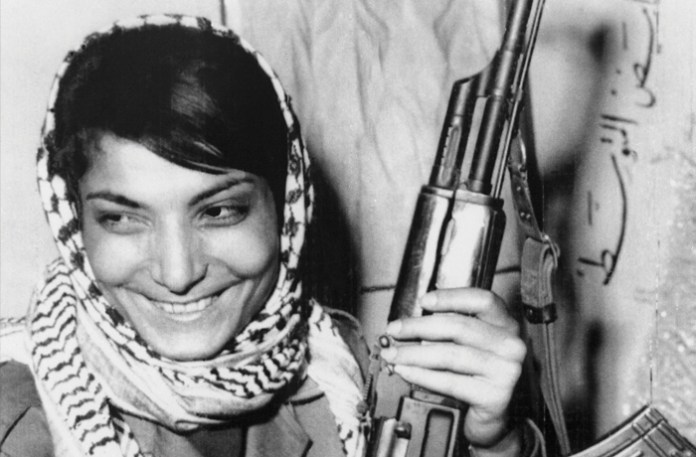
When Leila Khaled hijacked Trans World Airlines Flight 840 to Tel Aviv in 1969, jihad was the furthest thing from her mind. The 25-year-old member of the Popular Front for the Liberation of Palestine was a strict Maoist. Her aims in bringing down the airplane were entirely political. And by the standards of most terrorists, she was not even particularly violent. More than shooting, she was interested in lecturing. After Khaled redirected the plane to Syria for an emergency landing, she gathered the crew and passengers in the Damascus airport’s terminal and read a speech decrying colonialism, Zionism, and imperialism. She then handed out cigarettes and sweets in a show of solidarity, which was coldly received. “We are a part of the Third World and the world revolution,” she declared. “Greetings to all lovers of the oppressed!”
Khaled remains involved in Palestinian activism to this day. But her sort of radicalism is no longer the norm among those leading the anti-Zionist movement. In the Middle East, the goals of the New Left have long since been superseded by those of political Islam. How that happened is the subject of Jason Burke’s The Revolutionists: The Story of the Extremists Who Hijacked the 1970s, which argues that Islamism did not simply replace the Left. Instead, the Left undid itself over the course of a decade by allying with and empowering Islamist movements whose potency it misjudged. And its defeat was near total. By the end of the 1970s, nearly every secular, nationalist, and Leftist faction in the Middle East was either wiped out by ascendant Islamic movements or subsumed into their ranks. The dynamic has never substantially changed since.
Burke’s narrative is kaleidoscopic and sometimes hard to follow, but it is always compelling. He begins with Khaled and ends with Osama bin Laden. Along the way, he demonstrates that the course of Middle Eastern terrorism developed in three stages. In the immediate aftermath of Israel’s Six-Day War in 1967, radical groups were dominated by secular Palestinians who had received Western educations and were influenced by countercultural figures such as Frantz Fanon, Che Guevara, and Jean-Paul Sartre. These were heady days, when political, social, and sexual revolutions combined in a violent froth such that, for a few years, anything seemed possible.
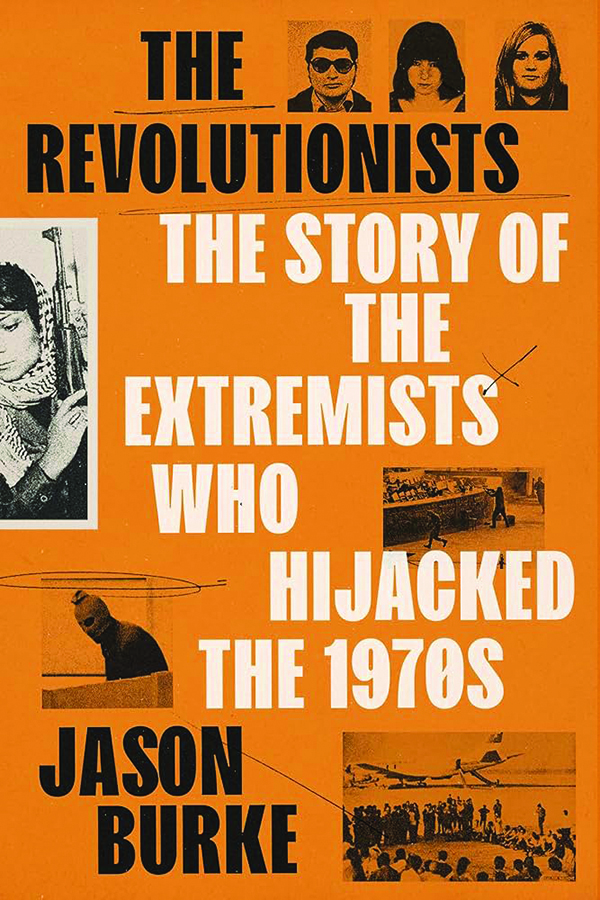
But when it became clear that theory alone would not bring about a worldwide uprising against capitalism and imperialism, the revolutionaries abandoned traditional modes of dissidence and turned to violent spectacle: “terrorism as theatre.” In one notable example, in 1970, the PFLP captured three airliners, landed them in the Jordanian desert, and, once everyone had safely deboarded, blew them up on global television. Even now, those videos are shocking. But they produced no effect. And when the activists turned to bloodier, more direct means of terrorism — Burke spends an inordinate amount of time on the infamous Carlos the Jackal — they only marginalized themselves. By 1973, the revolutionary movement’s energy was all but spent.
“The slogans and revolutionary invocations of the radical New Left were still widely spoken and popular, but the reality was that the acts they had inspired in the developed world had been neither cathartic nor effective,” Burke writes, “but sordid, bloody and mainly counter-productive.”
That same year, Richard Helms, the U.S. ambassador to Tehran, wrote a memo to then-Secretary of State Henry Kissinger in which he described a “swing toward conservative Islamic principles,” so prominent that even Leftists, who typically disdained Muslim society as backward and unprogressive, were now “giving lip-service” to Islam. Those leading the most powerful factions in the Arab world, “progressive/radical, moderate and conservative/reactionary,” were all “very strong on Islam,” Helms concluded. “This trend is well worth watching.”
In those few years, leftist leaders had discovered that quotations from Mao Zedong’s Little Red Book left most Muslims unmoved, but appeals to the Quran excited their fervor. In one telling anecdote, Burke recounts a hike that two Iranian dissidents took through the mountains sometime during the mid-70s. They were leaders of a secular revolutionary corps that had recently attempted to raise a group of rural peasants against the shah, without success. In the evening, they stopped at a dilapidated workshop in a depressed village and discussed their failure.
“Why did the rural masses not rise up? How can we get access to these people?” one wondered aloud. Then he noticed a portrait of then-Iranian Supreme Leader Ruhollah Khomeini on the wall. “Why do the ordinary folk, in villages like this one, not support us but pin pictures of Khomeini in their homes and workplaces?”
The full answer to that question would come too late. Although Khomeini opposed every leftist ideal, activists throughout the Middle East and the West championed his cause and helped bring him to power, ensuring their own downfall. Burke marks the Islamic Revolution as the definitive moment when Islam displaced leftism as the animating force of agitation in the Middle East. When the shah fled Iran in 1979, and Khomeini made his triumphant return to Tehran, the thought was that the old cleric would serve as a figurehead, an inspiration to the masses, while the more organized socialists set about reconstituting the state in their own image. The reality was the opposite. Leftism had not brought about the revolution. Islam had. And to the victor go the spoils.
The Islamic Revolution did not produce exact imitations throughout the Middle East. No one overthrew Saddam Hussein in Iraq. The Gulf States maintained their U.S.-backed stability. But Burke argues that other revolutionaries still learned an important lesson from Khomeini’s ascent: Religion is always a more powerful tool than political philosophy. He also notes that this period was formative for those who would initiate a global struggle with the United States in the 2000s. Bin Laden was 12 in 1970. The major regional conflicts of the decade — the Jordanian civil war, the Yom Kippur War, the outbreak of the Lebanese civil war — all took place when he was a teenager. And in his young adult years, he witnessed the Islamic Revolution, and, most importantly, the Soviet invasion of Afghanistan. The experience of armed conflict alone did not make him a jihadi, but when he did embrace radical Islam, it was no doubt in part because, unlike the other ideologies of his youth, it had a proven track record.
Burke ends with a scene of bin Laden training alongside the Afghan mujahideen in 1984. Early one morning, Soviet jets screamed over the militia’s base and dropped a massive payload on the fighters below. The mujahideen responded with imprecise anti-aircraft guns. The explosions, the violence, the thrill of war — it invigorated bin Laden. “I felt closer to God than ever,” he later wrote.
Just outside of this scene, and looming over the entire narrative, are the attacks of Sept. 11, 2001. Burke does not draw a neat parallel between the events he discusses and those of more recent history. He wisely leaves the comparison implicit. After all, it is inescapable: Both Mohamed Atta and Leila Khaled hijacked American planes in an attempt to change the global order irrevocably. Only one of them succeeded.
Nic Rowan is managing editor of the Lamp.
