
Sounds of silence: Review of ‘I Give You My Silence’

Mario Vargas Llosa won the Nobel Prize in Literature in 2010 “for his cartography of structures of power and his trenchant images of the individual’s resistance, revolt, and defeat.” Such images fill the pages and fuel the narratives of his finest novels. The War of the End of the World (1981) was an epic drama set against Brazil’s War of Canudos. The Feast of the Goat (2000) dealt with the life and crimes of the Dominican Republic dictator, Rafael Trujillo. And The Dream of the Celt (2010) followed the Irish nationalist Roger Casement, “a specialist in atrocities,” as he ventured into various arenas of conflict and learned the hard way that “there’s no bloodthirsty animal worse than the human being.”

The writer, who died last April, left us with a final work that tackles markedly different themes. I Give You My Silence sees Vargas Llosa returning to his native Peru and portraying one man’s unique and misguided attempt to capture his country’s spirit and unify hearts and minds. Brute force and political injustice may be in short supply, but the book’s sharp examination of obsession and delusion renders it a satisfying parting shot.

I Give You My Silence; by Mario Vargas Llosa; Farrar, Straus and Giroux; 256 pp., $28.00

Vargas Llosa introduces us to Toño Azpilcueta, who, at the age of 50, has experienced his share of moderate highs and devastating lows as a self-proclaimed “proletarian intellectual.” Years ago, while studying and working at the National University of San Marcos, he was poised to succeed his aging superior as chairman of the department of Peruvian Studies. But then the university delivered a hard knock by scrapping the professorship and torpedoing Toño’s prospect of an academic career. Since then, he has fended for himself, devoting his energies to his one true passion and eking out a living writing articles as a scholar of — and, in his eyes, the country’s greatest expert in — Peruvian music. 

One day, Toño receives an invitation out of the blue to attend a concert of Creole music in Lima’s old colonial district. There he will be able to listen to Lalo Molfino, the finest guitarist in Peru and maybe the world. Toño’s curiosity gives way to alarm: how has he never heard of this musician? He goes along to the performance and, like the rest of the audience, is entranced by the young guitarist’s virtuosity, his ability to wring “profound, disconcerting, unprecedented notes from the strings.” A few months later, Toño, still enraptured by his life-changing musical experience, is shocked to discover that Molfino died. Some say the cause was tuberculosis, others claim it was suicide.

Toño learns from his contacts that Molfino was a difficult man, a vain and arrogant neurotic who wanted the limelight for himself and often refused to mingle or even play with his fellow band members. Undeterred by the negative profile taking shape, Toño decides to write a book about Molfino. Not only will it be a biography of the gifted guitarist, but it will also chronicle the history of the music he played — music that Toño believes is “the summation of the Peruvian spirit.”

Funded by a friend and spurred by a determination to tell a story no one has told before, Toño embarks on a fact-finding mission. It proves hard; his trail frequently goes cold, as few knew Molfino. But Toño perseveres to track down leads and fill in blanks. He travels through the desert to visit the coastal town where Molfino was born. There, his childhood best friend reveals how he was abandoned to die on a trash heap by a desperate mother, until he was rescued and raised by a priest. The same friend admits to losing touch with Molfino after he discovered the guitar and dropped out of school to spend days and nights practicing on it. In the port city of Callao, a businessman describes giving Molfino his big break in a Creole group and the disaster that resulted from his recruitment. And back in Lima, Molfino’s former girlfriend provides more insight into his character by noting his “struggles with intimacy” and his love for his guitar over her.

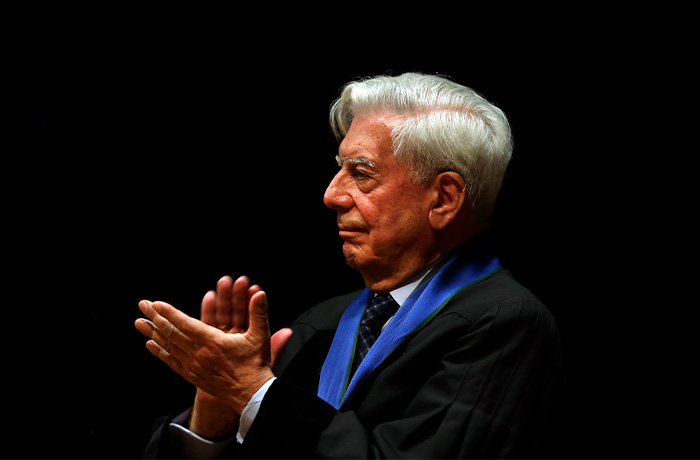
Peru's Nobel Literature Prize laureate Mario Vargas Llosa applauds during a ceremony after being awarded an Honoris Causa degree by Lisbon Nova university, Tuesday, July 22, 2014, in Lisbon. (Francisco Seco/AP)
Peru’s Nobel Literature Prize laureate Mario Vargas Llosa. (Francisco Seco/AP)

Up to this point, Molfino is the central focus of the novel. But Toño’s best efforts to understand the man and the myth get him only so far, and Molfino remains an elusive figure with hazy outlines. Gradually, and skillfully, Vargas Llosa turns our attention from Molfino to Toño. While the former lurks in the background as an unknowable ghostly presence, the latter grows in stature and becomes a compellingly fleshed-out protagonist made up of fatal flaws.

Those flaws are made apparent as Toño works on his book. He expands on his general thesis — “that creole music isn’t just for amusement, that it has the power to overcome prejudices” — and gets carried away, arguing that after years of violence and upheaval, Peruvian music can heal divisions and unite his countrymen. “I would call myself a seismograph, measuring the intensity of the vibrations of the nation’s soul,” he announces. The book is eventually published, but Toño is not satisfied with the result and so packs more and more extraneous material into successive editions. “Have you lost your mind?” asks his exasperated publisher. “You started off talking about a guitarist from Puerto Etén, then it was Peru, now it’s bullfights and witches and drugs and the fate of Latin America and all of humanity. You’ve lost me.” But has Toño lost himself?

Last novels can be dispiriting affairs. Some showcase recycled ideas and tapering talent. Others, such as the “lost novel” that appeared last year from Vargas Llosa’s former friend and onetime sparring partner Gabriel Garcia Marquez, are scrappy novellas that didn’t deserve to be found. I Give You My Silence is by no means a top-drawer, career-high Vargas Llosa novel, but it has more than enough merits.

One is the series of colorful extracts from Toño’s book that run parallel to Vargas Llosa’s main narrative. Toño’s celebration of Peruvian folk culture takes us into Lima’s winding alleyways and open fields where people play, drink, and dance for days on end. He meditates on Creole music — the pasillo, the marinera, the polka, the huainito and the resbalosa — then homes in to trace the origins and sing the praises of his first love, the Peruvian vals, a descendant of the European waltz, which, for Toño, represents “fraternity, festivity, unity.” And he illuminates the achievements of various singers, musicians, composers, and lyricists, and tells of an illicit romance that developed and flourished between “two souls, brought together by the vals.” Translator Adrian Nathan West does an admirable job making the unfamiliar familiar for Anglophone readers.

MAGAZINE: THE END OF JULIAN BARNES 

The novel’s other strength is its depiction of an increasingly tragic hero. We look on with discomfort as Toño grinds himself down and wears himself out with his research, and increasingly loses his grip on reality — particularly when his fear of rats leads to terrifying hallucinations. “You’re not crazy,” one character tells him, “you’re an idealist.” Vargas Llosa shrewdly shows what happens when idealists set themselves unreachable goals.

The novel isn’t perfect. Certain elements are repetitive. Toño’s everything-but-the-kitchen-sink approach to his work can prove exhausting. “What sort of music did the Incas play?” he asks at one point, drifting even further off-topic. But the stretches of brilliance constantly remind us that we are in the company of a consummate storyteller. What a pity that those stories have now come to an end.

Malcolm Forbes has written for the Economist, the Wall Street Journal, and the Washington Post. He lives in Edinburgh.

Related Content