

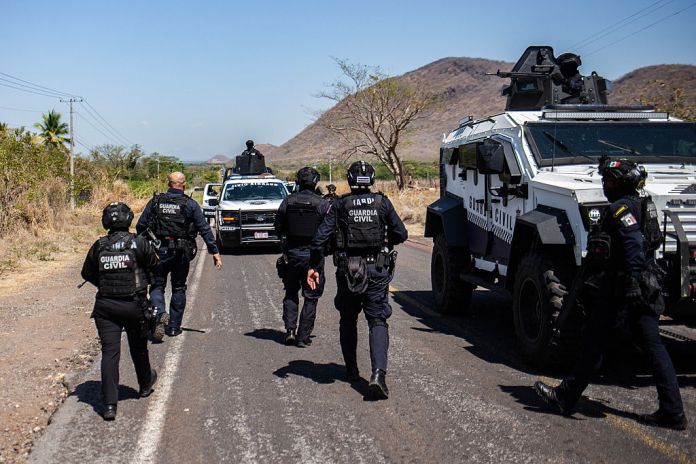
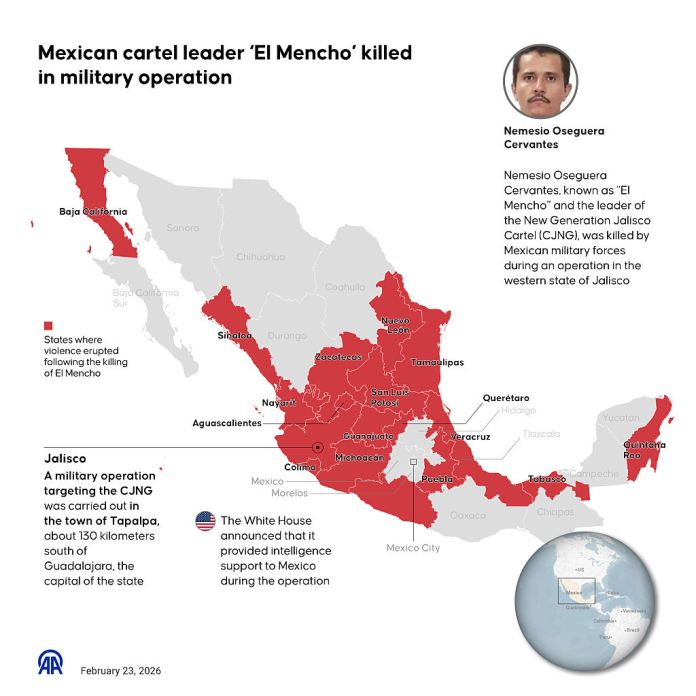
Mexican special forces killed the cartel leader El Mencho, known to his family and the Drug Enforcement Administration as Nemesio Rubén Oseguera Cervantes, on Feb. 22 in a gun battle at the tourist resort of Tapalpa. El Mencho’s outfit, the Jalisco New Generation Cartel, responded by blocking roads, setting fire to banks and businesses, and attacking the National Guard across more than 20 Mexican states. The Trump administration is pressing Mexican President Claudia Sheinbaum for results. But members of Sheinbaum’s leftist Morena party are alleged to be in partnership with the cartels, and Sheinbaum said on Feb. 24 that she seeks “peace, not war.”
In 2025, Sheinbaum said that starting a “war on drugs” like the one President Felipe Calderon launched in 2006 was “not an option” because it is “outside the framework of the law.” That is where the narcotics business begins, but it is not where it leads. Drug dealings and influence pass through the law into every aspect of Mexican society and governance via legitimate fronts such as businesses and politicians. Extraditing cartel suspects to the United States, as Sheinbaum has done, will not be enough. The National Security Strategy of December 2025 identified the cartels as “narco-terrorists” and proposed using U.S. military assets against them. Apart from being enemies of American society, the Mexican wave of drug crime is an obstacle to the administration’s “Donroe Doctrine” of hemispheric dominance.
Real journalism.Trusted by millions.
Unlimited access to in-depth reporting, expert analysis, and the stories that shape our country.
Already a member? Log in
No one knows how much the Mexican drug business is worth. A 2018 report from the United Nations Office on Drugs and Crime detected illicit financial flows worth $4.25 billion from gangs in the U.S. to their bosses in Mexico. This is only the tip of the white and powdery mountain that American consumers jam up their noses every year.
In 2023, then-Rep. Mark Green (R-TN), the chairman of the House Committee on Homeland Security, told a hearing on the Biden administration’s open-border policies that in 2021, Mexican cartels made “an estimated $13 billion just from human trafficking and drug smuggling alone.” These figures are much lower than the numbers in a 2009 report from south of the border. The consulting company Kroll de Mexico estimated that Mexican cartels generated between $25 billion and $40 billion a year. By that count, the drug business is more important to Mexico’s economy than remittances from workers north of the border, roughly $23 billion in 2009.
What analysts and law enforcement do agree on is that the Mexican cartels work much like multinational corporations. The drug business directly employs 180,000 workers in Mexico: about the same number as General Motors’s global workforce. The cartels diversify constantly into new products, markets, and partnerships. They control territory and impose “taxes” on residents and businesses. As their accountants launder the proceeds through the “formal market,” the true scale of the business becomes opaque. Drug money washes through every possible legitimate business, including cryptocurrency, real estate, the music business, and fraudulent timeshares for American retirees. El Mencho was killed in Tapalpa at an ecotourism resort in a region whose tourist businesses were flagged by the Treasury Department a decade ago as money-laundering fronts for the Jalisco New Generation Cartel. Mexican authorities failed to respond. “She’s not running Mexico,” President Donald Trump said of Sheinbaum on Jan. 3, following the arrest of Venezuela’s narco-dictator Nicolas Maduro. “The cartels are running Mexico.”
The mush of populist sentiment squishes before the hard reality of state failure on America’s doorstep. Candidate Trump won votes by rejecting foolish foreign wars, promising to wall off the chaos in Mexico, and also promising to root out the “deep state.” President Trump orders strikes on drug boats in the Caribbean and Pacific, arrests Maduro, and creates the Joint Inter-Agency Task Force-Counter Cartel, which, Reuters reported, mapped cartel networks and gave the Mexican government a detailed “target package.” While “America First” huffs isolationism in its parallel kingdom of podcasts, the “America First” presidency mobilizes the deep state for a forever war.
THE FRIENDS OF JEFFREY EPSTEIN
The shades of Allen Dulles and William Casey would approve. To control the security environment of Latin America and keep out Chinese influence, the U.S. must shape the domestic politics and economies of Latin America’s states. This is classic Cold War 2.0 stuff. Precedent suggests that the question is not whether something similar can be attempted in Latin America, but whether transforming a continent in the way that the U.S. transformed post-1945 Western Europe is feasible — and whether intervention might invite the ever-diversifying cartels to become silent partners in state-building.
The combined population of Western Europe in 1980 was around 170 million. The combined population of Latin America is over 650 million, plus 45 million in the Caribbean — together, roughly double the American population. While only Soviet satellites sought Soviet exports, the universal appeal of Chinese exports will complicate attempts to decouple Latin American economies. Washington seeks to remake states with strong traditions of anti-American populism, judicial corruption, and military coups. Democracy and the courts cannot be stabilized without empowering and expanding the middle classes, yet Latin America’s middle classes will resent quasi-colonial vetoes over foreign and economic policies. It’s corollaries all the way down.
Dominic Green is a Washington Examiner columnist and a fellow of the Royal Historical Society. Find him on X @drdominicgreen.
