
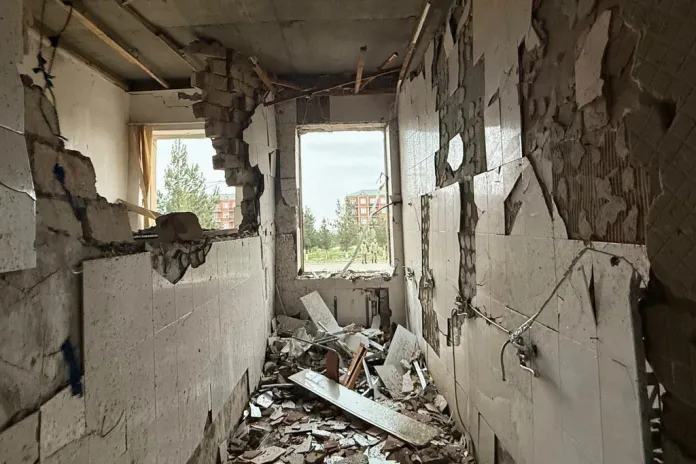
Iran spread the growing regional war to the Caucasus with its first drone strike into Azerbaijan, hitting an airport terminal and damaging a nearby school.
A video recorded by someone at Nakhchivan International Airport showed one of the drones exploding on impact, with another video showing smoke rising from the terminal. The strike makes Azerbaijan the 12th country Iran has targeted with drones and missiles since Feb. 28. Azerbaijan’s Foreign Ministry denounced the attack, saying it attacked civilian infrastructure with no military purpose and wounded two civilians.
Recommended Stories
“We demand from the Islamic Republic of Iran to provide, within the shortest possible timeframe, a clear explanation regarding the case, conduct an appropriate investigation, and take the necessary urgent measures to ensure that such attacks are not repeated in the future,” its statement read. “The Azerbaijani side reserves the right to take appropriate response measures.”
HOW GULF STATES ARE RESPONDING TO IRAN’S RETALIATORY STRIKES
The statement added that the Iranian ambassador had been summoned, and a “strong protest” would be conveyed.
After a denial by the Iranian military, Azerbaijani officials rejected the denial and claimed that there had been four drones in total fired by Iran into Azerbaijan. One of the drones had been shot down by the Azerbaijani military.
Numerous countries and international bodies came forward to condemn the attack, including Saudi Arabia, Qatar, and Kuwait, themselves the targets of Iranian drone strikes in the ongoing conflict.
A popular IRGC Telegram channel, with over 500,000 followers, claimed IRGC credit for the strike, claiming it hit a section of the airport where “Zionist regime” and U.S. officers were planning attacks on Iran. It also identified the drone not as the popular Shahed kamikaze drone, but the larger and more advanced Arash-2 drone.
“The drone that was at the Nakhchivan Airport, specifically in a section where Zionist regime and American officers were planning and managing attacks on our country’s infrastructure, was crushed by an Arash-2 drone. The enemy sees this for themselves and must know that Iran does not joke or compromise with any party. With a 120 kg warhead and very high destructive power, it is utilized by the Army Ground Force. This was only a warning shot to the mercenary regime and the traitor of Baku,” the message read, viewed by Azernews.
In an address after the attack, Azerbaijani President Ilhan Aliyev gave a harsh denunciation of Iran, saying it committed an “act of terror” against Azerbaijan.
DEMOCRATS FACE CHOICE TO REOPEN DHS AMID FEARS OF IRAN TERRORIST PROXIES RETALIATING INSIDE US
“The state of Azerbaijan condemns this ugly act of terror, and those who committed it must be immediately held accountable. Iranian officials must provide an explanation to the Azerbaijani side, an apology must be offered, and those who committed this terrorist act must be held criminally liable,” he said.
Aliyev then cut deeper, saying the attack was just the latest in a string of terrorist attacks against Azerbaijan by the state of Iran. He went on at length about the Jan. 27, 2023 attack on the Azerbaijani embassy in Tehran, claiming the attacker was “instructed by the Iranian special services,” and that the attack was “masterminded at the highest levels of the Iranian state in order to intimidate Azerbaijan and commit dirty deeds against Azerbaijan.”
He went on to list favorable acts Azerbaijan had recently performed for Tehran, including Aliyev being the only head of state to visit the country’s Iranian Embassy to pay his respects to the former Ayatollah Ali Khamenei.
“In return for all this, to strike Nakhchivan in an ugly, cowardly, and shameless manner? This stain will never be erased from their ugly face,” Aliyev said, previously saying Iranians were “acting like vile and ungrateful people.”
His address contained veiled threats against Iran, a country whose population is around one-quarter Azerbaijani ethnically. He said Azerbaijan’s military had been brought to “level-one mobilization and must be ready to conduct any operation.”
Iran’s military claimed Israel, a close ally of Azerbaijan, was actually behind the attack, “to disrupt relations between Muslim countries.”
In an interview with the Azerbaijani television news channel AnewZ, Iranian Deputy Foreign Minister for Legal and International Affairs Kazem Gharibabadi called for a “thorough investigation.” He said the policy of Iran only targeted neighboring countries with U.S. and Israeli military bases.
“This is not the policy of this Islamic Republic, actually, to attack or to target the neighboring countries… unless the military bases of our adversaries, namely the Zionist regimes and the United States of America, are active there and are used to attack innocent people in the Islamic Republic of Iran,” he said.
Azerbaijan holds a unique position, standing as a rare Muslim nation with close ties with Israel. The two have cultivated an alliance since shortly after the Caucasian country’s independence, with Azerbaijan providing much of Israel’s oil in return for extensive military hardware. The exchange has made Azerbaijan one of the most capable militaries in the region, and inflamed tensions with Iran.
Azerbaijan has repeatedly insisted Israel is not conducting strikes from its territory.
ISRAELI F-35 SCORES FIGHTER’S FIRST EVER MANNED AIR-TO-AIR KILL OVER TEHRAN
Vice President JD Vance visited Azerbaijan a few weeks before Operation Epic Fury, shoring up the newfound warm U.S.-Azerbaijan relationship. The visit probably heightened IRGC suspicions that the country’s territory was being used to strike Iran.
The U.S. and Israel launched a massive air campaign against Iran beginning on Saturday morning, killing dozens of top officials, including Khamenei, and battering its military. Iran responded with drone and missile strikes across the Middle East, triggering a wider regional war.