

Pentagon officials touted the early signs of success during a Tuesday hearing on Capitol Hill in its efforts to create an international coalition in the Western Hemisphere to target international drug cartels.
Securing the southern border, partnering with Central and South American allies, and carrying out kinetic operations against the cartels have all been a part of the Trump administration’s plan to prioritize securing America’s own backyard.
Recommended Stories


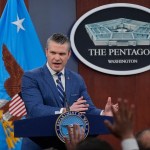
“Since this operation began, there has [been] a 30% reduction of drug vessel movements in the Caribbean and a 25% reduction in the eastern Pacific. Combined border flows of fentanyl, which is a weapon of mass destruction, has dropped by 56% and cocaine flows by 20%,” Joseph Humire, the acting assistant secretary of war for Homeland Defense and Americas Security Affairs, said.
He, along with Gen. Gregory Guillot, the commander of U.S. Northern Command, and Gen. Francis Donovan, the commander of U.S. Southern Command, all testified in front of the House Armed Services Committee on Tuesday.
The U.S. military has carried out 45 kinetic strikes on vessels since early September 2025 that supposedly were carrying drugs, which killed 157 people on board, Humire told lawmakers. He noted there was a 45-day period in which U.S. forces did not track any purported drug vessels in the eastern Caribbean, while SOUTHCOM last publicly announced a strike on March 8.
Earlier this month, Secretary of War Pete Hegseth hosted the inaugural Americas Counter-Cartel Conference at U.S. Southern Command Headquarters in Florida. Seventeen partner nations signed a Joint Security Declaration to signal their intention to combine their efforts for the common goals. Chile became the 18th member of that coalition last week, Humire told lawmakers.
Also earlier this month, the United States and Ecuador jointly carried out strikes targeting cartel infrastructure, and recently began a new operation targeting them that will last four about two weeks. Ecuador’s location between Colombia and Peru, the world’s largest producers of cocaine, makes it a prime shipping location for narcotics.
Humire declined to explicitly state that the U.S. would not carry out unilateral strikes on the sovereign soil of another country without its permission.
“At the moment, in the Department of War, we are prepared to give all options to the president,” he added, noting that they are “focused on partner-led, deterrence-focused operations through this coalition.”
There is a lot of current attention on Cuba, which is facing a growing energy crisis and a nationwide blackout after the U.S. captured former Venezuelan dictator Nicolas Maduro and cut off the country’s oil shipments to Cuba and elsewhere.
President Donald Trump said this week he believes he will have the “honor of taking Cuba,” because it’s “a very weakened nation right now.”
ECUADOR-US ‘WAR’ WITH DRUG CARTELS BEGINS WITH TWO-WEEK OPERATION
While Humire acknowledged Cuba “presented a significant threat to the United States’ hemispheric security for decades,” he also said he’s not “familiar with any plans on Cuba,” when asked about whether the department is preparing to invade the island.
The acting Pentagon assistant secretary said both he and Donovan have traveled to Venezuela since Maduro’s capture and in recent weeks have had discussions with their partners in Caracas who “are continuing to comply with a lot of the security guarantees that we’ve been asking for, both for our personnel, our embassy on the ground, as well as any kind of presence of any threats externally.”
