Completed ‘Hail Mary’

Movies too often use outer space as nothing more than a convenient setting for battles, explosions, and laser fights. The fabulously entertaining science-fiction movie Project Hail Mary offers something wholly different. It imagines space as a luminous yet mysterious backdrop for friendship, spiritual growth, and expressions of intergalactic empathy. Although, owing to its setting, the movie is jam-packed with the sort of sterile hardware associated with space travel — steel and screens and ladders and pods — watching it is akin to sinking into a big cozy sofa, one with all sorts of pockets and niches in which to lose popcorn and Junior Mints. It’s the most companionable space adventure movie ever made.

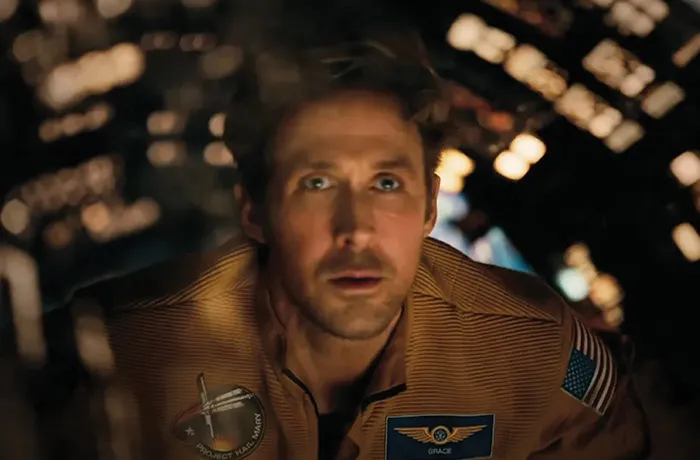
Ryan Gosling stars as Ryland Grace, first encountered while regaining consciousness after spending an indeterminate number of years in an induced coma aboard a spaceship. Confused about where he is, who he is, and what his mission could possibly be, Grace — he is consistently referred to by his surname, laced with theological implications — peppers the AI-powered, calm-voiced computer with questions like “Where are the living people?” and commands on the order of “Operation Go Home, in effect.” Alas, there is no such operation. 

In fact, Grace is the last soul to draw a breath on the ship, which is christened the Hail Mary in a nod to the urgency of its mission. Some years earlier, the ship was launched into the cosmos to stave off the climate consequences of an organism that is literally dining on the sun. “It’s a small-to-medium whoop,” Grace, in his earlier vocation of middle-school science teacher, tells worried students, who live with the specter of a severely cooled world — with its attendant weather calamities, mass starvation, and economic collapse — as children once lived under the threat of nuclear war. Even so, the dialogue in Drew Goddard’s script, based on author Andy Weir’s popular novel, is consistently bright and peppy.

Ryan Gosling in Project Hail Mary (Courtesy of Amazon MGM Studios)
Ryan Gosling in “Project Hail Mary.” (Courtesy of Amazon MGM Studios)

Indeed, despite ample opportunities to turn the material into a stern homily on climate change, directors Phil Lord and Christopher Miller have a bigger, bolder agenda in keeping with the movie’s friendly, shaggy dog spirit: they mean not to lecture the audience on environmental matters but to sketch the moral education of a man. 

As seen in flashbacks on Earth, Ryland Grace is fairly rudderless: quick-witted and easy-going, yes, but profoundly unmoored. Upon being recruited to help the world’s governments understand and conquer the sun-consuming organism, Grace embarks on his work with all the blitheness of a kid doing a science experiment — part of his charm but also part of his superficiality. “Hey, Carl, do we have an expense account?” he asks a government minder. Lord and Miller cleverly cut to a scene of Grace and Carl loading up their shopping cart with duct tape and aluminum foil. They pick up some Twizzlers on the way out. No expense will be spared to save the world. Even so, Grace is tapped for the mission because of his lack of immediate family or deep connections. His overseer, Eva Stratt (Sandra Huller), points out that he does not even own a dog. This is significant because the Hail Mary team is hurled into deep space with the understanding that, in trying to arrest the death of our dying sun, they will surrender their lives. There are insufficient fuel reserves to power a return trip. 

This backstory is threaded through the present-day scenes aboard the Hail Mary, where Grace, in time, calls to mind the details of his mission: to determine why the organism — named Astrophage — has affected all neighboring stars but one. That errant star’s seeming immunity to Astrophage may help halt its destruction of the sun. This has left Grace eons away from Earth — one amusing touch has him toggling through a celestial map that gives him a sense of his inconceivable distance from home — and, in the absence of living crew members, any tangible help. 

That changes when Grace finds the Hail Mary is drifting in close proximity to another, much larger and stranger ship. “Blip A Detected,” the AI computer warns in what turns out to be a gross understatement: Aboard the mystery vessel is an alien being who comes to be dubbed Rocky, a stony-featured creature who moves with the multilimbed dexterity of a spider, possesses great reasoning power but lacks knowledge of such basic things as radiation, and is an instant comrade in arms with Grace. Like Bruce Dern and his robot compatriots in the very similar 1972 sci-fi classic Silent Running, Gosling makes an art out of credibly and unself-consciously interacting with a nonhuman costar. One beautifully sweet little scene features Grace and Rocky tapping out the melody from Close Encounters of the Third Kind, which, if it isn’t already, ought to be the anthem for interspecies communication everywhere. 

The Grace-Rocky relationship reveals Lord and Miller’s actual aims. Although the plot tells us that Grace is on a mission to save his world (and, as it turns out, Rocky’s), the filmmakers make clear that Grace’s attachment to Rocky represents a real form of personal growth. After years of self-imposed solitude on Earth and more years of forced isolation aboard the Hail Mary, Grace has bonded with a squatty fellow with whom he can joke, to whom he can share his memories of Earth (with the aid of virtual reality), and of whom he becomes quite protective. The scenes of the duo problem-solving on behalf of their respective worlds are marvelously fun to watch. When Grace attempts to scoop up a sample of the atmosphere on that Astrophage-resistant planet, and Rocky is both rooting him on and cautioning him, we have no sense that Gosling is performing solo. As voiced by James Ortiz, Rocky is a full-fledged sidekick, teammate, and deliverer of amusingly unnatural English-translated dialogue: “Why room so messy?” Rocky asks upon being shown Grace’s working quarters on the Hail Mary. Meanwhile, Grace records video blog entries that hilariously understate the strangeness of collaborating with an extraterrestrial: “So I have a new roommate now,” he says. “Personal space is at a premium.” 

About a decade ago, Lord and Miller were given the heave-ho from Solo: A Star Wars Story, but given the interminable stagnation of that once-storied franchise and the authentic audience uplift induced by Project Hail Mary, it seems obvious that the moviemaking duo was wronged.

OSCARS 2026 

Yet, for all its qualities, Project Hail Mary has a curious flaw: although it takes Grace being shot into space and making common cause with an alien to find purpose, it is reasonable to expect that he should want to return home when given the unexpected opportunity in the third act. That the story imagines another, otherworldly future for Grace — one not unlike that of Billy Pilgrim in his Tralfamadorian biosphere in Slaughterhouse-Five, novel and film — is greatly depressing and part of a larger trend in movies in which characters check out of earthly reality altogether. Is this not a fair description of the entire premise of the endless Avatar movies?

Of course, Project Hail Mary is a much cheerier endeavor than any installment of Avatar, and it deserves to be the big hit it has become. Its vision of fellowship and cooperation among the stars is genuinely fortifying, but its notion of a satisfactory permanent residency on one of those stars is a tad unnerving and even a little weird. Remember, no Earthlings followed E.T. home. 

Peter Tonguette is the film critic for the Washington Examiner magazine.

Related Content
