Economy added 178,000 jobs in March: The key facts and figures

The headline

The economy showed surprising strength by adding 178,000 jobs in March, and the unemployment rate fell slightly to 4.3%, the Bureau of Labor Statistics said Friday.

Forecasters had expected the unemployment rate to be unchanged at 4.4% and that job growth would total 65,000.

The interpretation

Dan North, a senior economist with Allianz Trade Americas, told the Washington Examiner that the numbers came in “way better than expected.”

“I think we’ve seen a trend of … losing jobs in five of the last nine months, and the three-month average kind of really sinking, so this is a big change,” North said.

Still, he said all eyes are on the war in Iran.

“Next month, there’ll be a lot of influence from the Middle East conflict, and I suspect that’ll really sway the numbers,” North added.

What it means … for Trump

Friday’s report indicates that job growth has been relatively strong to start the year, which could help President Donald Trump raise his poor economic approval ratings. 

There are two major factors that suggest that the economy may be in much better shape than the headline jobs number suggests. 

The first is that much of the recent weakness in employment growth is attributable to federal government layoffs. Private-sector job growth has been stronger. 

The second is that much of the slowdown in hiring is attributable to Trump’s crackdown on illegal immigration. Fewer jobs are being created in large part because fewer people are in the country looking for jobs.

What it means for … the Fed

Friday morning’s strong report led investors to slightly reduce their expectations that Federal Reserve officials will cut their interest rate target this year. 

Trump has pressed for months for Chairman Jerome Powell to lower rates to boost borrowing and spending. 

He has nominated Kevin Warsh, a former member of the Fed’s board of governors, as a replacement for Powell when his term as chairman ends next month.

The underlying reality

Friday’s report showed that hiring has picked up to start the year.

It is helpful to look at the overall trend for the labor market. With revisions to the numbers for January and February, the three-month moving average of job gains was 68,000 in March. 

That may be enough to keep pace with population growth, thanks to the Trump administration’s crackdown on illegal immigration. 

The number of jobs needed each month to keep the unemployment rate trending down might be closer to zero if net migration has stalled, and it might even be negative if more people are leaving the country than entering. 

Prime-age employment, relative to the overall population, is strong by historical standards. It held steady in March.

Recession watch

The unemployment rate, taken from the jobs report’s household survey, is still low by historical standards, although it has been drifting upward. It fell a tenth of a percentage point to 4.3% in March.

Recessions entail a rising unemployment rate.

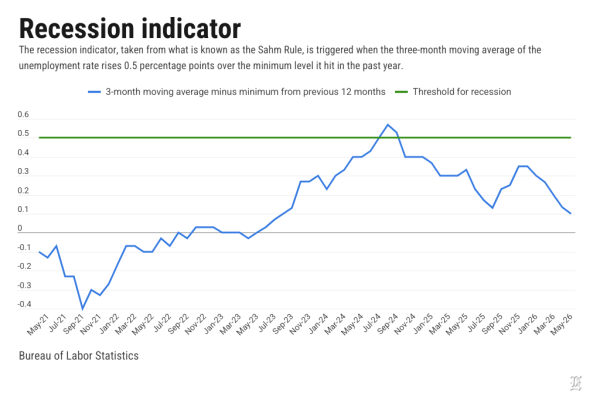
Friday’s data suggests that the U.S. labor market is moving away from triggering one major recession indicator — namely, when the three-month moving average of the unemployment rate rises half a percentage point relative to its minimum point over the past year. This indicator, known as the Sahm Rule, had signaled the start of all post-war recessions.

The indicator had been triggered in mid-2024, but is not signaling a recession right now.

What’s happening with federal government employment

Federal government employment fell by 18,000 in March. It has been declining in recent months, and plunged in October thanks to the end of the “deferred resignation” promoted by the Trump administration at the end of September. Federal employment is now down about 352,000 since Trump came into office. 

The number of federal employees is a key statistic to watch to see the effects of the budget-cutting efforts of the Trump administration and the Department of Government Efficiency.

What’s happening with manufacturing employment

Employment in manufacturing rose by 15,000 in March, stopping a downward trend. 

The manufacturing sector is of particular interest because Trump has said that his tariffs will bring manufacturing to the U.S. from other countries. He’s imposed tariffs on China and trading partners around the world, and on steel, aluminum, autos, auto parts, and a number of other goods and services. 

So far, though, the sector has lost 82,000 jobs during his time in office. 

What’s happening with employment in other important sectors

The leisure and hospitality sector has, over the past year, exceeded the employment levels it reached in February 2020, right before restaurants and bars were forced to shut down across the country. 

The sector added 44,000 jobs in March and is now slightly above its pre-pandemic level of employment. It is well off the pre-pandemic pace of hiring.

Construction employment rose by 26,000 in March. 

Economists are watching closely for any signs of slowing hiring in construction because the housing market took a massive hit over the past few years as mortgage rates have soared alongside the Fed’s rate hikes. The sector is also under pressure from Trump’s tariffs and his immigration overhauls. 

Unemployment rates by race/ethnicity

The household survey also includes unemployment rates by race and ethnicity. Rates for all groups had risen in recent months, but fell in March.

Related Content