

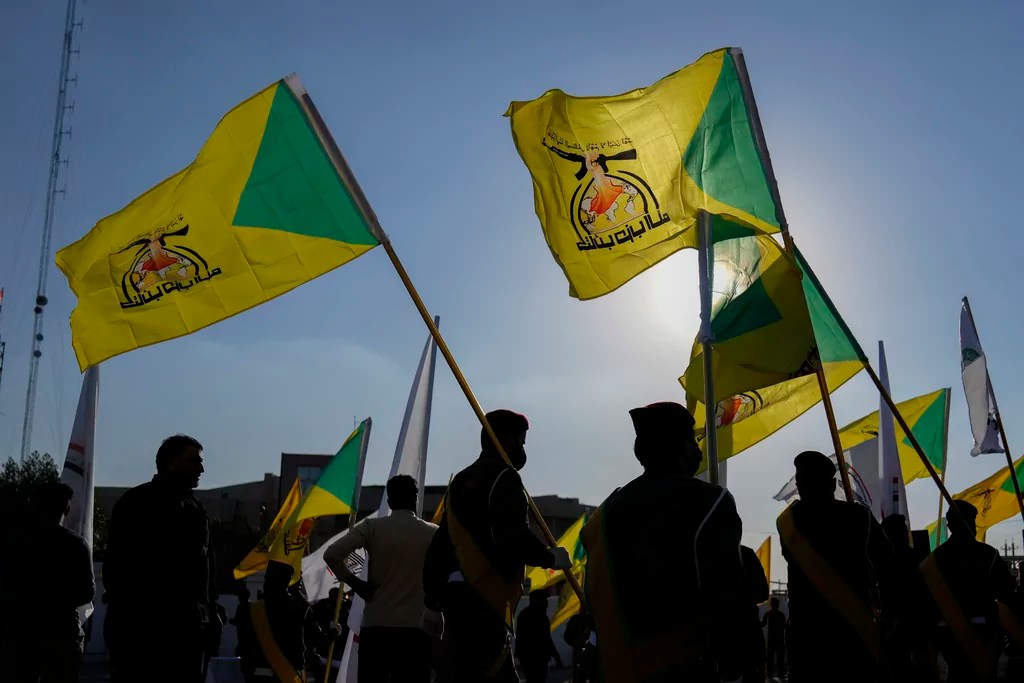
Iran, under financial isolation, is turning to an old friend: Iraqi cash.
Through informal financial channels and networks, currency-filled envelopes are moving across Iraq into Iran under the guise of humanitarian relief. In many cases, this is being facilitated by a network of Tehran-backed militias, many of which the United States has listed as terror groups.
Stay informed.Stay ahead.
Join Washington Examiner for unlimited access to the news, analysis, and commentary that matter most.
Already a member? Log in
A network of Shiite figures in Iraq, including religious institutions and media organizations, in addition to the militias, launched donation drives for their brothers and sisters in Iran and Lebanon. After nearly a month of conflict in Iran and prolonged fighting in Lebanon, many people in both countries have a legitimate need, but Iran’s so-called Axis of Resistance has a history of gifting allegedly humanitarian funds to terrorist groups in this network. Harakat Hezbollah al-Nujaba, a U.S.-designated Iranian proxy, launched a campaign with the innocent title “From Iraq, we will not abandon Lebanon — one hand resists … and one hand provides relief.”
Past actions show a concentration on helping with the resistance rather than the “relief.”
Not all the money is in cash, giving Washington a chance to scrutinize some financial transactions in this drive. In fact, at least one account that is being used for this kind of fundraising is at JPMorgan Chase in New York despite the bank’s compliance framework stating: “If you, your subsidiaries or affiliates plan to engage in Iran business, you must ensure that none of your transactions involving Iran are sent to, processed through, funded or otherwise facilitated by any part of JPMC.”
In 2011, JPMC paid an $88 million settlement for apparent violations of sanctions programs, including an instance related to Iran.
In a statement, Grand Ayatollah Ali al-Sistani, the preeminent Iraqi Shiite leader, requested that donations for Iranians and Lebanese be sent to an account at the bank in the name of the Holy Abbasid Shrine.
Asaib Ahl al Haq, a U.S-designated Iranian-backed proxy in Iraq, launched a campaign built entirely around cash collection titled “Faithful to the Promise.” Donors are explicitly prohibited from providing non-cash contributions. Instead, they are instructed to deliver money directly to group representatives, whose phone numbers are circulated across 16 of Iraq’s 19 governorates. Funds are funneled through informal intermediaries, bypassing banks and licensed money transfer systems entirely on the way to their final destinations.
Not all the cash is going to weapons. Some is being spent on a public relations effort to build goodwill among people affected by the various groups’ actions. Footage from al Nujaba’s campaign in Lebanon shows aid shipments being unloaded alongside Hezbollah flags. On the ground, Alaa Hassan, the group’s representative in Lebanon, and Abbas Kanaan, an associate of a Hezbollah-affiliated network, appear to be overseeing the Lebanese side of the operation.
Actors not officially labeled as terrorists by the U.S. government are also operating within this ecosystem. An appeal was circulated by Iraqi Member of Parliament Mahdi Taqi, a figure affiliated with the Badr Organization, an Iranian-backed group that remains undesignated as a terrorist group despite congressional efforts to do so.
The message is a donation drive, explicitly limited to financial contributions, to support “the Islamic Republic of Iran and Lebanon, who are fighting in the cause of Allah against the tyrants of this era.”
Taqi provides multiple phone numbers to coordinate contributions and instructs donors to deliver cash in person to the MP’s office in eastern Iraq. The system relies on direct, in-person handoffs that are localized and entirely outside regulated financial pathways.
Beyond these groups, a wider and more opaque fundraising architecture is taking shape.
The Iranian embassy in Baghdad has publicly called on Iraqis to donate directly to it. Notably, the appeal included no formal banking details, suggesting that contributions are expected to be made in cash, like the militia method.
The ecosystem extends even further. The Iraq office representing the late Iranian supreme leader Ali Khamenei has also begun soliciting financial contributions in support of the Islamic Republic.
AMERICAN EXCEPTIONALISM IS ALIVE AND WELL
Cash handoffs are hard to identify and interdict. To close long-term loopholes in the financial isolation of the Islamic Republic, the U.S. needs to support Iraq in shifting away from a cash-based economy.
Washington can do so by continuing to partner with programs that work to expand digital payments in Iraq. The Treasury Department should also sanction individuals and entities that may be directing funds to sanctioned individuals or the Iranian regime.
Ahmad Sharawi is a senior research analyst at The Foundation for Defense of Democracies, focusing on Middle East affairs, specifically the Levant, Iraq, and Iranian intervention in Arab affairs, as well as US foreign policy toward the region. Bridget Toomey is a research analyst at the Foundation for Defense of Democracies, focusing on Iranian proxies, specifically Iraqi militias and the Houthis.