

In Focus delivers deeper coverage of the political, cultural, and ideological issues shaping America. Published daily by senior writers and experts, these in-depth pieces go beyond the headlines to give readers the full picture. You can find our full list of In Focus pieces here.
President Donald Trump has made establishing an international alliance of like-minded populists in Europe a major goal of his second administration, but that campaign is faltering as friendships turn sour and other allies are removed from office.
Recommended Stories


The 2025 National Security Strategy laid out by the White House makes clear that a top priority of their foreign policy is helping Europe “to remain European, to regain its civilizational self-confidence” and the preservation of “Western identity.”
That mission, which includes broadly popular policy prescriptions such as ending mass immigration and cutting back continental regulation, has been undercut time and again by the president’s often hostile rhetoric and a habit of backing the wrong horse.
Angry Italians
Trump appears to have cut ties with Italian Prime Minister Giorgia Meloni, who was among his strongest allies at the beginning of his second administration.
The Italian leader has been beating her own war drum for Western revival for years and previously sprang to the defense of the White House in their shared fight.
When Vice President JD Vance provoked outrage among European elites after his 2025 Munich speech, Meloni backed him up by asserting the “political and cultural battle for conservative values” was “not just an American battle” but a “Western battle” for its entire civilization.
But much has changed since last year, and a mix of economic concerns and cultural offenses has split the trans-Atlantic power couple.
Trump noted in a Wednesday interview that Italy and the other European nations that did not spring to help Operation Epic Fury “do not have the same relationship” with the United States they once had.
Meloni, who was against the U.S. operations in Iran since the beginning, was dragged into a disagreement with Trump after the president began lambasting Pope Leo XIV for his opposition to Operation Epic Fury.
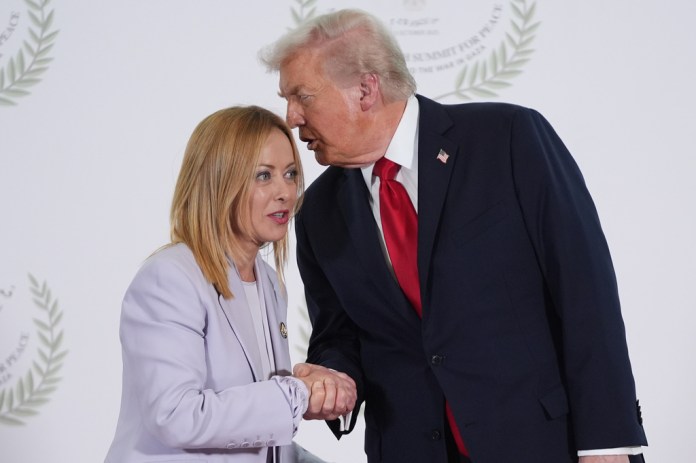
The Iranian conflict has been deeply unpopular in Italy, where the energy crisis caused by disruptions in the Strait of Hormuz is felt sharply at the gas pump. Meloni held her tongue as best she could, and her government tried to justify a lack of cooperation in the operation by citing defense protocol, but Rome was growing increasingly frustrated.
But when Trump blasted the Holy Father, a religious and cultural treasure of the peninsula, as “weak” and “terrible for foreign policy” in a long-winded social media rant, the Italian premier felt compelled to speak.
“I find President Trump’s words regarding the Holy Father to be unacceptable,” she shot back in an official statement from her office. “The Pope is the head of the Catholic Church, and it is right and normal that he should call for peace and condemn all forms of war.”
She later said that she remains in “solidarity with Pope Leo,” adding that she “would not feel at ease in a society where religious leaders do what political leaders tell them to do.”
That seemed to be the breaking point on Trump’s end, with the president telling Italian newspaper Corriere della Sera on Tuesday that he “thought [Meloni] had courage” but that she “was wrong.”
Deputy Prime Minister and Minister of Foreign Affairs Antonio Tajani tried to smooth over the scuffle with a defense of both Meloni’s judgment and the government’s commitment to reinvigorating Western civilization.
The deputy prime minister explained that while the Italians remain “staunch supporters of Western unity and steadfast allies of the United States,” this cooperation must be “built on mutual loyalty, respect, and frankness.”
“Until today, President Trump considered Giorgia Meloni a courageous person,” Tajani said. “He was not mistaken because she is a woman who never shies away from saying what she thinks. And on Pope Leo XIV, she said exactly what all of us Italian citizens think.”
The entire debacle, which seems to have fumbled one of Trump’s most ideologically solid allies on the continent, is representative of a larger trend in which Europeans who might otherwise be on board with a U.S.-supported, populist movement on their continent are turned off with distaste.
“It will be a little bit more difficult for the Trump administration to pursue this ideological agenda … because when you look at some of the far-right politicians in the Western Europe — you know, France, Italy, and all the other ones — they are not necessarily very pro-American,” a European Union diplomat told the Washington Examiner.
The diplomat explained that personal distaste for Trump among their own voting bases will hamper their ability to cooperate with the U.S. because “for these politicians, coming to the U.S. or inviting some of the MAGA people won’t necessarily help them with their electorate.”
Hungarian upheaval
The electoral defeat of Hungarian Prime Minister Viktor Orban is another recent blow to Trump’s goals in the Old World.
Orban was ousted from his office on Sunday after more than a decade and a half of governance, and with him, the White House’s functional base camp for winning over Europe.
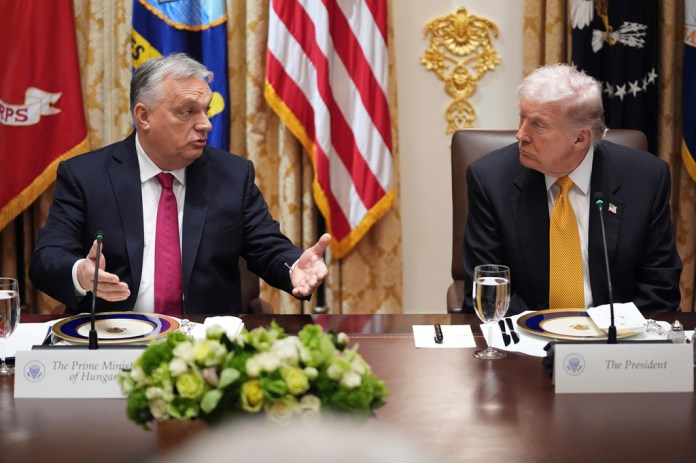
Under the outgoing administration, Budapest and Washington saw themselves as aligned in broad ideological commitments: strident nationalism, Christianity-centered civics, and distaste for out-of-touch technocrats running institutions such as the United Nations and the EU.
And they were willing to be the tip of the spear for Trump’s plans.
“The pendulum has gone very far to the liberal direction, especially in Europe, where the liberal mainstream basically overruled everything, and the liberal mainstream cannot digest conservative success,” Hungarian Foreign Minister Peter Szijjarto told the Washington Examiner last year. “But we are very committed to push this pendulum back and build an alliance, maybe global, of patriotic forces.”
Hungary even imported the U.S. Conservative Political Action Conference in 2022, with annual conferences in Budapest that brought right-wing activists from across the U.S. and Europe.
The Trump administration threw everything but the kitchen sink into a campaign to keep Orban in power.
The president urged Hungarians to “GET OUT AND VOTE FOR VIKTOR ORBÁN” and called the leader “truly strong and powerful.” Vance was deployed to Budapest to stump for the government, where he made accusations toward Brussels of illicit election tampering.
The playbook was the same as ever, and the phrase of the week was once again “Western civilization.”
“There is so much that united the United States and Hungary, and unfortunately, there have been too few people who have been willing to stand up for the values of Western civilization,” Vance told a Hungarian audience last week. “Viktor Orban is the rare exception that has unfortunately proved the rule.”
In the end, Orban was steamrolled by incoming Prime Minister Peter Magyar, who has signaled that under his administration, the primary focus of foreign policy building will be the EU.
Symbolically, the CPAC Hungary events hosted and funded by the Orban government will not be continuing.
The ousting of Orban might lose Trump a personal friend and leave a black mark on his ability to tilt the scales of foreign elections, but he seems to have made peace with his ally’s defeat, calling Magyar a “good man” — a compliment that the incoming prime minister was quick to gleefully share on social media.
Keeping Trump at arm’s length
Trump still has allies in the Old World who are showing a good chance at swinging their homelands toward the right, but getting too convivial with a foreign leader so mercurial on foreign affairs is a dangerous prospect.
Tariffs, threats of annexing territories, unannounced wars in the Middle East, and a general propensity to insult anyone going against him have made Trump a political liability overseas.
Reform UK leader Nigel Farage, whose populist party continues to dominate British polls ahead of local elections next month, has maintained that he can remain good friends with Trump even when they have disagreements.
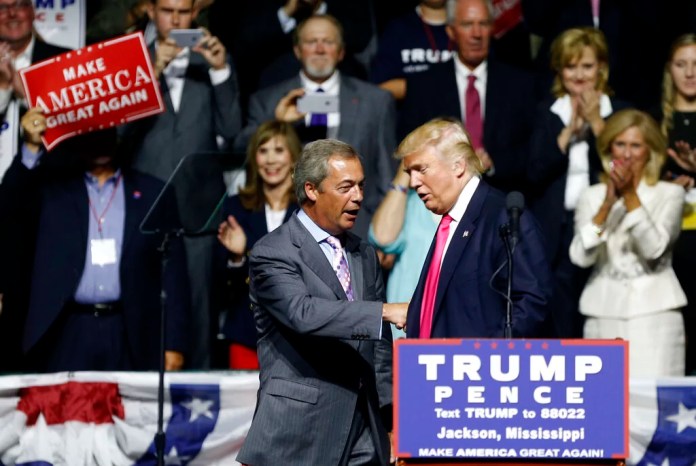
But the Reform UK leader is clearly trying to downplay his MAGA associations on his crusade to become prime minister.
Once a perennial guest at CPAC, Farage stayed well away from the event this year. Reform policy chief James Orr made an on-stage appearance at CPAC Hungary in Budapest in March, which, with Magyar’s reforms, may have been the conference’s final year.
Meanwhile in France, the National Rally is also enjoying unprecedented success at the polls. Trump has been a longtime supporter of the party and its leader, Marine Le Pen, but the party is reportedly uncomfortable with this association.
Le Pen did not keep her mouth shut when Trump initiated his operation in Iran, lamenting that “these strikes were carried out blindly” with little regard for the “catastrophic consequences” it would have on the world economy.
Some conservatives in Europe assert that they cannot blame all of their woes on Trump when their own continent continues to struggle to make any substantial reforms to the political landscape.
“Europe broadly should cry a little less and do a little more,” one European official in Washington told the Washington Examiner. “It doesn’t take us particularly far just complaining about Trump when there’s so much of Europe’s own laundry still to be washed and dried.
“The trans-Atlantic relationship is a little more tortured right now than it has to be, also partly because of the various domestic political dynamics at play. But on the policy side of things, Europe, whatever criticisms we might levy against the administration, we still nonetheless have a role to play in trying to be constructive in all this.”
TRUMP SAYS NATO ‘WASN’T THERE FOR US’ AND WON’T BE ‘IN THE FUTURE’
If the various parties with political ties to Trump and his sphere secure their respective high offices, it might present an opportunity to reset the playing field with incumbent governments sharing broad alignment on cooperative nationalism.
But until then, the specter of American vulgarity may suppress such open collaboration.
