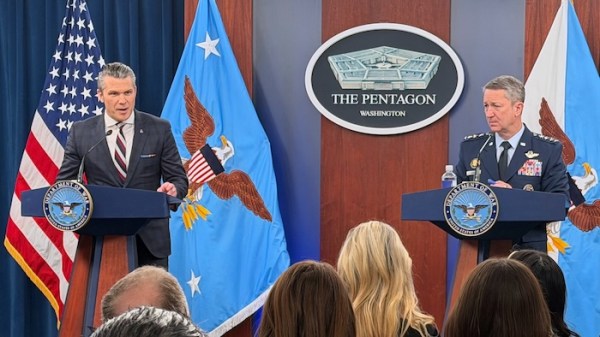
Iran is attempting to “dig out” its bombed-out facilities during the ceasefire, U.S. Secretary of War Pete Hegseth announced on Thursday morning.
The country is “digging out [its] remaining launchers and missiles,” he told reporters during a press briefing, adding that it does not have the “the ability to replenish [its] remaining launchers and missiles.”
Recommended Stories

The United States and Israeli militaries carried out thousands of military strikes during the war, which began on Feb. 28. The ceasefire commenced on April 7, largely degrading Iran’s capabilities, though not eliminating them entirely.
Hegseth warned the Iranians that the U.S. military is prepared to restart offensive operations if needed.
“If Iran chooses poorly, then they will have a blockade and bombs dropping on infrastructure, power, and energy,” he said. “The world watched, and so did you, as the U.S. military moved seamlessly from major combat operations to a world-class blockade. We can make that transition again, very quickly and even more powerfully than ever.”
IMF WARNS OF GLOBAL RECESSION RISK IF IRAN WAR ESCALATES
The secretary did not specify which facilities the U.S. believes Iran is trying to dig out, what was stored there before its bombing, or how widely the country is trying to unearth its buried facilities.
Spencer Faragasso, a senior fellow with the Institute for Science and International Security, told the Washington Examiner that it’s believed Iran is trying to recover its underground missile storage and production facilities, but has not seen indications the country is trying to dig through nuclear facilities that American forces destroyed last year in Operation Midnight Hammer.
He said it would be a “major development” if the U.S. got intelligence indicating Iran was trying to dig through the facilities believed to be where its highly enriched uranium is buried. Iran has more than 900 pounds of uranium enriched well beyond the point of civilian usage, which would be enough for multiple nuclear bombs.
“We know exactly what they have, and they know that. And they will either give it to us, which the president has laid out, we’ll — they’ll give it to us voluntarily,” Hegseth said during a briefing last week. “We’ll get it. We’ll take it — we’ll take it out. Or if we have to do something else ourselves, like we did Midnight Hammer or something like that, we reserve that opportunity.”
Following last weekend’s U.S. and Iran negotiations in Pakistan that did not result in a broad, longer-lasting agreement, President Donald Trump announced that the U.S. military would begin a blockade of vessels going to or from Iranian ports, to match the Iranians’ effort to shut down shipping in the waterways that don’t benefit it.
To date, the U.S. military has deterred 13 ships that were either heading to or coming from Iranian ports since the blockade went into effect on Monday. In one instance on Tuesday, an Iranian-flagged cargo vessel tried to evade the U.S. blockade after leaving Bandar Abbas, but the guided-missile destroyer USS Spruance successfully redirected the vessel.
“Any ship that would cross the blockade would result in our sailors executing pre-planned tactics designed to bring the force to that ship, if need be, board the ships and and take her over. And that includes a series of escalated force options, which could include warning shots and others,” Gen. Dan Caine, the chairman of the Joint Chiefs of Staff, said during the briefing.
U.S. forces have not yet had to board any vessels that sought to defy the U.S. blockade.
A White House official told the Washington Examiner on Wednesday that Trump is “content” with leaving the naval blockade in place “until the Iranians show they are serious about making a deal.”