

Celebrated environmental personality and former Stanford University biologist, Paul Ehrlich, passed away on March 13, 2026, at the age of 93. Earth Day gives us an opportunity to reflect on Ehrlich’s outsized impact, the event’s history, and to better understand how harmful environmental policies can be quickly normalized.
Actively promoted by elected officials and the media, Ehrlich’s profile grew throughout the 70s and 80s, allowing his extreme views to steer governments toward environmental policies that raise energy prices, restrict freedoms, and still harm people today.
Recommended Stories



With his published concerns about overpopulation and resource depletion, Ehrlich played a pivotal role in launching Earth Day and ramping up the early environmental movement.
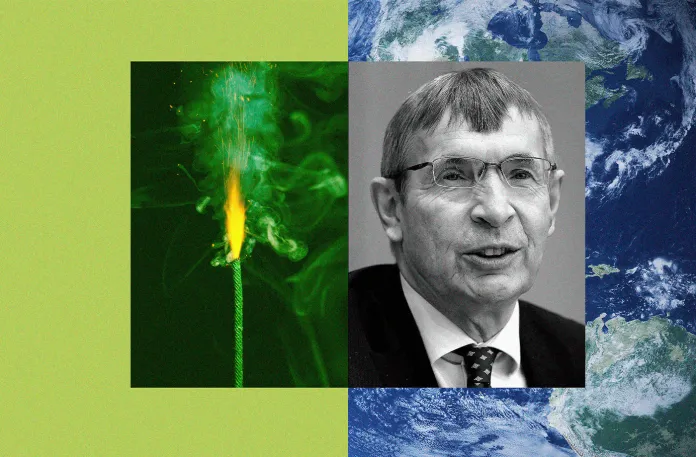
Ehrlich viewed humans in the same light as the insect populations he had studied and believed we faced the same resource constraints. His 1968 book, The Population Bomb, fleshed out his extreme ideas and helped radicalize the fledgling green movement. Its apocalyptic predictions treated growing human populations as a threat, not a blessing, and forecasted famine and widespread starvation.
“The battle to feed all of humanity is over,” lamented Ehrlich in the prologue of The Population Bomb. “In the 1970s and 1980s, hundreds of millions of people will starve to death in spite of any crash programs embarked upon now. At this late date, nothing can prevent a substantial increase in the world death rate.”
As a member of the steering committee of the organization that founded Earth Day, Ehrlich’s ideas influenced the event’s founder, Sen. Gaylord Nelson, and organizer Denis Hayes. First held on April 22, 1970, the event was modeled after anti-war rallies and intended to “force the issue [of the environment] into the political dialogue of the country.”
The movement now claims to have “mobilized over 1 billion people annually on Earth Day, and every other day, to protect the planet.” A laudable goal, to be sure; however, the impacts of much environmental action hinge on the definition of the word “protect.”
Initially, many in the environmental movement highlighted commonsense concerns, such as the repeated fires on the Cuyahoga River. But others expanded their demands well beyond cleanup and conservation to promoting the notion that protecting the planet meant radically reducing human populations to limit our impact on the natural environment.
Ehrlich was a ringleader for that mindset. Predicting that “the collapse of civilization is a near certainty within decades,” he recommended severe restrictions on industrial activity and energy use, wealth redistribution, and often unsettling “population control” measures.
In one 1970 interview, Ehrlich argued, “We’d all end up dead” if we allowed the U.S. population to remain at 50 million and continued using fossil fuels. But the past 50 years have shown that Ehrlich’s warnings have been persistently and chronically wrong.
We’re doing much better; living longer and breathing cleaner air. Over 340 million people now live in the United States, but only 3% of the country is developed as an “urban area.” More than 80% of the land in the U.S. is parks, farms and cropland, forests, or grassland.
Our oil and gas production has grown from 9.5 million barrels per day in the 1970s to over 13 million. At the same time, life expectancy has increased from approximately 70 years in 1970 to almost 80 years today. We have reduced airborne emissions of the six “criteria pollutants,” which are known to harm human health, by almost 80%.
Despite Ehrlich’s chronically inaccurate forecasts, the media and elected officials still treated him as a green prophet. The New York Times eulogized Ehrlich as a “leader of the environmental movement,” whose prophecies “proved premature.” Translation: New York Times editors believe the predictions weren’t wrong; they just haven’t come true yet.
Ehrlich and many in the media and environmental movement wrongly view humanity as an obstacle to the planet’s health, something that must be forcefully controlled rather than its stewards.
But we’re not like the insects Ehrlich studied. They are incapable of moderating their reproduction and consumption. Instead, humans are creative, intelligent, and adaptable. Rather than want and deprivation, humanity’s ability to invent and adapt has clearly debunked the doomsayers’ philosophy.
CLARENCE THOMAS BREAKS HIS SILENCE AND ISSUES A WARNING
On this Earth Day, we don’t have to fear Ehrlich’s apocalyptic predictions. Instead, we can look to the example of innovators like Norman Borlaug, the father of the Green Revolution, and rational optimists like Julian Simon, who proved that, by relying on our creative intellect, humanity can continue to expect a bright and productive future.
Jason Hayes is Policy Director, Energy & Environment at The America First Policy Institute