

In American politics, the arc from City Hall to the Cabinet is one of the longest imaginable. Most politicians spend entire careers trying to travel it and never arrive.
Stay informed.Stay ahead.
Join Washington Examiner for unlimited access to the news, analysis, and commentary that matter most.
Already a member? Log in
Dirk Kempthorne, the former Idaho governor, U.S. senator, and secretary of the interior who died April 24 in Boise at the age of 74, not only made that journey — he made it look, somehow, like the most natural thing in the world.
Dirk Arthur Kempthorne was born on Oct. 29, 1951, in San Diego and raised in San Bernardino, California — a fact that his adopted state of Idaho might have held against him, but never did. After a stint at San Bernardino Valley College, he transferred north to the University of Idaho in Moscow, where he earned a degree in political science, served as student body president, and found the place he would always call home. He also found his future wife, Patricia, whom he married in 1977 in a sunrise ceremony atop Moscow Mountain, a setting that reflected his conviction that there was no more beautiful cathedral than the outdoors.
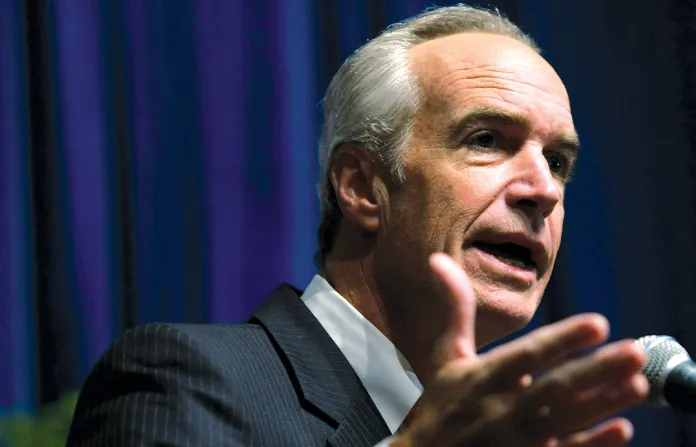
After graduation, Kempthorne worked as executive assistant to the director of the Idaho Department of Lands and then as executive vice president of the Idaho Home Builders Association, gaining practical knowledge of how government actually worked. His entry into electoral politics came in 1985, when, at 34, he ran for mayor of Boise — the youngest candidate in the race by a margin of 15 years. His successful platform was straightforward: Revitalize a downtown that two decades of failed urban renewal had left a patchwork of empty lots and an abandoned mall dream. Seven years later, Boise had a new convention center, a regional shopping mall, a Grove Plaza, and a renovated cityscape to show for it.
Kempthorne had also developed the instinctive, small-d democratic touch that would define his public persona — an almost supernatural ability to remember not just names but spouses’ names, children’s names, the last conversation he’d had with someone years before. To those who experienced it, it felt less like a politician’s trick than a genuine expression of interest in other people.
In 1992, Kempthorne won the U.S. Senate seat vacated by Republican Steve Symms and arrived in Washington with an agenda shaped by his years running a city that had to live within its means while Congress dictated terms. His signature achievement became Senate Bill 1 of the 104th Congress: the Unfunded Mandates Reform Act of 1995, which barred the federal government from passing costs down to state and local governments without corresponding funding. Getting a bipartisan bill signed by a Democratic president as a freshman Republican senator was no small feat. On the Senate floor, he argued that Congress had been “far too willing to merely pass the bill and then pass the buck to the states and localities, but the ultimate billpayer is the same weary American taxpayer.” President Bill Clinton signed it. Kempthorne also overhauled the Safe Drinking Water Act in 1996.
Rather than seek Senate reelection in 1998, he ran for governor of Idaho and won with nearly 68% of the vote. As governor, he championed education reform, requiring Idaho children to read at grade level by the third grade, and pushed through a transportation financing program that broke Idaho’s long tradition of pay-as-you-go infrastructure. When the legislature balked, Kempthorne invited the TV cameras to his ceremonial office. On April Fools’ Day 2005, he grabbed a giant red veto stamp and slammed it down on eight House bills in quick succession. The legislature came around.
In 2006, President George W. Bush appointed Kempthorne the 49th secretary of the interior — the first person to hold the position who had previously served as governor, senator, and mayor. Kempthorne delivered at least one notable surprise: In 2008, he insisted that the polar bear be listed as a threatened species under the Endangered Species Act due to Arctic sea ice loss. Bush backed him. During his tenure at Interior, Kempthorne lived on a houseboat moored in the Potomac, a fitting image for a landlocked Westerner making his way in Washington.
After leaving government, Kempthorne spent eight years as president and CEO of the American Council of Life Insurers and later chaired The Peregrine Fund, the raptor conservation organization. He remained engaged in retirement. In 2021, he helped organize the private evacuation of nearly 400 Americans and Afghan allies from Taliban-held Kabul, spending months raising money and navigating diplomatic channels to charter an Airbus A340 and get them out.
As a University of Idaho student, Kempthorne had honed his public speaking by going out to the campus farmland to deliver speeches to the grazing cows.
“I’d go out there where you’d find a number of cows, and they’d be grazing,” he once recalled, “And I’d go and I’d give them a speech.” The cows, apparently, were a tough crowd. Idaho turned out to be a more appreciative audience, and Kempthorne never stopped giving them his best.
Daniel Ross Goodman is a Washington Examiner contributing writer and the Allen and Joan Bildner Visiting Scholar at Rutgers University. Find him on X @DanRossGoodman.
