

President Donald Trump’s new surgeon general nominee, Dr. Nicole Saphier, has drawn praise from anti-abortion advocates for her decision not to terminate her unplanned teenage pregnancy.
Saphier, a former Fox News contributor whom Trump nominated for the nation’s top public health spokesperson position on Thursday, has been very public about her journey of not succumbing to pressure to abort her child when she became pregnant at the age of 17.
Recommended Stories


A radiologist specializing in breast cancer diagnosis and treatment, Saphier completed college, earned her medical degree, and completed a fellowship through the Mayo Clinic after giving birth to her son while she was still in high school.
In her book of vignettes on motherhood, Love, Mom, as well as multiple television interviews, Saphier has shared that she was deeply connected to her Catholic faith at the time of her first pregnancy.
Abortion-rights advocates often argue that it is exceedingly difficult for young women to make career advancements while pregnant or parenting, making Saphier’s story a textbook example of the anti-abortion counterargument.
Lila Rose, head of the anti-abortion group Live Action, posted on X shortly after Saphier’s nomination, calling her “inspiring.” Rose stopped short of praising Trump, however, or expressing hope that Saphier would use her experience to inform her work as surgeon general.
Trump and his advisers have had a rocky relationship with the anti-abortion wing of the GOP during his second term in the White House, adding additional weight to the decision to appoint an anti-abortion surgeon general.
Anti-abortion advocates secured a key victory against the Trump administration on Friday evening when the U.S. Court of Appeals for the 5th Circuit temporarily suspended the Food and Drug Administration’s decision to allow the abortion pill to be sold online and shipped in the mail.
But anti-abortion advocates have been pressuring the administration, and Health and Human Services Secretary Robert F. Kennedy Jr. in particular, to voluntarily undo Biden-era regulations and reinstate in-person screening requirements for the abortion pill.
Kennedy and FDA Commissioner Dr. Marty Makary have promised they are conducting a safety review for the pill after a study involving insurance claims data found that mail-order mifepristone has a complication rate of nearly 11%, which is 22 times higher than the FDA’s warning on the drug estimates.
Anti-abortion advocates lauded Saphier for her decision to choose life on Thursday after Trump announced that he was withdrawing the nomination of Dr. Casey Means.
Means, a champion of the Make America Healthy Again movement, ultimately did not have the votes in the Senate to pass confirmation. She also received significant pushback from socially conservative groups for her more mystical approach to certain health issues.
Means also came across as fickle on abortion and reproductive health topics during her confirmation hearing before the Senate Health, Education, Labor and Pensions Committee earlier this year.
She not only dodged questions on whether she would support anti-abortion efforts to curb mifepristone use, but she also did not convince Democrats on the panel that she supported access to hormonal contraceptives, which she previously condemned on multiple occasions.
Personal choices or policy moves

In addition to Live Action, several other anti-abortion advocacy groups praised Saphier for her bravery as a teenage mother and expressed hope that her experience with pressure to abort will inform her policy decisions in the Trump administration.
Gavin Oxley, media relations manager for Americans United for Life, praised Saphier’s experience on X, saying she ought to give voice to women pressured or coerced into abortion using mifepristone.
“Dr. Saphier knows firsthand the pressure women face from abortion culture and the hope brought by choosing life,” Oxley said. “As Surgeon General, she must bring that same hope to women by facing down the public health crisis of mail-order abortion.”
The National Right to Life Committee, one of the oldest anti-abortion groups in the country, called Saphier “an excellent choice” from Trump.
NRLC’s outreach director, Raimundo Rojas, said Saphier’s nomination gives anti-abortion advocates “a public witness to the truth we have defended for decades.”
“America does not need a Surgeon General who treats motherhood as a burden or unborn children as abstractions,” Rojas said. “America needs leaders who understand that women need support, children deserve protection, and families form the heart of public health.”
It is unclear whether or not Saphier will take her personal beliefs and life choices into her new role, should she be confirmed by the Senate.
A 2019 Fox News op-ed from Saphier condemns the rhetoric of abortion-rights advocates, who charge that abortion ought to be a right because some children are “unwanted.” But she does not in that piece say specifically that she does not believe in a legal right to abortion or that the state should restrict abortion after a certain gestational age.
In the piece, she specifically highlights how personal a situation such as an unplanned pregnancy is.
“Although my situation as a girl with an unplanned pregnancy is unique to me, I do not hold myself to a higher standard than anyone who makes a choice different than I did so long ago,” Saphier wrote. “I can only say with certainty that although my pregnancy may have been unwanted, my ‘kid’ certainly was not.”
Precedent: Reagan’s Surgeon General and abortion
Saphier would not be the first surgeon general to receive pressure to act in an official capacity on the abortion issue from special interests.
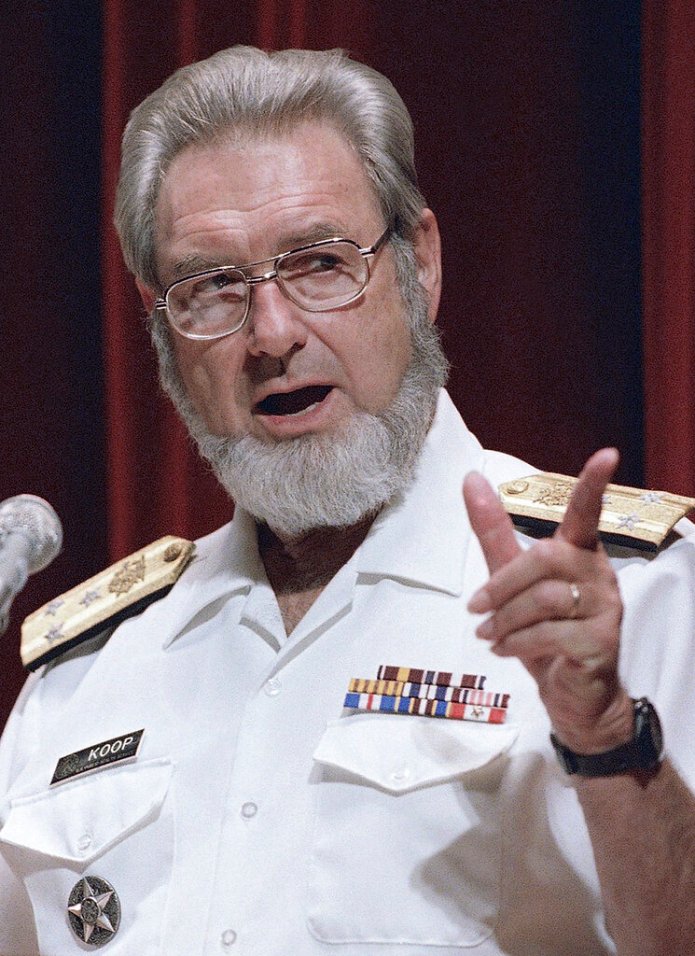
President Ronald Reagan’s Surgeon General C. Everett Koop personally identified as “pro-life” but clashed with his administration over how to approach the issue as the public health spokesperson-in-chief.
Koop established the nation’s first neonatal surgical intensive care unit at the Children’s Hospital of Philadelphia in 1956. He served as a professor of pediatrics at the University of Pennsylvania School of Medicine from 1959 until he was nominated for surgeon general in 1981.
Koop worked closely with Reagan during the HIV/AIDS epidemic, but the two clashed in 1989 when the president instructed Koop to write a report outlining the negative psychological effects of having an abortion.
Reagan and anti-abortion advocates at the time, only 16 years after Roe v. Wade, wanted the surgeon general to produce a report condemning abortion as a risk to women’s mental health and documenting what was called at the time “post-abortion stress syndrome.”
Before Congress in March 1989, Koop testified before the House, saying that his team “could not prepare a report that could withstand scientific and statistical scrutiny.”
“There is no doubt about the fact that some people have severe psychological effects after abortion, but anecdotes do not make good scientific material,” Koop said.
National Library of Medicine’s biography on Koop documents that he subsequently expressed his stance against the Reagan administration was greatly exaggerated by the press at the time, citing his experience treating critical care infants at CHOP.
“My concern for the unborn followed as the night, the day my concern about the newly born,” Koop said. “How could I ever accept the destruction of the unborn after a career devoted to the repair of imperfect newborns, knowing the joy and fulfillment they brought to their families?”
The Washington Examiner contacted HHS and Saphier.
