

Three people aboard a cruise ship sailing the Atlantic Ocean have died as a result of suspected hantavirus infections, according to the World Health Organization.
Hantaviruses are a family of pathogens spread by rodents, mostly mice, and excreted from their saliva, urine, and droppings. If left untreated, hantavirus infections can progress rapidly and result in low blood pressure, low oxygen levels, and death by organ failure.
Recommended Stories


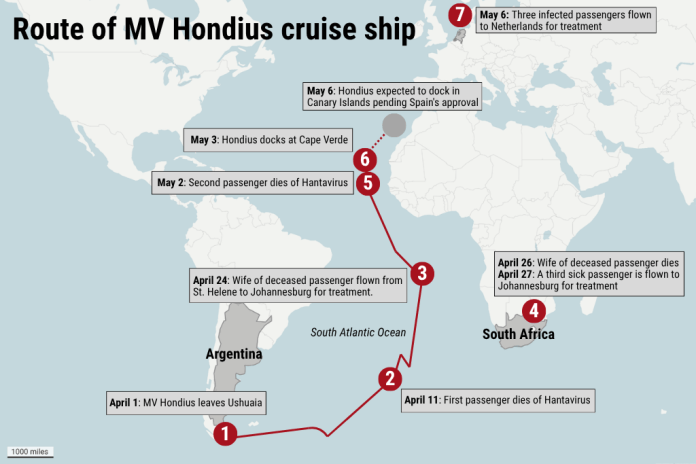
Five people are suspected to have been infected, and there has been one confirmed case, according to the WHO. Of those six, three have died due to the infection.
The cruise, Oceanwide Expeditions’ MV Hondius, was carrying roughly 150 passengers and set sail from Argentina about three weeks ago. The ship made stops in Antarctica and several other islands on its way to Cape Verde, an island chain in West Africa.
Foster Mohale, a spokesman for the National Department of Health in South Africa, said in a statement Sunday evening that passengers on the international cruise were being treated in South African medical facilities “following serious health complications arising from undiagnosed severe acute respiratory infection.”
Hantavirus made headlines last spring following the sudden death of actor Gene Hackman’s wife, Betsy Arakawa, from hantavirus pulmonary syndrome, or HPS. Three other people died in Mammoth Lakes, California, from the same condition shortly thereafter.
Here is everything to know about the rare but fatal condition.
What are the symptoms?
The early symptoms of HPS are similar to cold and flu symptoms. A fever higher than 101 degrees Fahrenheit, body aches, chills, and headaches are some of the first signs of HPS, according to the American Lung Association. Nausea, vomiting, and abdominal pain are also early symptoms.
The Centers for Disease Control and Prevention said HPS patients often develop a dry cough and shortness of breath between four and 10 days of symptom onset. This can lead to chest tightness due to fluid collection in the lungs.
In the most severe cases, the virus damages the heart’s ability to pump blood, causing very low blood pressure and decreased oxygen levels that can cause organ failure.
Nearly 4 in 10 patients who develop respiratory symptoms could die from the infection, according to the CDC.
How do people get infected?
There are no rapid diagnostic tests for HPS. That makes a history of rodent exposure the fastest way to identify the infection, according to the ALA.
“Because HPS is an airborne disease spread by rodent saliva, urine, or feces, you might never see a rodent and still breathe air contaminated by the virus,” the ALA’s briefing page on HPS says.
Deer mice, white-footed mice, cotton rats, and rice rats are the most frequent carriers. Rodents most frequently encountered in urban communities in North America, namely the house mouse and the Norway rat, are not carriers.
The cases contracted on the MV Hondius are puzzling for infectious disease physicians, since human-to-human transmission of the virus has not been previously documented.
Dr. Emily Abdoler, a physician and professor of medicine at the University of Michigan Medical School, told the New York Times that she had not previously heard of any cases reported on a cruise ship.
“This is not a common infection, but it’s even less common to have the human spread raised as a possibility,” she added. “Six people sick on a cruise ship — I’ve never heard of that from this kind of infection.”
What is the treatment?
CDC guidance says there is no specific treatment for hantavirus infections, but clinicians must act quickly if they suspect a patient is infected with HPS.
“Early intensive medical care is critical because patients who have sudden acute disease can rapidly become severely sick and die,” the CDC’s guidance for healthcare providers says. “If a patient is experiencing full distress, it is less likely the treatment will be effective.”
Patients should seek emergency care if they suspect an infection so that they can have their heart function and oxygen levels monitored to prevent symptoms from developing.
Without swift and sufficient treatment, the CDC said, most deaths occur in patients with HPS within 24 to 48 hours of developing cardiopulmonary trouble.
How rare is HPS?
The CDC has reported 890 cases in the U.S. between 1993 and 2023, averaging roughly 30 cases annually. That includes HPS and nonpulmonary hantavirus infections.
HANTAVIRUS OUTBREAK LEAVES THREE DEAD ON CRUISE SHIP, BUT ‘NO NEED TO PANIC’
During those 30 years, HPS has been identified in 34 states, mostly in the Four Corners region where Utah, Arizona, New Mexico, and Colorado meet. Nearly all cases, 96%, occurred in states west of the Mississippi River.
Gavi, an international vaccine network, identified roughly 200,000 global cases of hantavirus-like symptoms, particularly in the Andes region of South America, including Argentina.
