

As is the case with every other institution in society, public opinion of the Supreme Court has turned sharply negative since 2020, nearing historic lows. Even so, it remains the branch of government most trusted across American society. As far as public opinion of the court has fallen, it is nowhere near as bad as the people’s opinions of Congress and the president.
Recommended Stories



In author Sarah Isgur’s telling, this is more about the failure of the two political branches than about changes in the high court — and even those changes are reflections of the failure of Congress to hold up its end of the constitutional bargain. Isgur details that and more in her lively and illuminating romp through Supreme Court history, practice, and theory, Last Branch Standing: A Potentially Surprising, Occasionally Witty Journey Inside Today’s Supreme Court.
Explaining the law to non-lawyers sounds simple enough, but few are as good at it as Isgur is, from the podcast she co-hosts, Advisory Opinions, to the website she edits, the indispensable SCOTUSblog, and now to this book. This service is increasingly necessary because the courts loom larger than ever over American political life. Congress does not seem to want to pass laws, and presidents increasingly rely on executive orders that, besides being impermanent, often conflict with existing statutes or constitutional provisions. Rather than exercise the independent constitutional judgment the Founders intended, politicians in the 21st century are often inclined to do what they want and then depend on the courts to clean it up.
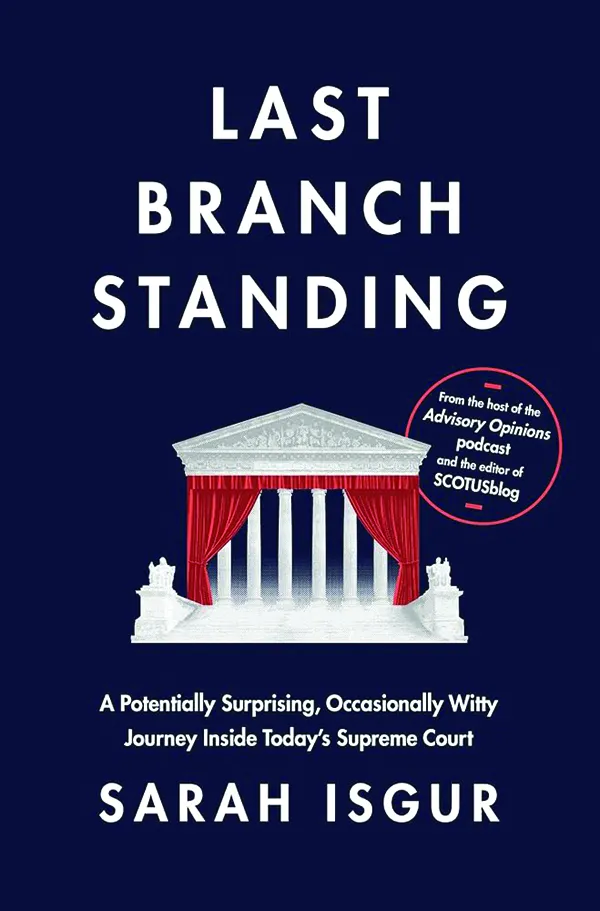
That has, unsurprisingly, led many Americans to think of our Supreme Court as a super-legislature, one whose 6-3 Republican majority works the same way as a majority in the House or Senate would. One of Isgur’s first tasks in Last Branch Standing is to dispel the notion that the court lives on a single left-right axis. Instead, she adds another “institutional axis” that goes a long way to explaining what the mainstream press prefers to ignore: there’s a lot more going on here than R versus D.
The second axis, she writes, “measures a different kind of conservatism, one that is distinct from the popular understandings of ‘right’ and ‘left.’” It measures a temperamental conservatism — how much a justice defers to precedents, considers the need for the law to be dependable and predictable, and thinks about the need for incremental rather than radical change. Two justices might be equally “conservative” in their views of what the Constitution means and how the laws should be interpreted, but their implementation of those ideas can vary wildly from “baby steps” to “let’s just do it and be legends.”
Respecting precedents — the idea of stare decisis, as the courts put it — is not a simple concept, and not one that any judge honors 100% (or 0%) of the time. All judges say they respect case law, but that reverence wanes when the precedent is one that they believe has always been wrong and is actively doing harm. It is also lessened when the status quo is less easily changed — when, for instance, it would take a constitutional amendment to overturn the court’s prior ruling. It is not altogether a bad thing for judges to be flexible about this — some precedents from the court’s past deserve to fall.
Isgur explains this and other legal canons well, and in terms that educated non-lawyers can easily parse. She also delves into the history of originalism (now in its third phase, in the author’s telling) and how this now-commonplace idea — that laws mean what people thought they meant when they were written — grew from a fringe theory on the academic Right to one with which even left-leaning judges are compelled to wrestle.
In explaining that two-dimensional analysis, she debunks the thing that political journalists — and the editors who write their headlines — routinely ignore: this is not a 6-3 Supreme Court. It is a 3-3-3 Court, with Justices Clarence Thomas, Samuel Alito, and Neil Gorsuch sitting at the opposite end of the institutional axis from Chief Justice John Roberts and Justices Brett Kavanaugh and Amy Coney Barrett. And even among the more tightly grouped liberal justices (Elena Kagan, Sonia Sotomayor, and Ketanji Brown Jackson), differences in that temperamental-institutional axis explain why Kagan is more likely to join with the Roberts grouping — and sometimes with all six conservatives — than the other two liberals are.

Beyond this, the book also explains the ins and outs of a day at the Supreme Court: how oral arguments work, what the clerks do, what the justices’ workday looks like. There are analyses of each justice, their backgrounds, and how they approach their jobs on the court. There is also a brief history of the court, and how it got from the “least dangerous branch” that met sporadically in the basement of the Capitol to the far more powerful institution it is today.
REVIEW: MOLLIE HEMINGWAY’S ‘ALITO’ DIVES INTO HOW THE JUSTICE RESHAPED THE SUPREME COURT
Isgur also adds her thoughts on how we got here and how we went from making change through the laws to relying on the courts. There is even a group of eight proposed constitutional amendments that feels a bit out of place, but many of them are good ideas — I, too, would love to see a legislative veto added to the Constitution.
The book is written with a light touch, witty asides, and pop-culture references. But it is not light on ideas. Isgur’s prose is deceptively breezy while still thoughtfully explaining weighty concepts that drive our judicial branch. She is accurate without being boring — a rare combination in legal writing.
Kyle Sammin is the managing editor of Broad + Liberty.
