

In Focus delivers deeper coverage of the political, cultural, and ideological issues shaping America. Published daily by senior writers and experts, these in-depth pieces go beyond the headlines to give readers the full picture. You can find our full list of In Focus pieces here.
The summit between President Donald Trump and Chinese leader Xi Jinping has ended without a dramatic formal announcement. Xi’s invocation of the “Thucydides Trap” in his opening remarks was a dramatic reminder of the breadth of his ambitions and the danger they pose for the United States.
Recommended Stories


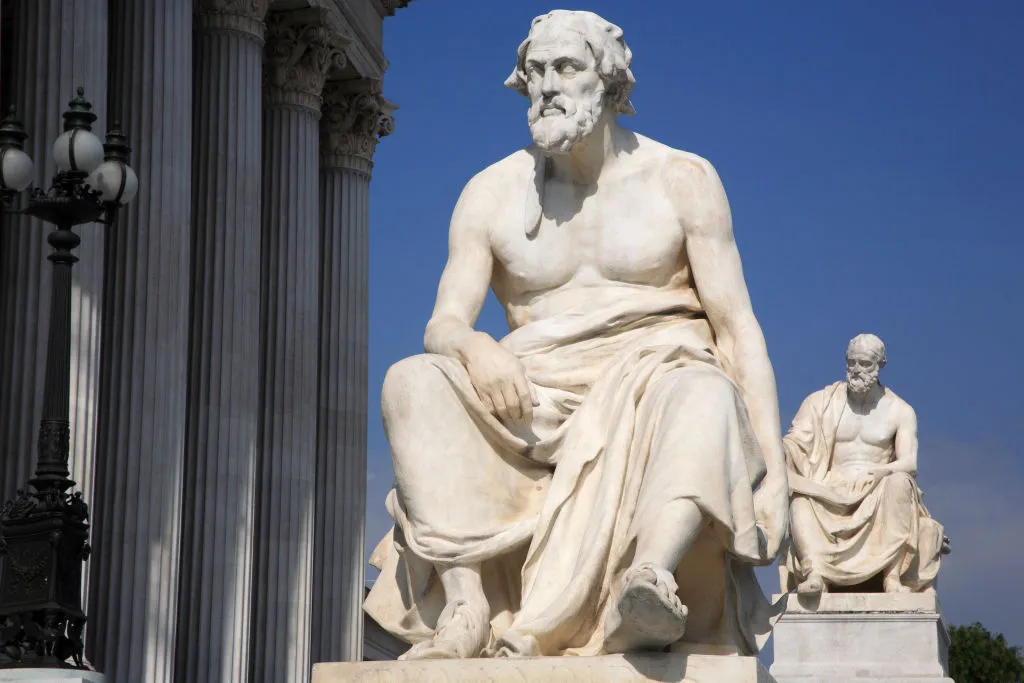
The Thucydides Trap is a term coined by political scientist Graham Allison and refers to the ancient Greek historian’s explanation for the Peloponnesian War between Athens and Sparta. Thucydides says that the war arose because Athens’ aggressive rise made Sparta, the historic great power among Greek city states, afraid it would lose its preeminence. This prompted Sparta to launch a war against Athens to curb that city’s ambitions, a war that lasted over 30 years and engulfed all of Greece.
Xi presumably invoked this to analogize between his nation and the U.S. In this reading, China is the new Athens and America is the old hegemon Sparta. If America lets her fear of China govern her reactions, Xi seems to warn, it will lead to a war more deadly than you can possibly imagine.
There are many ways to interpret that, but all share a common recognition that China under Xi intends to become a global power on par with the U.S. That desire will inevitably lead it to do what all great powers do: acquire economic, military, and diplomatic influence in and over other countries. Given America’s status as the only truly global power, it’s clear why Xi’s ambition would stoke anxiety, if not fear, among U.S. leaders.
The two nations are currently engaged in a global battle for influence, with the U.S. seeking to revitalize its long-standing alliances and China probing for weaknesses in that structure while trying to gain de facto hegemony over nations outside the U.S.’s web. This explains why the U.S. is pushing its allies to increase defense spending and invest in America’s domestic military-applicable manufacturing infrastructure and why China is using its economic power to invest in nations throughout the unaligned global South.
The two nations’ competition comes most directly to a head over Taiwan. China has always stated that the island nation, founded in 1949 by the defeated anti-Communist Nationalist government after its defeat by the Chinese Communists, belongs to it. Xi has ramped up that traditional demand and has clearly signaled his willingness to use force if necessary to bring Taiwan back under Beijing’s control.
That would be a disaster for the U.S. and its allies. Taiwan is part of the “first island chain,” a string of islands stretching from Japan south to the Philippines, which stands guard against China’s ability to safely project power into the Pacific Ocean. Take Taiwan, which is near the center of that chain, and China can much more easily project power northward toward Japan and Korea or south toward the Philippines, Indonesia, and Australia. Control of Taiwan would also give China the ability to cut Japan off from the Middle East, from which it gets much of its oil.
It would also be a disaster because of Taiwan’s supremacy in the manufacture of advanced computer chips. Take Taiwan, and the West would become even more dependent on China for the lifeblood of the modern economy.
Xi’s warning, then, can be viewed as a statement that American defense of Taiwan would be akin to Sparta’s reaction to Athens’ continued incursions into its traditional sphere of influence. That means war, a war that America might not win.
THE RIGHT WAY FORWARD: THE ROLE OF THE STATE IN THE ECONOMY
The Soviet Union rarely took such an aggressive position vis-à-vis the U.S. during the Cold War. They made clear that American attempts to militarily overthrow the communist governments in Eastern Europe would be met with force, but the USSR never directly implied it would defend other satellite nations. Thus, the U.S.’s direct involvement to stop North Vietnam’s attempt to conquer South Vietnam did not lead to Soviet intervention, nor did America’s blockade of Cuba, which precipitated the Cuban Missile Crisis.
Most observers take Xi’s not-so-veiled warning as a sign of strength. But one should remember an admonition of the great ancient Chinese strategist, Sun Tzu. In his classic treatise, The Art of War, he counseled that a leader should “appear weak when you are strong, and strong when you are weak.” Xi’s attempt to demonstrate strength — a feature of the entire summit — could be a ploy to mask weakness.
There’s reason to think that might be the case. Chinese weapons systems are said to have not fared well in recent conflicts with U.S. weapons in Venezuela and Iran. If that is true, then Xi might well realize that the vast navy he has constructed would still be a severe disadvantage in a war with the U.S. Without a navy capable of battling the Americans to at least a standoff, Xi’s ability to seize and hold Taiwan becomes infinitely harder.
Xi could also recognize that China remains vulnerable to American economic pressure. Its growth has slowed significantly to around 5% last year and an estimated 4.4% this year. This has slowed the movement of people from farms to cities, creating a massive housing crisis that has left tens of millions of units unsold or vacant. China may not have the financial wherewithal to address this serious financial challenge and risk a war with the world’s only superpower.
Xi’s strategy, then, must try to do two things at once. He must try to prevent the United States from exerting its maximum pressure, economic or military, on China while the country navigates its internal problems. He must also maintain China’s push for global relevance and avoid a serious reverse.
In the best of all possible worlds for Xi, he succeeds beyond his wildest dreams by convincing Trump to reduce pressure on China. Xi cannily is dangling significant investments in American businesses as a carrot, knowing that Trump tends to see international relations through the lens of a balance book. If he is successful, Trump could cut some of his tariffs or do other things to increase the volume of trade between the two nations. That would help increase China’s GDP growth, thereby helping it to better address the financial challenge that flows out of its housing crisis.
It’s unlikely, however, that he will succeed in persuading Trump to abandon support for Taiwan. America’s Pacific allies are united in their desire to see Taiwan remain out of China’s grasp, and any move Trump would openly make in that direction would hurt his efforts to shift the defense burden in the Pacific to the allies. Trump will want to keep the U.S.’s willingness to defend Taiwan in case of war ambiguous, as that provides him with some leverage over Xi.
The most Xi could reasonably hope for, then, is a slowing of American arms sales to Taiwan, or perhaps even a cancellation or reduction in sales already agreed to. Trump would surely not want to do that, as the very mercantile focus that makes him open to a deal that maximizes investment makes him want to continue to sell arms to Taiwan. Any post-summit move in this direction, then, should be taken as a significant win for Xi — and lead one to wonder what, if anything Trump obtained in return.
No one should doubt Xi’s desire to be seen as one China’s great historic leaders. He can achieve that lofty pinnacle only by doing things that others have not. Mao Zedong created the modern Communist state, while Deng Zaoping launched the economic revival that is making China rich. Xi’s distinctive addition to their achievements must lie in recasting China’s relations with the West, taking it from the humbled power of the 19th Century to at least the equal, if not the dominant, power in the world.
Xi does not have much more time to realize his ambition. He turns 73 next month, and even vibrant, healthy men feel their mortality slipping away. No one is remembered as a great leader if one dies before great things are accomplished. One should therefore expect Xi to be more rather than less aggressive in his pursuit of Taiwan and Chinese power, even as he is flexible over how to obtain those goals.
He should nevertheless remember the real lessons of Thucydides’ immortal history. Sparta’s attempt to prevent Athens’ rise did initially lead to defeat, but Athens’ conceit led it to invade Syracuse and suffer a massive defeat. Sparta ended up winning the war it started, forever ending Athenian dreams of dominating Greece. The trap Xi might think will entangle America in a war it will not win may therefore end up being the snare that brings Chinese ambition crashing to the ground.
