In Focus delivers deeper coverage of the political, cultural, and ideological issues shaping America. Published daily by senior writers and experts, these in-depth pieces go beyond the headlines to give readers the full picture. You can find our full list of In Focus pieces here.
I have attended Sarah Lawrence College commencements for nearly 20 years, and I know what these ceremonies normally feel like — the college’s unique pedagogy means that commencements are often cathartic, inspiring, and uplifting. Even when speeches run long or weather intrudes, there is a recognizable emotional atmosphere on campus of relief, celebration, pride, laughter, and noise. Students hug each other. Families cry. And at the end, when the president closes the ceremony, the tent erupts — applause, cheers, caps in the air.
Recommended Stories
This year, there was no joy. When the president closed the ceremony, the response was thin and formulaic. A scattering of applause. No cheers. No hats. The graduates simply stood up and walked out quietly. It was cold. Emotionally empty. Faculty colleagues who have sat under the tent with me for years remarked afterward on the flatness. None of us had seen anything like it.
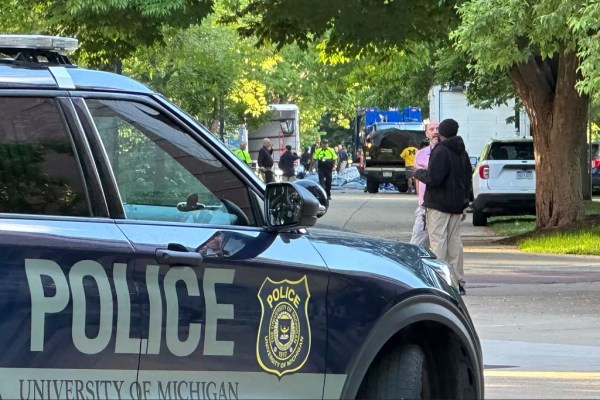
There was also a visible law enforcement presence. Cameras monitored the grounds. Security was difficult to ignore. In another era, commencement ceremonies projected institutional confidence and communal trust. Here, the atmosphere suggested caution, anticipation, anxiety, and even fear. The setting felt less like an unguarded celebration than a carefully managed event attempting to prevent disruption before it occurred.
I watched my own students as the ceremony unfolded. Among them were Zionist Jewish students who have spent years on this campus under sustained ideological assault — singled out in classrooms, isolated by peers, abandoned by an administration that has refused to defend them. On what should have been the day they crossed into the rest of their lives, they sat shut down, exhausted. The faces I had watched grow into sharp, brave thinkers over four years had gone flat. They were not celebrating. They were enduring. That is what an institution does to its own students when it spends years refusing to enforce its own norms.
And then, during the ceremony, a master’s candidate who was the graduate student speaker concluded her remarks by shouting, “Free Palestine.” President Cristle Collins Judd, seated on the platform, said nothing. Did nothing. The moment passed without acknowledgment or correction.
For anyone who has watched Sarah Lawrence under Judd’s leadership, the silence was familiar. It was the same silence that allowed Ezra Klein to be shouted down on her campus in January, while she sat beside him onstage and offered only “Welcome to Sarah Lawrence” by way of response. It was the same silence captured in the House Committee on Education and the Workforce report that documented internal emails in which Judd agreed with her dean of students that the local Hillel director’s pleas to defend Jewish students were “alarmist.”
This is not a series of unfortunate moments. It is a leadership posture — applied consistently, over years, regardless of the cost. A commencement platform was turned into a political megaphone, and the president of the college treated it as unremarkable because, under her leadership, it has become unremarkable. That is not neutrality. That is the abdication of the role itself.
When institutions fail to enforce shared norms consistently, the immediate assumption is often that more people will feel free. In reality, the opposite usually happens. Shared norms are what allow people to relax and even thrive in communal spaces. They create predictability. They establish boundaries. They reassure participants that the purpose of the gathering will remain intact.
Once those norms become uncertain, everyone becomes emotionally vigilant. Students begin scanning the room for possible confrontation. Parents wonder whether a celebration will suddenly become a protest. Faculty members worry about saying the wrong thing or responding the wrong way. Administrators grow anxious about escalation. When every space becomes contested terrain, nobody fully settles into the moment itself.

The result is not liberation. It is exhaustion. And that is exactly what I saw beneath that tent.
Sarah Lawrence is not unique. It is simply unusually legible. What happened beneath the Sarah Lawrence tent is happening, in varying degrees, across higher education.
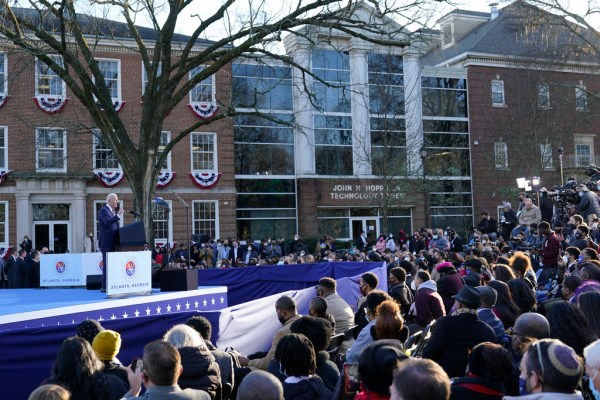
I have written about this from other angles over the past month. At the University of Michigan, the Faculty Senate chairman used his commencement remarks to deliver a political verdict on the Israeli-Palestinian conflict, in violation of the university’s own institutional neutrality bylaw. At New York University, the student government assembly and the student newspaper published an op-ed denouncing Jonathan Haidt, one of the most consequential social scientists of his generation and an NYU faculty member, as unworthy of addressing graduates because his ideas did not “share students’ values.”
A commencement ceremony is not merely administrative theater marking the completion of credits. It is one of the few remaining civic rituals in American life — a communal moment designed to recognize achievement, transition, aspiration, and belonging. Alexis de Tocqueville understood that democracies survive through the small ceremonies of associational life, not the grand declarations of policy. The American capacity for self-government rested, he argued, on the dense web of communal rituals through which citizens learned to belong to something larger than themselves. Commencement is one of the last such rituals higher education still holds. When colleges hollow it out, they are not merely producing a thinner ceremony. They are eroding one of the few remaining sites of civic formation our institutions still possess.
American institutions increasingly misunderstand neutrality. It is not moral cowardice. In pluralistic settings, neutrality is what makes common life possible. It is the framework that allows people with profoundly different convictions to inhabit the same space under shared rules. A school does not preserve legitimacy by satisfying every faction in the room. That is impossible. It preserves legitimacy by articulating standards clearly, applying them consistently, and refusing to turn every communal gathering into a political battlefield.
This does not require suppressing political disagreement. Universities should absolutely permit robust debate, protest, and activism. But healthy institutions also understand that not every moment exists for political confrontation. Some spaces are meant for argument. Others are meant for celebration. Mature institutions know the difference. Increasingly, ours do not — because increasingly, the people running them have neither the conviction nor the courage to draw the line.
In May 2014, Barbara Walters returned to Sarah Lawrence for commencement. Presiding over it was Karen Lawrence, a serious scholar and a serious leader, the kind of college president who understood that her role was to hold the institution together and to elevate the moments that mattered. Walters had just retired from broadcast news, and she came back to her alma mater to announce that she was donating her archive — the tapes, transcripts, and papers of one of the most consequential journalistic careers of the 20th century — to the college that had formed her. She told the graduates that Sarah Lawrence had taught her not to be afraid to ask questions. She closed by thanking, in her words, “this college I love.”
People wept. Graduates embraced. The tent was euphoric. I remember that moment vividly. So do my colleagues.
A little over a decade later, under the same tent, on the same lawn, with families who had sacrificed just as much and graduates who had worked just as hard, there was none of it. No weeping. No euphoria. No hats in the air. A master’s candidate shouted a political slogan, and Judd said nothing. The graduates walked out quietly into the rest of their lives.
That is what leadership failure looks like in practice. Not a single dramatic collapse, but the slow disappearance of the moments a community is supposed to be able to share. The silence under that tent was not the silence of peace. It was the silence of something lost.
I write this as a teacher. I have spent nearly 20 years preparing students for the day they cross that stage — reading thesis drafts at midnight, writing recommendation letters, arguing with them in seminar, watching them grow into thinkers and adults. The ceremony at the end is not incidental to that work. It is the moment the institution gathers to say, “We saw what you did, and it mattered, and now we send you forward.” And it does something else, too.
Commencement reminds faculty why we chose this life in the first place. We are not in this profession for the money — there is none. We are in it for ideas, for the slow work of forming young minds, for the conviction that thought matters and the written word matters and that institutions devoted to both are worth a life’s labor. Over the years, I have wept at commencement. I have been moved by speakers and by ideas, by graduates I taught walking across the stage into lives I had some small hand in shaping. Those moments are not sentimental. They are the renewal of vocation. They are the answer to the question, “Why do we do this?” — the question every professor asks in the harder seasons of academic life. Commencement, when it works, gives the answer back.
Students earn that moment. Their families earn it. Faculty members who have walked beside them for four years earn it. And when the institution fails to deliver it, when the cue is given and the response does not come, when Jewish students sit through their own graduation shut down and exhausted, something is taken from all of us that cannot quite be put back.
I want the rituals back. I want the cheers and the hats and the emotional parents. I want the speakers who move us and the ideas that remind us what we are doing here. I want the choreographed release that says the years were real and the work was honored and the community is still capable of celebrating its own. These are not nostalgic indulgences. They are the connective tissue of institutional life. Without them, a college is just a credentialing operation with a lawn.
Above all, recovery requires leaders who understand that their job is not to manage factions but to defend the institution itself and who are willing to be unpopular in service of that defense. Without such leaders, ceremonies will continue to hollow out. Students will continue to walk out quietly. Jewish students will continue to graduate exhausted from years of institutional abandonment. Faculty will continue to lose the moments that renew our vocation. And the silence under that tent will become the sound of American higher education itself.
That is our sad future, unless the people who run these institutions choose otherwise, or until those who refuse are replaced by people who will.
The next generation of campus leaders needs pressure and patience from the rest of us in equal measure. Trustees must stop rubber-stamping presidents who manage decline rather than defend institutions. Donors must ask harder questions before they write the next check, and harder ones still about where their existing money is going. Alumni must speak up when their colleges fail the students currently enrolled, not just reminisce about the colleges they attended. Faculty must refuse the quiet complicity that lets bad leadership go unchallenged in meeting after meeting.
And parents must demand that the institutions taking their tuition deliver the rituals, the standards, and the seriousness their children deserve. None of this is radical. It is what every functional institution requires of the people who care about it.