

President Donald Trump convened a meeting with senior officials in the Situation Room on Friday to make a “final determination” on the possible agreement with Iran that could close one chapter of the war.
The memorandum of understanding, which as of Friday afternoon had still not been signed off on, would mark the most significant diplomatic breakthrough since the United States and Israel began the war on Feb. 28. But the agreement, as is widely believed, would focus on the Strait of Hormuz, while the subject of Iran’s nuclear program would require additional negotiations.
Stay informed.Stay ahead.
Join Washington Examiner for unlimited access to the news, analysis, and commentary that matter most.
Already a member? Log in
Iran’s effort to shut down shipping through the vital waterway has rippled through the global economy about three months since the war commenced. Prior to the war, roughly 20% of the world’s traded oil typically flowed through the Strait of Hormuz, which runs along Iran’s coast.
Domestically, the effect has been seen most acutely at the gas pump. The national average gas price was $4.39 a gallon as of Friday, according to AAA, which is lower than it was a week ago, when a gallon cost on average $4.55. Two days before the war began, gas cost $2.98 a gallon, however.
It’s unclear what would happen if Trump were not to accept the current proposal. He has repeatedly threatened to restart offensive strikes on Iran, but hasn’t done so. He publicly announced he called off major strikes on Iran earlier this month at the request of multiple Gulf countries that feared Iran would retaliate against them if attacked.
Kelly Grieco, a Middle East expert with the Stimson Center, told the Washington Examiner: “I think you have to think about the choices he’s facing. He doesn’t like this agreement it seems, that he has paused on it. It’s not exactly what he would like, the war hasn’t gone the way he would have liked either, and the agreement reflects that reality. But if he doesn’t accept this agreement and take this deal, what is the alternative? Either it’s a return to escalating this war, fighting the war further, which doesn’t serve U.S. interest, particularly when we think about the expenditure of weapons, and it doesn’t serve U.S. interest because it’s unlikely to actually change the Iranian negotiating position much.”
Even if the president finalizes the deal, it will take time not only for Iran to de-mine the strait, but for shipping companies and insurers to feel confident transiting the once dangerous waterway that goes along Iran’s southwest border.
The economic pain has also demonstrated Iran’s ability to leverage the global economy for its own gain at a time of its choosing, a threat that will persist long after the president decides whether to agree to this framework.
“Our war games in the past have anticipated that Iran would do something like this, but I think the recognition that’s taken place in the last several weeks by Iran is that the main tool that they have available to them, even perhaps a more important deterrent tool than a nuclear weapon, is their ability to shut down the strait and to cause a lot of pain economically and security-wise around the world. So yes, I think that’s definitely something that we have to be concerned about going forward,” retired Gen. Joseph Votel, a former commander of U.S. Central Command, told the Washington Examiner.
The U.S. Navy has carried out its own blockade of Iranian ports in and around the strait as a way to make Iran feel a similar economic burden as the rest of the world. U.S. Navy vessels have stopped dozens of Iranian tankers from leaving or arriving at Iranian ports, and in some cases they have had to fire upon ships because they ignored repeated warnings.
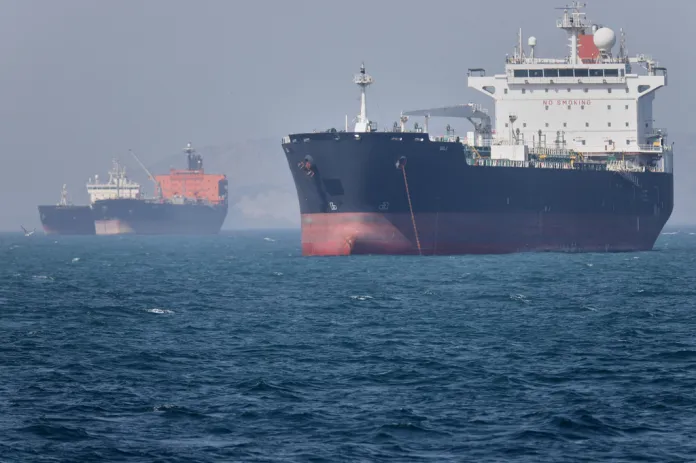
The U.S. would end its blockade as part of an agreement. Trump said, “Ships caught in the Strait due to our amazing and unprecedented Naval Blockade, which will now be lifted, may start the process of ‘heading home!’”
In several instances, Iranian forces fired drones or missiles at U.S. or commercial vessels that dared to try and sail through without meeting Iranian demands. U.S. troops have defended themselves and carried out retaliatory attacks, and this has occurred as recently as Monday.
“With the blockade, there are ships that maintain station, which means that they are in a constant general position — doesn’t necessarily mean they’re sitting in one place, but they are moving around in specific areas to maintain control of the blockade line. They may be rotating ships in and out of the blockade line using all of their systems, to include their eyeballs, to provide persistent surveillance of the waterway and, as necessary, take action to turn them around or stop them,” Votel said. “All of that, of course, is supported by air assets overhead, both manned and unmanned, that are contributing to that surveillance. There is a ground component as well, largely composed of Marines, who are stationed on vessels probably behind the picket line, and they are used to deploy by helicopter to go on these ships that are disabled to take control of them and bring them under control.”
Even though U.S. forces have severely degraded Iran’s air force, navy, its defense industrial base, and more, the geography of the area greatly benefits Tehran.
“The terrain on the Iranian side of the strait, more so than the terrain on the Emirati and Omani side, gives the IRGC a distinct advantage to control ships entering, transiting, and exiting the narrowest portion of the waterway,” Votel added.
If the strait were to open, it would provide financial relief for both sides, an effective return to where things were before the war.
COMMERCIAL TRACKING DATA BEING USED BY ADVERSARIES TO TARGET US TROOPS: CENTCOM
The subsequent negotiations over Iran’s nuclear program will be very difficult. The Iranians are in a stronger negotiating position after the war because the regime withstood all the U.S. was willing to throw at them and survived, Grieco argued.
“Iran is in a stronger negotiating position now on this because they’ve seen American military power and that they can survive it. That combined with the fact that, because there was a very clear attempt at regime change, Iran’s disincentivized from actually agreeing to a nuclear deal, I’d have to imagine that there are many voices inside the government that think that Iran should plan to push ahead with a nuclear program now. And of course we have a more hardened government coming out of this war, a more hardened extreme Iranian government, so I think it’s going to be hard to find an agreement on the nuclear issue,” she said.
