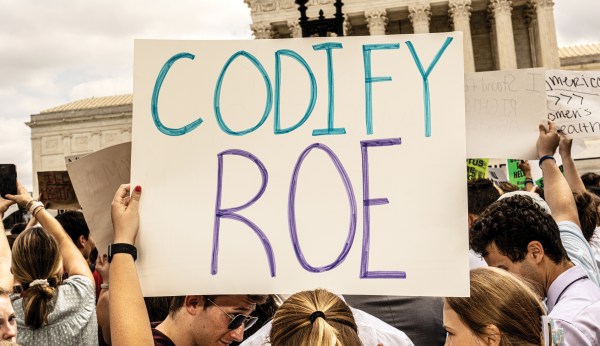
The 14th Amendment’s due process clause says no state shall deprive any person of life, liberty, or property without due process of law. It’s a procedural guarantee — it governs how the government takes something from you, not which rights you hold. That sentence, read in full, leaves no room for the doctrine that courts spent the 20th century building from it.
That doctrine is called substantive due process. It holds that the due process clause protects certain liberties so fundamental that the government can’t infringe them regardless of how fair the procedure is. The word “substantive” appears nowhere in the Constitution. Courts constructed the entire framework.
Recommended Stories

The Lochner era — roughly 1897 to 1937 — used this theory to strike down economic regulations. FDR’s court-packing pressure ended that era, but the methodology survived. Griswold v. Connecticut (1965) relocated it from economic liberty to personal privacy, finding a right to contraception in the “penumbras, formed by emanations” of the Bill of Rights. Justice Hugo Black’s dissent was right about the methodology. The majority were probably right about the result. Connecticut’s law was an absurdity. That gap between correct outcome and indefensible reasoning is why the doctrine has never achieved a stable footing.
Roe v. Wade (1973), Lawrence v. Texas (2003), and Obergefell v. Hodges (2015) each extended Griswold’s logic. Each used the 14th Amendment as a warrant for rights the Constitution doesn’t enumerate. Each was constitutionally fragile for the same reason: It depended entirely on the court’s willingness to maintain it.
Dobbs v. Jackson Women’s Health Organization (2022) proved this. The majority overruled Roe and Casey on the ground that the constitutional right Roe constructed had no basis in the text, structure, or history of the 14th Amendment. The test Justice Samuel Alito articulated — rights must be “deeply rooted in this Nation’s history and tradition” and “implicit in the concept of ordered liberty” — preserves Griswold, Lawrence, and Obergefell. Justice Clarence Thomas’s concurrence disagreed: If the methodology is wrong, applying it correctly in one case doesn’t fix the underlying problem.
I’m not a lawyer. I’m a financial practitioner with 30 years of experience watching what happens when legal frameworks rest on foundations that can’t bear the weight placed on them. Substantive due process rights are real in the sense that people have ordered their lives around them. They aren’t textually grounded, which means they’re only as durable as the current court’s composition.
LIBERAL LAW PROFESSOR MARK TUSHNET SHOULD’VE BEEN CAREFUL WHAT HE WISHED FOR
The resolution isn’t complicated. Rights the country wants to protect should be in the Constitution. The Respect for Marriage Act (2022) showed the way: Congress codified federal recognition of same-sex marriages through statute, creating a floor that doesn’t depend on the court’s constitutional holdings. For rights that require constitutional protection rather than statutory protection, Article V exists. The amendment process is hard. It was designed to be. What it produces is a settlement that doesn’t shift with every court appointment.
Dobbs didn’t close the substantive due process debate. It reopened it. The country has been governing the difference between a right and a ruling for 60 years without quite being willing to do the work the Constitution’s design requires.
Jay Rogers is a financial professional with more than 30 years of experience in private equity, private credit, hedge funds, and wealth management. He has a BS from Northeastern University and has completed postgraduate studies at UCLA, UPENN, and Harvard. He writes about issues in finance, constitutional law, national security, human nature, and public policy.