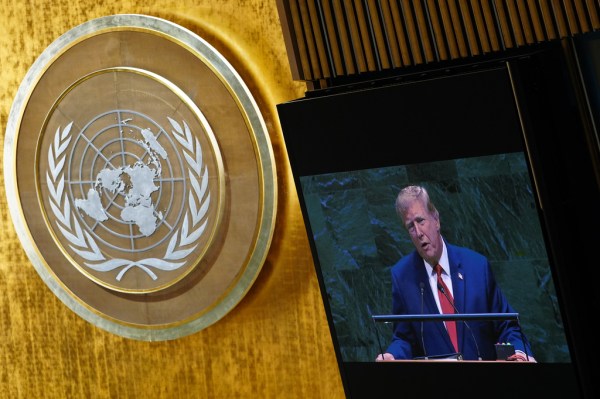
Before the year is out, the United Nations must appoint a new secretary-general. This is an opportunity to be seized, not a misfortune to be endured — precisely because multilateralism is navigating heavy headwinds.
The U.N. must rediscover its core mission: guardian of peace and provider of humanitarian relief at the intersection of national sovereignties. That means keeping its distance from the chimera of a world government lacking any democratic legitimacy, and from the dysfunctions of a bloated bureaucratic contraption. It is also the only way — the sole way, I believe — to open the path toward fairer representation within the U.N. system, and within the Security Council in particular.
Recommended Stories
A first step in that direction would be taken with the election of the candidate who, in my view, best embodies such a renewal of the United Nations: Macky Sall, former President of Senegal, a seasoned statesman known for his working method rather than strident rhetoric.
UNITED STATES SHOULD PULL THE PLUG ON UNRWA
As will be true of 1 in 4 human beings by century’s end, he is African. And on the continent — the cradle of humanity — it is customary to remember one’s roots.
The U.N. was born in the aftermath of World War II and its roughly 75 million dead, from the will of the victorious powers, who reserved for themselves a permanent seat on the Security Council and the right of veto.
It is this system — imperfect but realistic — that must be made to work as well as possible, both in the service of its member states and of the latest victims of violence, preventing conflicts wherever possible.
I am therefore puzzled by the current defeatism that declares the world “more polarized than ever” and the U.N. “utterly powerless.” During the Cold War, through the crises in the Congo, Korea, Cuba, and Vietnam, was the East-West world somehow not polarised?
Did the U.N. invariably succeed in keeping the peace?
And how can one lament the “return of war” while forgetting that, although a World War III was mercifully averted, numerous proxy wars were fought across the developing world, several of them in Africa?
Sall, a discreet mediator for many years — including in the conflict between Russia and Ukraine — is acutely aware of this.
Is multilateralism in crisis? Undoubtedly — but certainly not for the first time, nor always for the wrong reasons. “The nature of imbalance is to generate movement,” observed the French demographer Alfred Sauvy, who coined the term “Third World” in the early 1950s.
The Global South, as we say today, might draw from this the quiet assurance that by century’s end, a planet where 8 in 10 inhabitants will be, in equal measure, either Asian or African could no longer recognize itself in a distorting U.N. mirror — which, in the long run, is unthinkable.
Provided, of course, that the international institution is preserved.
And it can only be preserved by agreeing to reform itself motu proprio, on its own initiative. Only within a U.N. that takes efficiency seriously across all its missions will a seat at the table prove preferable — for all concerned — to the politics of the empty chair and the budget black hole.
Of this, too, Sall — accustomed to achieving much with little — is fully conscious.
Of course, it is “Latin America’s turn,” not all African states have rallied behind the candidate endorsed by the African Union, and Sall is not a woman. I speak all the more freely about these downsides because inter-continental rotation within world fora matters to me as a principle, because African unity would have been ideal, and because the representation of the better half of humanity is a vital imperative.
But I also know that Sall thinks as I do — and I need not take him at his word, since the actions he has taken throughout his career attest to his earnest commitment to sharing power equitably.
ISRAEL CUTS TIES WITH UN SECRETARY-GENERAL AFTER GUTERRES ADDED COUNTRY TO SEXUAL VIOLENCE BLACKLIST
With that conviction firmly held, I support his candidacy as a rallying point for all friends of the U.N.
Since the times are hard and the trials ahead — from widening inequality to the challenge of artificial intelligence, by way of a global crisis of representation — will require a steady and firm hand at the helm of the U.N., I simply wish, in the words of the arena: May the best man win.
Jean-Yves Ollivier is the chairman of the Brazzaville Foundation