

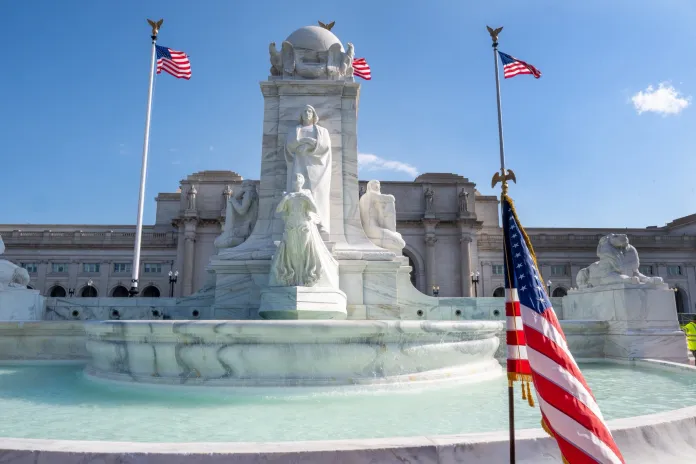
In the 1939 film Mr. Smith Goes to Washington, the idealistic young congressman’s first steps in Washington, D.C., are through the doors of Union Station, where he is greeted by the Columbus fountain and, beyond it, the Capitol dome.
That same fountain was renovated this year in the span of just five months, after sitting non-functional since 2007, nearly two decades and three presidencies later. It had been stained by graffiti, rusted by disuse, and battered by pigeon droppings. The landmark had become so unrecognizable that residents believed it was a statue, not a fountain.
Recommended Stories


Whatever one’s politics, one must admit the city is not just safer now but cleaner than in years past. The recent “Making DC Safe & Beautiful” initiative is restoring Columbus Circle, once defaced by protesters, and other monuments such as the Meridian Hill Park fountain and the World War II Memorial. One of the most extensive projects, resealing the National Mall’s reflecting pool, is expected to be completed before July 4.
As the nation’s capital, Washington’s marble mask is shining once again after decades of disrepair. It is only fitting that these repairs are made ahead of the country’s semiquincentennial, as Americans rush to celebrate our nation’s founding.
The United States is a young nation, but its instinct for preservation is ancient. The republic’s founders were steeped in Enlightenment philosophy, Roman civic memory, and Christian faith. But as Pierre L’Enfant, the French-born architect of the district, said, “No nation had ever before the opportunity offered them of deliberately deciding on the spot where their Capital City should be fixed.” Our capital is unique in that it was the first to be built from scratch, a destiny waiting to be etched into stone.
Those who argue the restoration of our monuments is impractical are not just factually wrong (these repairs remain within budget), but have allowed the country’s birthday to be twisted by partisan tendencies, ignoring the necessity of conserving our shared history.
The poem Ozymandias by Percy Shelley, husband of Mary Shelley, describes an empire long forgotten by time, with only a singular inscription bearing witness to it. Leaders pass, and kingdoms fall, but why should our monuments fall to ruin before our civilization does? Every nation has its moments of progress and duress, but the future of America remains ever-expanding, and so should the record of its definitive legacy.
The Biblical tradition says we are called to “fill the earth and subdue it,” joining in the work of creation in a way no other creature can. This includes the arts, preserving history, and building a legacy on this Earth that reflects the life of the world to come.
Thoreau once said, “The perception of beauty is a moral test.” If we ignore the importance of preserving our monuments and establishing new ones yet to come, we deny a part of our humanity. If we have no record of our past, we have no future.
It was only a few years ago that mobs tore down statues, erased records from museums, and turned reverence for the nation’s past into a cardinal sin. On this national anniversary, we must promise ourselves never to return to that state of ignorance.
MY 3-YEAR-OLD HAS STARTED YELLING AT E-BIKERS. I TAUGHT HER WELL
The Fountain of Youth was believed to have existed in modern-day Florida. If fountains represent life, why then should we let them run dry?
Our country is still in its adolescence. Let the fount flow.
Carly Moran is an associate at On Brand Strategies and the author of Exegesis Americana, a newsletter dedicated to the American Gen Z identity.