GOP attorneys general demand abortion pill water safety tests from EPA

GOP attorneys general demand abortion pill water safety tests from EPA

Published June 10, 2026 11:46am ET | Updated June 10, 2026 3:08pm ET


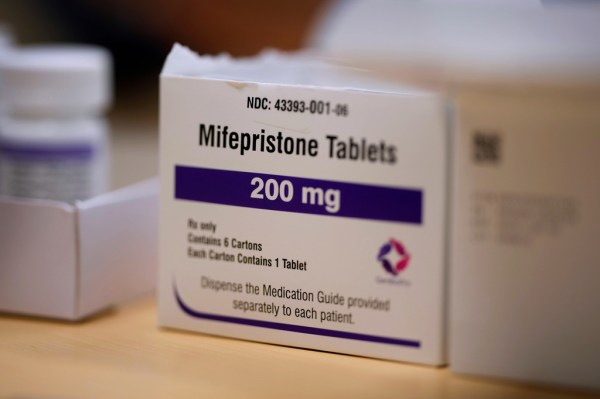
Fourteen Republican-led states are demanding that the Environmental Protection Agency increase scrutiny of at-home abortion drugs for wastewater contamination from at-home abortions.

The request, laid out in a letter sent Tuesday from 14 attorneys general, marks the most significant effort in advancing the theory posed by hard-line anti-abortion advocates that self-managed abortions using the abortion pill mifepristone could be contaminating drinking water and in violation of the Safe Drinking Water Act. 

Missouri’s Republican Attorney General Catherine Hanaway and her 13 colleagues requested that the EPA add mifepristone to other pharmaceuticals listed in the agency’s Contaminant Candidate List. Chemicals on the list are not subject to a legal maximum contaminant level, but they may be subject to monitoring or under consideration for regulation. 

“As mifepristone’s use is now at an all-time high, its inclusion on the CCL is a logical step to further investigate the impact of its newfound prevalence on the public health,” the attorneys general wrote. 

Mifepristone, which is used in roughly two-thirds of abortions in the United States, is the first pill used in a two-drug medication abortion regimen and has become a flashpoint in the abortion debate since the Supreme Court overturned Roe v. Wade in 2022.

Anti-abortion advocates have argued that the Food and Drug Administration’s 2023 decision to remove in-person screening requirements for obtaining mifepristone has created a saturated online market for abortion pills, even in Republican-led states with strict anti-abortion laws.

Abortion policy experts attribute the slight rise in abortions, to a total of 1.1 million in 2025, since the overturning of Roe, to online abortion pill sales. 

Most of these abortions are managed at home by the patient directly. This results in waste from the abortion, including the pregnancy tissue and any chemical residue, being flushed down the drain or commode.

“Conventional wastewater treatment is not designed to remove these type of contaminants, so there is strong reason to conclude that the compounds persist in both the environment and the water supply,” wrote the attorneys general.

Mifepristone blocks progesterone, a hormone necessary for keeping the embryo or fetus alive in the womb. Within 24 to 48 hours of taking mifepristone, a patient is instructed to take four pills of misoprostol to induce contractions to expel the pregnancy tissue. 

The attorneys general wrote that, in theory, “if mifepristone reaches sufficient concentration, pregnant women who unintentionally ingest the drug through the public water supply could be at greater risk of health complications than the general population.”

Attorneys general from Alabama, Idaho, Nebraska, Alaska, Indiana, Oklahoma, Arkansas, Kansas, South Carolina, Florida, Kentucky, Texas, and Louisiana also signed onto the letter.

The letter comes after the EPA on April 2 announced it would be conducting sweeping changes to add hundreds more medications to its Contaminant Candidate List, including antidepressants.

A spokesperson for the EPA told the Washington Examiner after initial publication that the agency “takes the issues of pharmaceuticals in our water system seriously and employs a rigorous, science-based approach to protect human health and the environment.” 

The spokesperson added that stakeholders have the opportunity to comment on the new list of 374 new pharmaceuticals to be added to the Contaminant Candidate List, as the attorneys general exercised on Tuesday.

Zeldin told the Daily Signal in May that, although mifepristone is not being monitored, misoprostol is included among the pharmaceuticals that were added to the list this spring.

Being added to the Contaminant Candidate List also signals to scientists and public health experts that they should take health concerns more seriously as part of their research. 

So far, there has only been limited research from the environmental health experts to suggest that exposure to mifepristone metabolites, or the chemical byproducts from the drug pose a threat of hormone disruption for humans and other mammals. 

But the anti-abortion advocacy group Students for Life of America has been pressing the FDA and EPA for several years to conduct more rigorous environmental impact studies for the drug. 

Since 2022, Students for Life has filed five citizen petitions with the FDA requesting the agency to mandate catch-kits for medical waste with each mifepristone prescription to prevent wastewater contamination. 

Kristan Hawkins, Students for Life president, previously told the Washington Examiner that her organization has conducted a study of wastewater pre-and post-treatment that indicates there are high levels of progesterone-disrupting chemicals in drinking water that can only come from at-home abortions. 

PRO-LIFE ACTIVISITS SKEPTICAL OF FDA ABORTION PILL STUDY

Hawkins said on X last month that including misoprostol on the list contaminant list is a “great start,” but incomplete. 

“It’s like folks at the EPA are having brain fog from drinking all of the chemicals in our water,” Hawkins said. 

The Washington Examiner contacted the EPA for comment.