

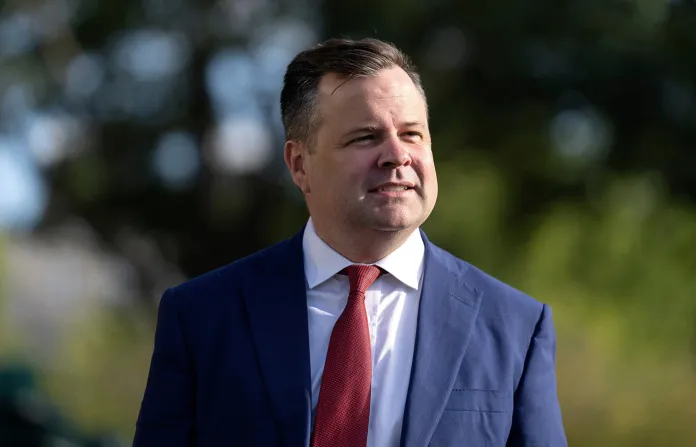
President Donald Trump’s appointment of Bill Pulte to be acting director of the Office of National Intelligence may well spell the beginning of the end for the agency that was created as a direct response to the terrorist attacks of Sept. 11, 2001.
Recommended Stories


Pulte — a successful money market manager who worked in his family’s residential home building business — is, by bipartisan consensus, eminently unqualified for the job as the nation’s top spymaster. Which by statute requires the position to be filled only by someone with “extensive national security expertise.”
Pulte likely won’t be on the job long once he takes over on an interim basis on June 19 from Tulsi Gabbard, former congresswoman and retired Army Reserve lieutenant colonel. Trump said on June 11 he will nominate Jay Clayton, U.S. attorney for the Southern District of New York, to be Gabbard’s permanent replacement. Clayton was chairman of the Securities and Exchange Commission for much of Trump’s first, nonconsecutive term.
But having Pulte in the intelligence chief’s role for even a short time reflects Trump’s low opinion of the job. And foreshadows the likely demise of ODNI.
Pulte is just the latest in a string of underqualified directors that signal Trump’s contempt for the office, which, not unlike the position of national security adviser, Trump has demonstrated he can do without.
Gabbard’s appointment reflected Trump’s deep antipathy toward what’s known as the IC, the 18 separate agencies that make up the “intelligence community” as a whole.
Trump treated Gabbard as a figurehead, rather than someone he relied on for crucial intelligence, even though, paradoxically, it was Trump in his first administration that made the DNI a Cabinet-level position.
Despite her job description as “head of the U.S. Intelligence Community” and “principal adviser to the President,” Gabbard was deliberately excluded from the planning of the mission to capture Venezuelan strongman Nicolas Maduro. And also left out military planning for the Iran war, which was based on Trump’s gut feeling that the threat of a nuclear-armed Islamic Republic was “imminent.”
Gabbard was sidelined to the extent that the inside joke at the White House was that DNI stood for “Do Not Invite.”
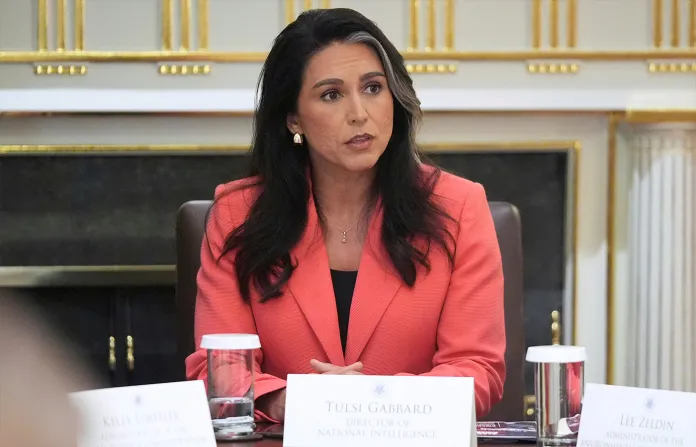
In 2025, Gabbard testified before the Senate Intelligence Committee that “The IC continues to assess that Iran is not building a nuclear weapon and Supreme Leader Khamenei has not authorized the nuclear weapons program that he suspended in 2003.”
The assessment — the consensus of the Intelligence Community — remained unchanged this year. But Gabbard omitted that from her oral testimony, which Democrats suspected was because it directly contradicted Trump’s public claims of an “imminent threat” from Iran.
Sen. Mark Warner (D-VA), the Intelligence Committee’s vice chairman, questioned the omission. He noted Gabbard’s written testimony stated: “Iran’s nuclear enrichment program was obliterated; there have been no efforts to try to rebuild their enrichment capability.”
“Time was running long, and I skipped through some of the portions of my oral delivered remark,” Gabbard said, by way of explanation.
Trump expressed shock and surprise that after the U.S. bombed Iran for 29 days, Iran attacked U.S. allies in the Gulf and closed the Strait of Hormuz.
Wasn’t Trump warned? Warner asked.
“I think those of us here at the table can point to the fact that, historically, the Iranians have always threatened to leverage their control over the Strait of Hormuz,” Gabbard said.
Department created in a crisis atmosphere
The Office of the Director of National Intelligence was set up after a massive intelligence lapse in 2001 — the failure of the 18 U.S. intelligence agencies, including the CIA, the DIA, the NSA, and more than a dozen others, to connect the dots showing that Islamic terrorists were plotting to hijack commercial airliners and fly them into buildings.
“It was recognized that the intelligence failures led to 9/11 and our inability to anticipate the attack and thwart the attack, because the intelligence community members weren’t talking to each other,” said retired Rear Adm. James McPherson, who served as acting DNI during Trump’s first term. “They weren’t coordinating. They weren’t communicating, and that needed to stop.”
The 2004 report of the “National Commission on Terrorist Attacks Upon the United States,” better known as the 9/11 Commission report, called for the creation of a National Intelligence director who would “provide all-source analysis in their areas of responsibility, balancing the advice of these intelligence chiefs against the contrasting viewpoints that may be offered by department heads at State, Defense, Homeland Security, Justice, and other agencies.”
“They needed to have an overarching authority of the 18 members of the intelligence community that could direct their actions, that could direct that they speak to each other and put the puzzle pieces together,” McPherson said.
But instead of serving as Trump’s point person on intelligence, Gabbard was relegated to doing personal favors for the president. Including things outside the normal purview of the DNI, such as overseeing the FBI search and seizure of voter rolls in Georgia, looking for evidence of interference in the 2020 election that Trump claimed was rigged.
“If we were playing poker, Jake, that would be a tell,” said McPherson, who also served as acting Navy secretary during Trump’s first term. “I think that the former DNI, Ms. Gabbard, was down there for a reason. And the reason was to create an argument that there is a foreign influence in the election in November.
“That’s dangerous, and I think it undermines the integrity of the election,” McPherson said, calling it a “grave concern that the DNI was down there involved in that.”
Trump said he is still looking for “a permanent nominee with experience in national security,’ while counting on Pulte for the next six months to bury the agency, not to save it.
‘[I] have asked him to execute the immediate and needed downsizing of the office, reverting staff to their home agencies,” Trump said in a Truth Social post on June 10.
Trump has so neutered the once-preeminent post that many Republicans are ready to shutter it permanently.
“I think some of my Democratic colleagues are trying to make it sound like this is the point of all gathering of information for intelligence. It’s not,” Sen. James Lankford (R-OK) said in a recent appearance on Fox News Sunday. “It is a bureaucratic entity. By the way, there is a wide perspective to be able to get rid of it entirely because it literally slows down the intelligence gathering across all of our intelligence agencies.”
Lankford will get no disagreement from Sen. Tom Cotton (R-AR), who argues it’s high time to downsize the ODNI. Which, similar to Trump, he sees as an outdated, bloated bureaucracy.
“I look forward to implementing last year’s Intelligence Authorization Act … to implement wide-ranging reforms that will shrink the DNI and take it back to its original intent to provide a mere coordinator or process role for the intelligence community.”
Democrats see nothing but a license for Pulte to engage in mischief on behalf of the president, as they claim he did in his current job as director of the FHFA. A job, by the way, he would hold concurrently, and presumably return to after his temporary stint as DNI.
“The only thing that might qualify him in the eyes of Donald Trump is his enthusiasm for going after his perceived political enemies, something he has done in his role as the head of the mortgage financing agency,” said Sen. Chris Coons (D-DE), an ardent critic of the president.
While at the FHFA, Pulte has alleged — to the delight of his boss — that Trump foes New York Attorney General Letitia James, Sen. Adam Schiff (D-CA), Federal Reserve Governor Lisa Cook, and former Rep. Eric Swalwell, a California Democrat, all committed mortgage fraud.
Congressional Democrats are staging a fight to force the appointment of someone with bona fide credentials to lead America’s premier spy agency. They’re threatening to block reauthorization of Section 702 of the Foreign Intelligence Surveillance Act, which would possibly hamper the federal government’s ability to monitor foreign threats.
“We had bipartisan agreements. This is always controversial,” the committee’s Vice Chairman Warner said. “And then Donald Trump throws a live grenade by appointing somebody who’s got no intelligence experience, whose only record in public life has been willing to disclose private mortgage information.
“My Republican colleagues on this one have been great,” Warner said on CNN. “They have hung in, trying to push the president that this is not going to work. My fear is that the intelligence reauthorization of 702 will lag. And the full responsibility lies with Donald Trump.
MELANIA TRUMP FORGES HER OWN PATH IN TRUMP’S SECOND TERM
“This guy is currently the head of the mortgage regulatory agencies,” Warner said. “He’s going to make him also head of the intelligence community, 18 different agencies.
“What could go wrong if you give the guy the keys to these 18 agencies?”
Jamie McIntyre (@jamiejmcintyre) is the Washington Examiner‘s senior writer on national security.
