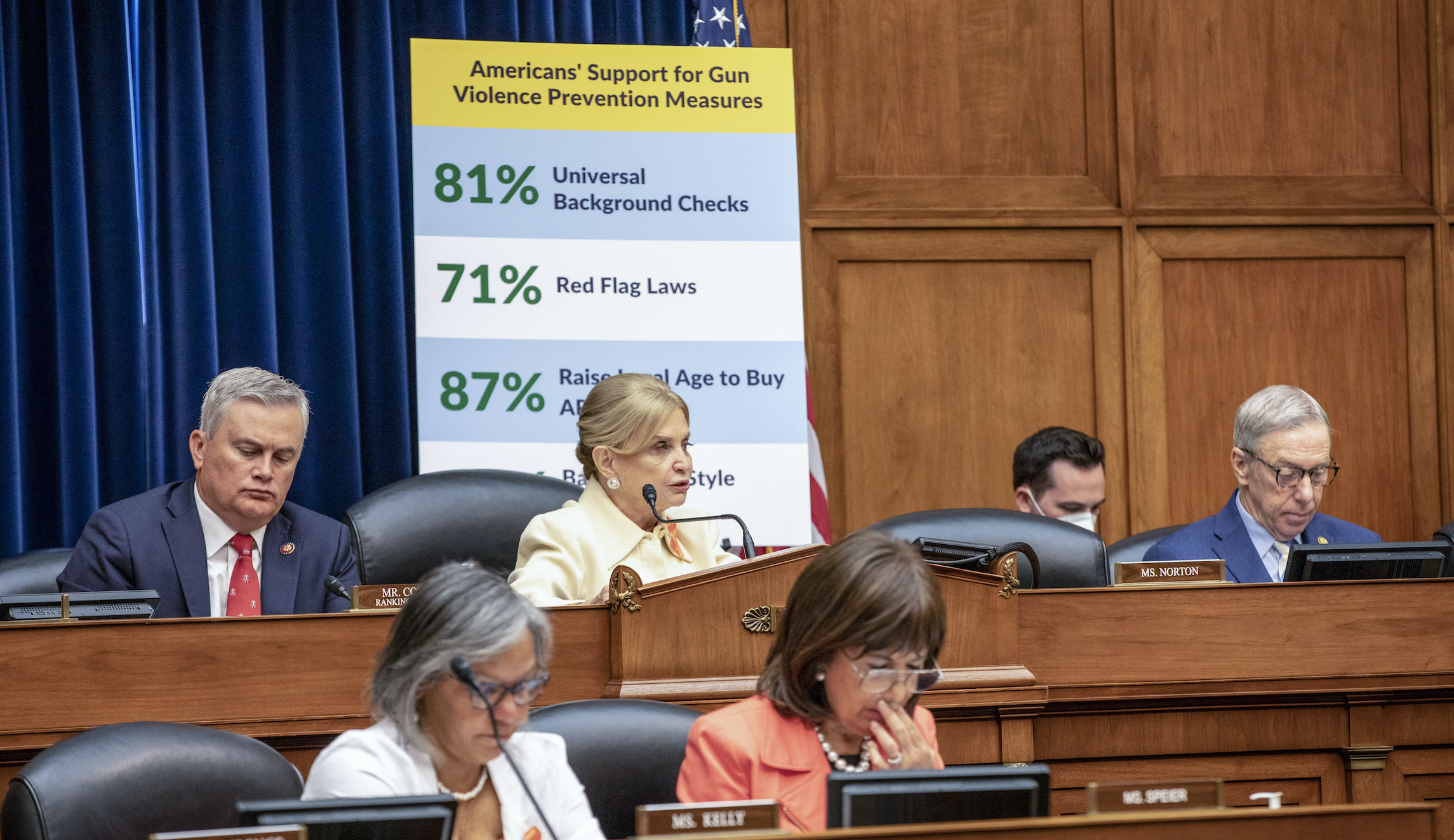
A House hearing on gun violence Wednesday featured emotional testimony from survivors of recent mass shootings and the family members of victims, as well as tense partisan exchanges regarding gun policy.
The hearing took place the same day the House considered a raft of legislation that would raise the required purchasing age for semi-automatic weapons from 18 to 21 and ban high-capacity magazines and bump stocks for civilian use, as well as other new restrictions. The bill, which will likely pass the House, is unlikely to be approved by the Senate.
MIAH CERRILLO, FOURTH GRADER FROM UVALDE, TESTIFIES IN HOUSE HEARING ON GUN VIOLENCE
The Committee on Oversight and Reform hearing was divided into two panels, one featuring survivors or victims’ families and one featuring activists or policy witnesses.
In an opening statement, Rep. Carolyn Maloney (D-NY), chairwoman of the committee, told members she wanted them to “listen with an open heart to the brave witnesses who have come forward to tell their stories about how gun violence has impacted their lives.”
“Our witnesses today have endured pain and loss,” Maloney said. “Yet they are displaying incredible courage by coming here to ask us to do our jobs. Let us hear their voices. Let us honor their courage. And let us find the same courage to pass commonsense laws to protect our children.”
Rep. James Comer (R-KY), ranking member of the committee, told the witnesses that “the American people grieve with you” after the attacks. He argued that “Americans of all backgrounds should be empowered to defend themselves against rising violence.
UVALDE CONGRESSIONAL HEARING AS IT HAPPENED
“Our Second Amendment is an important tool in securing our individual rights to self-defense,” Comer continued. “Knee-jerk reactions to impose gun control policies that seek to curtail our constitutional right to bear arms are not the answer.”
Among the witnesses was Miah Cerrillo, a fourth grade student who survived the shooting at her Uvalde, Texas, elementary school last month, who told lawmakers she no longer feels safe going to school. Cerrillo testified via video, but was represented by her father, who attended in person, holding back tears as he told lawmakers that he “could have lost my baby girl.”
Kimberly Mata-Rubio, mother of Lexi Rubio, one of the 19 children who died in the Uvalde shooting, testified via video that her daughter was recognized in a school award ceremony the morning of the shooting and that she had promised to take her out for ice cream that evening in recognition of receiving all A’s, but she never got the chance.
“Somewhere out there, a mom is hearing our testimony and thinking to herself, ‘I can’t even imagine their pain,’ not knowing that our reality will one day be hers unless we act now,” Mata-Rubio said while sitting alongside her husband, Felix.
Zeneta Everhart, the mother of Zaire Goodman, who was injured in a mass shooting at a Buffalo, New York, grocery store that authorities said was racially motivated, told the committee that her son will live with bullet fragments in his body for the rest of his life.
“If after hearing from me and the other people testifying here today does not move you to act on gun laws, I invite you to my home to help me to clean Zaire’s wounds so that you may see up close the damage that has been caused to my son and my community,” she said.
None of the survivors’ or victims’ families were questioned by lawmakers, and they departed for the second panel, setting the stage for more partisan and tense exchanges in the following round.
Rep. Andy Biggs (R-AZ) called it “egregious” that Democrats on the committee had Cerrillo, 11, testify, arguing her inclusion made “that poor little girl relive this.” Some Democrats took umbrage at the suggestion the witness was being used as a political prop, arguing she deserved to have her story considered by lawmakers.
Rep. Katie Porter (D-CA) clashed with Heritage Foundation legal fellow Amy Swearer, a witness invited by Republicans on the committee, questioning her previous congressional testimony and arguing that her testimony on a prior bill was false. Swearer said she wanted to address that charge, and the witness and lawmaker continued to interrupt one another as Swearer said Porter wouldn’t let her explain.
Porter then referenced Swearer’s opening statement, in which she said she hoped to never again testify before Congress in the context of the aftermath of a mass shooting.
“Earlier today, you testified that you hope that this was the last time you testify before Congress,” Porter said. “For the sake of our nation and integrity of this Congress, I do too.”
“I said after a mass shooting trying to figure out how to solve a problem that we are all heavily invested in solving,” Swearer interjected as the two talked over one another again. “How dare you?” she added.
“How dare you misstate the law?” Porter replied.
New York City Mayor Eric Adams (D) was among the second round of witnesses. He argued that due to what he called permissive gun laws, “it is high noon in America.”
“Time for every one of us to decide where we stand on the issue of gun violence,” Adams said. “Time to decide if it is more important to protect the profits of gun manufacturers or the lives of our children. Time to decide if we are going to be a nation of laws or a confederation of chaos. And we must do it now.”
Adams, citing his experience as mayor of the largest city in the United States and as a former police officer, argued in favor of House Democrats’ legislation, calling it “commonsense gun reform.”
Maloney closed the hearing by saying members would then go to the floor “to vote for gun safety.”
The House is expected to approve the raft of legislation Wednesday evening that proponents say will reduce gun violence, but that legislation faces difficult odds in the Senate. Opponents say other school safety measures and mental health resources should be prioritized instead of firearm restrictions they argue would limit gun rights for law-abiding citizens.
CLICK HERE TO READ MORE FROM THE WASHINGTON EXAMINER
Republicans in the upper chamber are unlikely to support as broad a measure as the one passed by the House. Due to their razor-thin majority, Senate Democratic leadership would need to win at least 10 Republican votes to clear the 60-vote filibuster and pass any gun bills.
Bipartisan negotiations on gun legislation continue in the Senate, where some Republicans have indicated they would support incentivizing states to pass red flag laws or enhance background checks.
