
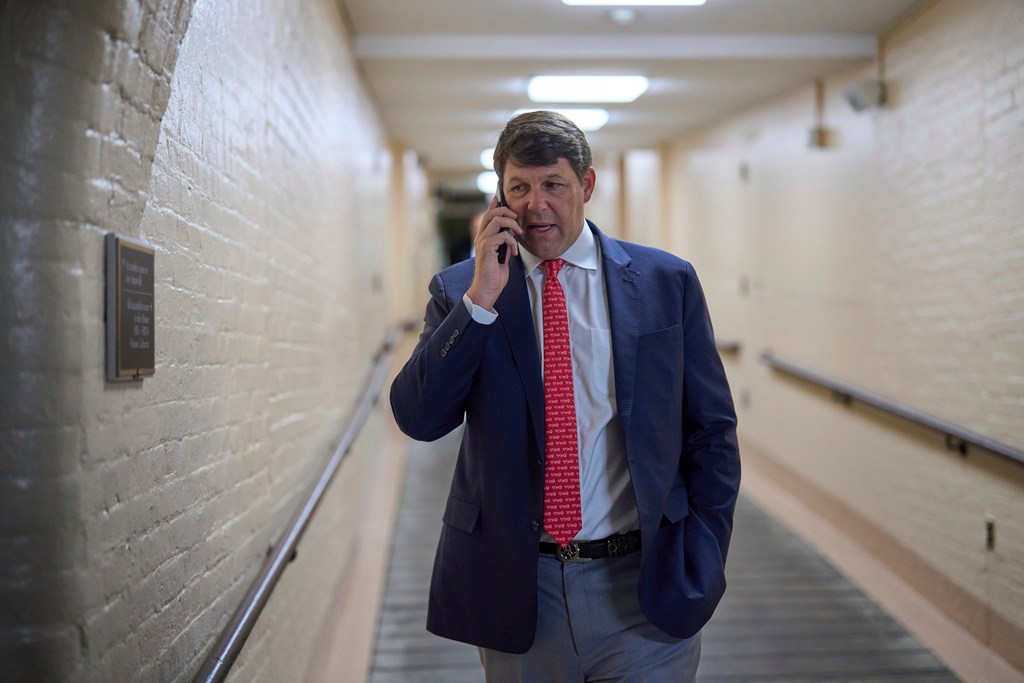
House Speaker Mike Johnson (R-LA) is set to meet with House Budget Committee Republicans on Wednesday, an important meeting that comes as Republicans race against the clock to advance a third party-line spending bill.
Republicans have only seven working days left before the House leaves for a weeklong 4th of July recess. Upon the House’s return on July 13, Republicans will only have eight days before Congress’s scheduled monthlong August recess.
Recommended Stories
“I think we’re getting closer to a final decision,” House Budget Committee Chairman Jodey Arrington (R-TX) told reporters. “And then we got to mark this, we got to mark it up.”
Arrington said he hopes to have a framework for the GOP’s third reconciliation bill out before the House leaves on July 2, an ambitious timeline as Republicans face a dwindling legislative calendar.
“I think we could, because these guys don’t remember; this is not the big, beautiful bill,” Arrington said, referring to GOP concerns that putting together a third reconciliation package would take too much time.
Senate Republicans have been cool towards talk of a third party-line measure, with Sen. Mitch McConnell (R-KY) saying earlier this month, “it’s safe to conclude there will not be another reconciliation bill.”
But House Republicans have pushed on with efforts to assemble a third budget bill despite the Senate GOP’s skepticism. Republican Main Street Caucus Chairman Mike Flood (R-NE) told the Washington Examiner that he is hopeful Republicans can complete the budget bill, but said he doesn’t like the comments he has heard from the Senate.
“We need to do a couple of things, one of which, and most importantly, is to fund our military and replenish our munitions,” Flood said. “I’d love to work on some of the fraud issues that are present, but I think there’s a will in the House. I’d like to see more enthusiasm in the Senate.”
Part of the debate House Republicans are having is what spending would need to be cut in order to offset spending for a third reconciliation package, with Arrington saying “everything’s on the table right now.”
Republicans have claimed that cracking down on alleged fraud in Medicaid, Medicare, and other social programs could give them the offsets needed for a third budget bill. However, Arrington conceded that cutting more spending for certain welfare programs could divide Republicans ahead of the November elections.
“It’s not an exercise in what the budget committee wants or what the budget chairman wants,” Arrington said. “Everybody has to feel good about it, and, and that, that includes members that have different political sensitivities than I do in my Ruby Red West Texas district, and that’s a reality I embrace.”
House Budget member Rep. Ben Cline (R-VA) told the Washington Examiner that he is “excited about the possibilities” of pursuing a third reconciliation bill, saying, “It’s my hope that we can find a path to a third reconciliation bill.”
“There’s so much that has to be undone from the wreckage of the last administration, the damage that was done to working families during the Biden administration, being able to set our spending on a course to fiscal responsibility, while making sure that Americans keep more of their hard-earned money in their pockets, instead of handing it over to a ineffective bureaucracy that that hinders more than it helps,” Cline said.
Another major crossroad Republicans will have to face is whether to include parts of the GOP’s voter ID immigration bill, which has stalled in the Senate, because it has been unable to overcome the 60-vote filibuster. Known as the SAVE America Act, the legislation has been a sore point between the House and the Senate, with several House members pledging to vote against any legislation sent over by the Senate until the upper chamber passes the bill.
One potential avenue for Republicans to attach voter ID to a third proposed party-line spending bill, is the House Administration Committee’s Voter ID Act, introduced by Chairman Bryan Steil (R-WI) last week. The legislation would require voters to show a photo ID when casting a ballot in a federal election and create a new grant program for states that provide IDs at no cost to those who cannot afford one.
Including the measure in a third reconciliation bill would allow Republicans to sidestep the filibuster. It’s unclear whether the language would pass the Byrd requirement — which governs policies allowed in reconciliation bills — in the Senate in its current form. But the inclusion of the grant program would create a budgetary impact, one of the measures by which reconciliation is governed.
“I think we should do as much of the Save America Act as we can,” Arrington told the Washington Examiner, saying that Republicans would need to use incentive grant monies to make it Byrd-compliant. “Look, it’s not as powerful of a policy tool to do it the way we would need to do it for it to pass muster on budget reconciliation, but I think it’s a good start.”
TRUMP ENDORSEMENT TRACKER: HERE’S WHO THE PRESIDENT HAS PICKED IN GOP MIDTERM ELECTION PRIMARIES
Arrington said that the House Administration’s legislation would be the framework that Republicans would have to include a voter ID requirement for it to “pass muster,” noting it would still have to be reviewed by the Senate parliamentarian.
By including aspects of the SAVE America Act, Arrington said he believes it will “help us get the consensus needed to pass it out of the House, and I would think it’d be even more popular in the Senate, because they’re having a tough time with making the call on whether they should do a standing filibuster or do away with the filibuster, put it on the floor just for a vote.”
Arrington continued, “I mean, so having it already in the House coming over, maybe it provides a little bit of a release valve for the Senate.”
