

Kelly Neidert was painfully familiar with the Elm Fork John Brown Gun Club well before it was linked to a terrorist attack.
The University of North Texas graduate, now head of Texas Coalition for Kids, built a reputation around the college town of Denton as an activist leading protests against LGBT events for children. The Elm Fork John Brown Gun Club’s members spent years trying to crash her events with rowdy protesters and confronting her in their masks, black uniforms, and rifles, she recalled to the Washington Examiner. She first encountered them in October 2021 after the gun club encouraged people online to disrupt her “christo-fascist” vigil against abortion, showed up with a mob that yelled obscenities, and prompted university police to escort her away, she said.
Recommended Stories



“They all came up to me and surrounded me, and they all had on their masks, of course, and they had their guns, and it was very scary,” Neidert said, remembering another local incident in 2024 where she tried filming an event they protected.
“I don’t know that they, in broad daylight, would have harmed me, actively harmed me, but they were definitely making it clear that I needed to leave and … they flat out told me to my face I was not safe there,” she told the Washington Examiner. Neidert gradually recognized and identified some gun club members through the years, including a leading figure named Benjamin Song, as the group drew increasing media attention.
Now, Song and fifteen others are in prison over a fiery July 4, 2025, nighttime attack on an Alvarado immigration facility in which Song shot a police officer from nearby woods, nearly killing him. The last federal defendant was sentenced this week in the case, which put members of multiple leftist groups behind bars. Jurors convicted Song in March of attempted murder of a public official, material support for terrorism, riot, and explosives and gun charges, and he received the harshest sentence of all the participants at 100 years.
Song’s journey from activist to terrorist leader was years in the making. He and his openly “insurrectionist” gun club received support via sympathetic media coverage and allies, legal help from his father, funding and digital tools from international groups, and codefendants who hid him for 11 days after the officer’s near-death injury, until a SWAT team detained him at an associate’s Dallas apartment. The Trump administration’s successful case against Song’s “antifa cell” represents a key victory in its crackdown on leftist political violence, a threat repeatedly downplayed by Democratic politicians.

Tailim Song, identified in multiple reports as Benjamin’s father and defense attorney, did not respond to the Washington Examiner‘s requests for comment. The younger Song appealed his sentence and showed no remorse in a June statement, claiming he shot the Alvarado cop to stop him from aiming a gun at a comrade.
“Nothing saddens me more than when I think about all of these different people and their different families and communities, and how they have suffered, and how unfairly they have been treated, just like me,” he said.
How the gun club ‘fell together’
Authorities nearly had a chance to stop Song’s risky behavior six years ago.
Song was a Marine reservist from about 2011 to 2016, but received an “other than honorable discharge,” according to records in his federal case. The Dallas resident was later arrested at a 2020 Black Lives Matter protest in Austin after police officers asked him and other protesters to clear a road, KXAN reported. With a rifle slung over his chest, Song refused arrest, allegedly aimed the weapon at two officers, and ran into a crowd before being caught.
“We were able to get him out of jail (thank you to the org he was with while there) but now we are hoping to raise funds for his attorney,” a self-described friend of Song’s wrote on an August 2020 GoFundMe page for him. The post described Song as formerly partnered with Republican and Libertarian Party groups and a member of the Socialist Rifle Association.
Travis County prosecutors failed to convince grand jurors to indict Song on aggravated assault charges, court records show. He does not appear in Texas’s public convictions database.
Song’s Elm Fork John Brown Gun Club made headlines over the next few years as a so-called “community defense” group guarding LGBT people or protesting conservatives across North Texas. Liberal outlets wrote positively about its “armed antifascist protection.”
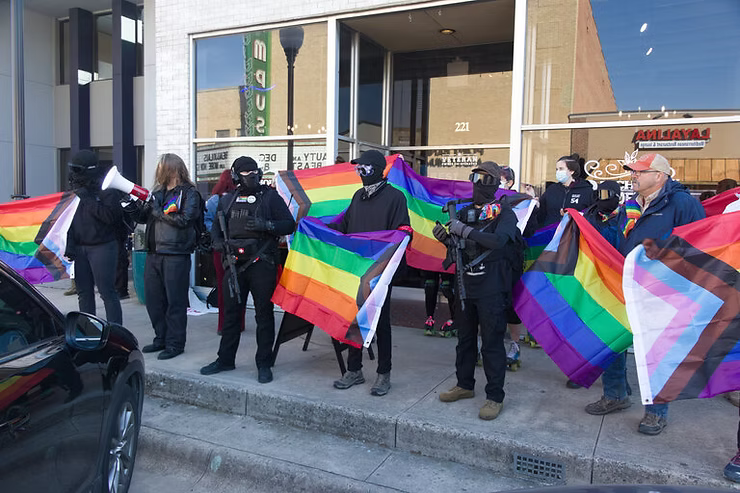
The group “just kind of fell together” after the founders met at events such as 2020 BLM marches, a gun club member nicknamed “Tex” said in a friendly June 2023 interview with a Second Amendment-themed podcast.
Another Elm Fork John Brown Gun Club speaker on the podcast called himself “Bubble” — an alias Song used, according to trial notes from a support group created for the antifa defendants. The guest’s voice resembled Song’s from archived footage of his firearm training unearthed by journalist Andy Ngo.
“Bubble” lamented on the podcast that “being very outspoken about right-wing politics” can be “legitimately threatening to a lot of people.”
“It’s not just a political disagreement if you’re saying, ‘Women should stay in the kitchen’ or something like that,” the Elm Fork John Brown Gun Club member said. “That’s a statement about someone trying to control your life and your opportunities and things like that.”
The speaker floated the idea that armed pushback might become necessary.
“If you look at history, most genocides happen when one group is relatively disarmed,” he said.
“We’re not necessarily opposed to property damage,” he told the hosts during another portion. “If it’s like, ‘Keep this Starbucks out of my neighborhood,’ I don’t find that objectionable.”
‘The insurrectionist generation’
The national John Brown Gun Club is named after a Civil War-era abolitionist who led a violent anti-slavery revolt. It is not clear if Song’s Elm Fork chapter had an official leader or whether it still functions after the Department of Justice dismantled Song’s antifa cell. Anonymity was key to its operations as masked gunmen in black clashed with protesters and police.
The Elm Fork John Brown Gun Club’s website uses a domain from NoBlogs, an anonymous web service that the Italy-based Autistici/Inventati Collective offers to help leftist activists post publicly while hiding identifying data from authorities.
“Without us, this state is nothing. We outnumber them,” the club’s website boasted in 2022. “We are the only ones giving them power. We can take just as quickly as we can give. And we will take just as quickly as we gave. We are the insurrectionist generation.”

Prosecutors were clear about Song’s leadership role in the informal group that attacked the immigration facility, saying he provided guns and gave firearms and combat training. Codefendant Seth Sikes, who pleaded guilty to a terrorism charge and testified for the government, told jurors that he met Song and seven other codefendants at a 2024 self-defense class and later joined Song at shooting ranges as a Socialist Rifle Association member, KERA reported. The trial never firmly established how many defendants belonged to the Elm Fork John Brown Gun Club, though sources told The Washington Post there were more than just Song.
The gun club partnered with groups in Texas and beyond on activist-oriented events, including the Socialist Rifle Association’s now-defunct Dallas-Fort Worth chapter, Denton Left, and Armed Queers Salt Lake City in Utah. “@EFJBGC provided pepper spray and stun guns for free, and educated [folks] on how to safely use them,” Dallas-Fort Worth Socialist Riffle Association said in a June 2021 X post about a joint event. The global group Antifa International also sold EFJBGC-themed shirts online in 2022 to help the group pay for “tent-safe heaters, food & hygiene supply distribution, & teaching/training vulnerable community members safe firearms skills.”
Prosecutors included an internal Socialist Rifle Association “roster” as further evidence tying the defendants to leftist organizing. The Socialist Rifle Association did not respond to the Washington Examiner‘s request for comment.
Legal troubles started brewing for the Elm Fork John Brown Gun Club after black-clothed activists were seen on camera allegedly spraying pepper spray on Christian protesters and tussling with police in April 2023. The incident prompted a yearslong civil case against Song and the EFJBGC and criminal charges against other gun club members.
Tailim Song represented his son in the civil case, court records show. Antifa International donated more than $4,000 to the arrestees in the criminal case and more money to counter the lawsuit, the Washington Examiner previously reported.
Neidert thinks more Elm Fork John Brown Gun Club arrests could have been made, but police did not act even when she filed reports, she told the Washington Examiner. “They would literally just come up to us and push us and the police wouldn’t care,” she said. Neidert remembered being unsurprised upon hearing about the July 2025 riot Song led, which involved fireworks, vandalism, and gunshots.
ANARCHIST WEBSITE TURNS FROM FAR-LEFT TOOL TO EVIDENCE IN DOJ INVESTIGATION
The DOJ critics who claim prosecutors unfairly punished the convicts for a peaceful protest gone wrong do not understand Song’s network, Neidert told the Washington Examiner.
“Even before this event, they made it very clear that they were willing to cross the line between peacefully protesting and breaking the law to get their point across,” she said.
