

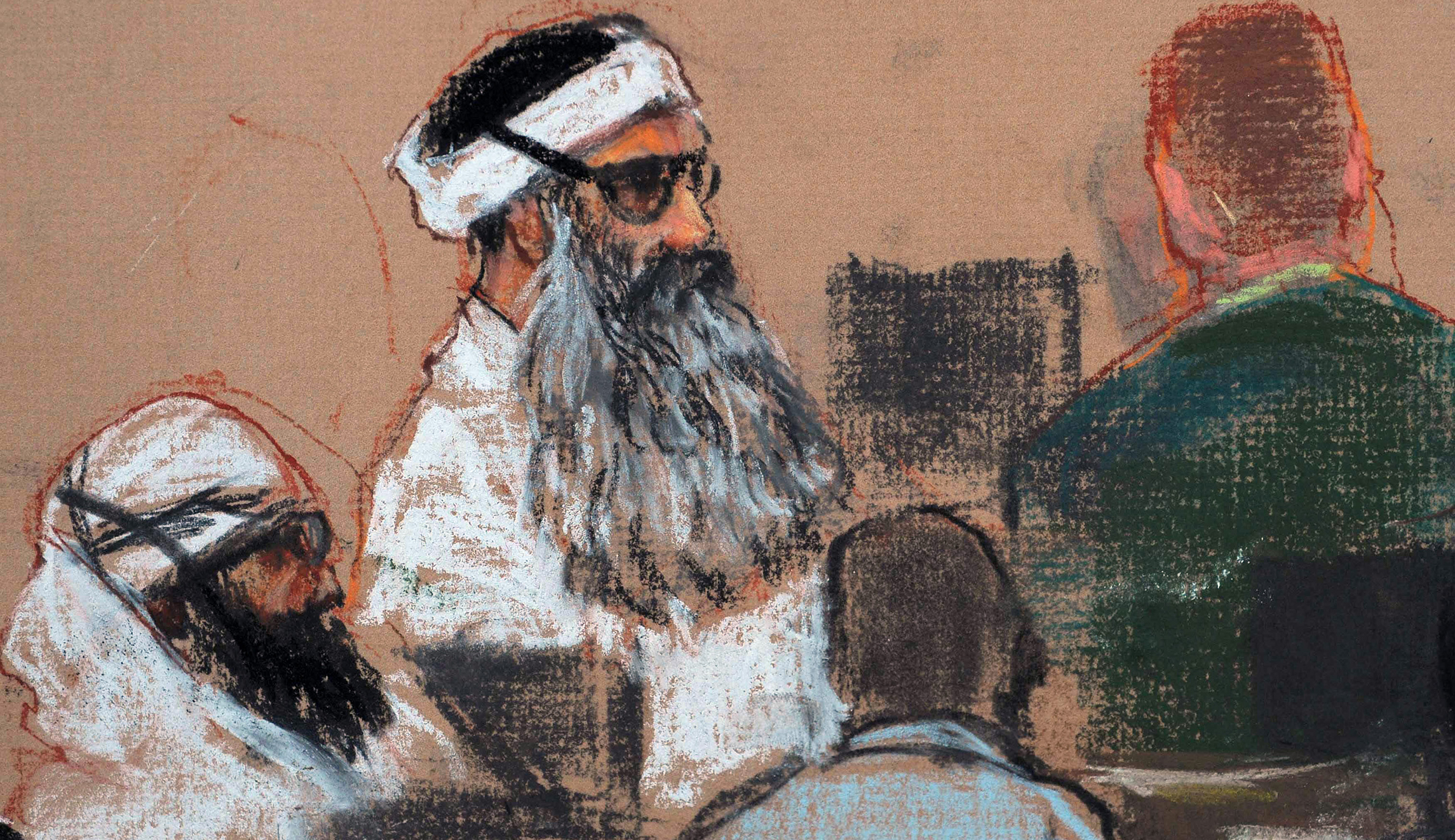
GUANTANAMO BAY, Cuba — The lawyers for the alleged mastermind of the 9/11 terrorist attacks today will question the psychologist who designed the CIA’s enhanced interrogation program and who waterboarded their client.
The defense team for Khalid Sheikh Mohammed, 55, dubbed “KSM” and described as “the principal architect of the 9/11 attacks” in the 9/11 Commission Report, will grill Dr. James Mitchell, a former Air Force survival school psychologist who helped design coercive interrogation methods for the CIA.
Recommended Stories


Mitchell, who testified last week in the military courtroom in Guantanamo Bay, personally waterboarded Mohammed in five different waterboarding sessions in 2003 at CIA black sites believed to be in Afghanistan and Poland. The sessions included at least 183 applications of the simulated drowning technique.
“I’ll be ready,” Mohammed’s lawyer, David Nevin, told the judge last Friday, predicting a day or so of questioning. “Clearly, I’m going to explore some things with the witness that haven’t been explored.”
“Yes, that’s what I expected,” replied the presiding judge, Col. W. Shane Cohen, who took over the case from a previous judge last summer. “Obviously, he had significant interaction under EIT’s with your client.” Cohen is the third judge since 2012 to preside over the proceedings
During last week’s testimony, and in his 2016 book titled Enhanced Interrogation, Mitchell defended his actions as being part of his patriotic duty to stop further attacks in the wake of the 9/11 al Qaeda hijackings. The attacks left 3,000 people dead at the World Trade Center, the Pentagon, and a field near Shanksville, Pennsylvania.
“I’d get up and do it again,” Mitchell said.
Mohammed looks much different than he did in the post-capture scowling picture of him in 2003 when he was overweight, mustached, and disheveled in a stretched T-shirt. He showed up to court last week in traditional Pakistani clothing with a white tunic and turban, wearing a dyed-red beard and a camouflage hunting jacket. He seemed to pay close attention to Mitchell’s testimony.
Mitchell repeatedly criticized the CIA’s chief of interrogations, known in court as “NX2,” accusing him of mistreating a number of different detainees and claiming Mohammed outsmarted him.
“He could lure the man I referred to as ‘New Sheriff’ into a battle of wills,” Mitchell testified, adding that “it set the interrogation back.”
Mitchell said he, Dr. Bruce Jessen, and a third yet-unknown man he dubbed “The Preacher,” waterboarded Mohammed while guards kept a watchful eye, and a physician used a hand-held clicker to count the number of water pours, and others used a stopwatch to time them. The sessions were timed in order to make sure they were safe and complied with legal guidelines. Mitchell, who derived his methods from the U.S. military’s Survival, Evasion, Resistance, and Escape program, contended the waterboarding elicited information from Mohammed.
“He would say to me, ‘My religion prohibits me from answering any question that you do not directly ask me, but since I know you will eventually get the answer out of me, it’s okay for me to answer it’ … And he would tell me the better question, and I would ask him the question, and he would give me a better answer,” Mitchell claimed.
In one specific instance, after a female subject matter expert had finished questioning Mohammed, Mitchell says, “He said ‘go get the lady who gets the notes’ — he’s a chauvinist, because she’s actually an expert — and that’s when he told us about beheading and dismembering Daniel Pearl.”
“I decapitated with my blessed right hand the head of the American Jew, Daniel Pearl, in the city of Karachi, Pakistan,” Mohammed said, confessing in 2007 before a now-defunct military tribunal to murdering the Wall Street Journal reporter.
Mitchell testified that “when KSM mentioned his interactions with Daniel Pearl, we were pressing him about WMD. My impression from that is he did that to distract us from WMD … The shift was to protect that information rather than protecting himself.”
Mohammed, a close ally of al Qaeda founder Osama bin Laden, is being tried in a death penalty case alongside four co-defendants. These include his nephew, Ammar al Baluchi; alleged 9/11 hijacking trainer Walid bin Attash; 9/11 facilitator Ramzi bin al Shibh; and al Qaeda money man Mustafa al Hawsawi.
The defense teams have sought to paint the CIA’s interrogation program as synonymous with torture, and claim that the confessions obtained through “clean” interrogations conducted by the FBI after the detainees were transferred to Guantanamo Bay in 2006 should be tossed.
The defendants’ admissions to the FBI were thrown out by one previous judge and reinstated by another. Judge Cohen will issue a ruling on this before the trial begins in January 2021.
Prosecutor Jeffrey Groharing previously argued the confessions were “some of the most critical evidence in this case.”
“I was responsible for the 9/11 operation, from A to Z,” Mohammed said in a statement he made more than a decade ago. “I was the operational director for Sheikh Osama bin Laden for the organizing, planning, follow-up, and execution of the 9/11 operation.”
Mohammed also confessed to planning assassination plots against presidents and a pope and is suspected of participating in other terror attacks. These include the 1993 World Trade Center bombing that killed six people, Richard Reid’s “shoe bomber” 2001 attempt to blow up an airliner, and the 2002 Bali nightclub bombing in Indonesia that killed 202 people.
Nevin previously defended Kevin Harris, who was acquitted in the 1992 Ruby Ridge murder of deputy U.S. Marshal William Francis Degan. He also represented Saudi graduate student Sami Omar al Hussayen, who was acquitted in 2004 on charges of supporting terrorism. Nevin spent years as the lead counsel for Mohammed until last year when the position was filled by Gary Sowards, most famous for representing “Unabomber” Ted Kaczynski, whose domestic bombing campaign killed three people.
Others on the defense team are Lt. Col. Derek Poteet, ACLU staff lawyer Denny LeBoeuf, and human rights lawyer Rita Radostitz. The female lawyers and paralegals typically wear head coverings to accommodate their client’s religious beliefs.
The defense team is paid by the Pentagon’s Convening Authority of the Military Commissions pursuant to the Military Commissions Act of 2009.
