

Thomas Jefferson is officially unwelcome at the New York City Council. Officials removed his statue from the council’s chambers back in 2021 because they considered its presence offensive.
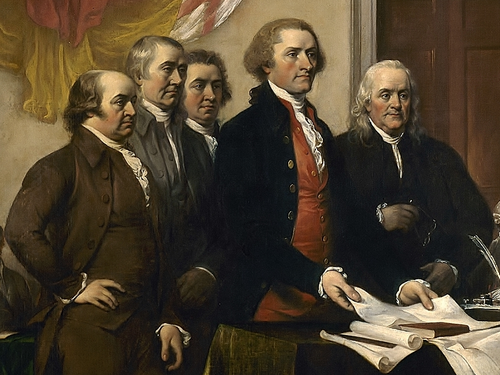
Jefferson was, of course, the author of the Declaration of Independence, the third president of the United States, a champion of education, and a brilliant polymath. In toasting a large group of Nobel laureates, President John F. Kennedy famously remarked, “I think this is the most extraordinary collection of talent, of human knowledge, that has ever been gathered together at the White House, with the possible exception of when Thomas Jefferson dined alone.”
Stay informed.Stay ahead.
Join Washington Examiner for unlimited access to the news, analysis, and commentary that matter most.
Already a member? Log in
In calling for the statue’s removal, however, one former council member and then-state assemblyman had a different view: Jefferson was “a slaveholding pedophile who should not be honored.”
Jefferson is perhaps the most frequent target of radical activists and academics, but few of the founders are immune — not even George Washington. Statues have been taken down, schools renamed, and historical sites “reinterpreted” to avoid honoring some of our nation’s most formative leaders.
Americans may find this troubling for several reasons. First, there is the visceral reaction to having one’s own heroes scorned, along with the suspicion that attacks on the founders are thinly veiled attacks on the present-day citizens who wish to honor them.
Then there is the sense that social ties are weakening. Unified nations need unifying figures, and the founding generation served that role for much of our history. Although we have always had political conflicts, there are some natural restraints on radicalism when both sides claim the mantle of Washington and Jefferson and Madison. Not anymore.
Most troublingly, modern-day critics seem to have forgotten that early American leaders gifted us with more than just nice words about liberty. In reality, the original colonists transplanted into North America a set of British cultural practices, including private property, voluntary association, and self-government. The founding generation embedded that culture into our country’s economic and governing institutions.
“Would America be the America it is today,” the political scientist Samuel Huntington once asked, “if in the seventeenth and eighteenth centuries it had been settled not by British Protestants but by French, Spanish, or Portuguese? The answer is no. It would not be America; it would be Quebec, Mexico, or Brazil.”
In that sense, rejecting the founders is dangerously radical. It invites policies that could undermine our prosperity. For example, if the people and their culture are largely irrelevant to how a nation works — if they need only claim to support “freedom” or some other creedal term — then mass immigration becomes less objectionable. Under this theory, the U.S. can take in millions of people from all around the world every year without altering the nation’s fundamental character.
In fact, a burgeoning literature shows that the power of assimilation is limited. Immigrants not only bring their cultural values with them to their new nations but also transmit them to their descendants. Trust, frugality, environmental concern, civic involvement, preference for redistribution, tolerance of corruption, and support for labor regulation are all traits that are slow to change after immigration. Some differences are still observable among fourth-generation Americans!
In observing that culture undergirds wealth-creating institutions, the economist Garett Jones warns that when people move to a new land, their previous institutions tend to follow them. “If you’re trying to guess how rich a country is today, you’ll make a far more accurate guess if you know the history of the people rather than the history of the place,” he writes.
The danger becomes even more pronounced when immigrants without a strong background in a free-enterprise culture enter the U.S. and internalize the anti-founder narratives. If the economic system fostered by our forebears has little to do with our prosperity, then why not radically alter it to spread that prosperity around?
RECITE THE CREED. SAVE THE COUNTRY
Of course, some immigrants are strongly supportive of free enterprise, and many natives are not. However, it is perhaps not a coincidence that leading politicians aligned with “democratic socialism” are often either immigrants or the children of immigrants. There are the congressional stalwarts, such as Sen. Bernie Sanders (I-VT) and Reps. Rashida Tlaib (D-MI), Ilhan Omar (D-MN), and Pramila Jayapal (D-WA). Then there are the up-and-comers — New York City Mayor Zohran Mamdani, Los Angeles mayoral candidate Nithya Raman, Michigan Senate candidate Abdul el Sayed, and likely 2027 House members Melat Kiros of Colorado and Darializa Avila Chevalier of New York.
Their rhetoric fails to appreciate that America is more than an idea. It’s a people with a cultural inheritance that has infused real vitality into concepts like liberty and freedom — concepts that might be mere words in other times and other places. Restoring the founders to a place of honor means understanding their full contribution to today’s America.
Jason Richwine is a resident scholar at the Center for Immigration Studies.