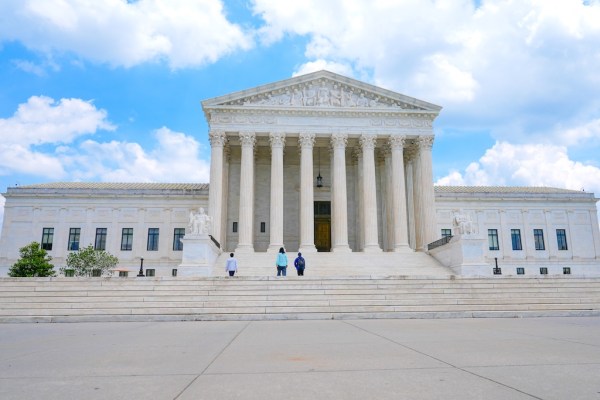
The Supreme Court’s recent decision in National Republican Senatorial Committee v. Federal Election Commission discarded yet another senseless campaign finance law. The ruling should strengthen political parties heading into the 2026 midterm elections, giving them greater freedom to work with their own candidates and shape the campaigns run under their banners.
For those of us who value free political speech, NRSC is cause for celebration. But it’s a quiet, perfunctory celebration of a very predictable outcome.
Recommended Stories
Yes, NRSC is another win for the First Amendment. But it’s also a reminder that we keep nibbling at the most obvious edges of this system, rather than asking whether the system should exist at all.
Federal campaign finance law is a sprawling morass of limits, definitions, exceptions, reporting rules, coordination standards, and disclaimers. Replete with potential traps and tripwires, this Byzantine structure does far more than prevent corruption. It regulates ordinary political participation to the point that many Americans choose not to participate in the first place.
Then, every few years, a case challenging a sliver of this regulatory contraption makes its way to the Supreme Court. And if the court gets it right, we celebrate.
NRSC provides a telling example. For about half a century, federal law has limited the ability of political parties to team up with their own candidates to help them win elections. That’s an odd rule that imposes serious First Amendment problems. And it should have been an easy case.
Political parties, after all, exist to help their candidates get elected. They develop policy platforms, recruit nominees, persuade voters, organize volunteers, and get people to the polls. It’s bizarre to think the government could limit a party’s ability to coordinate with the very candidates who represent it in the election.
Yet the law did just that. And it took several decades and two trips to the Supreme Court for common sense to prevail.
NRSC is a great victory for free speech. It joins a growing list of recent cases in which the Supreme Court has whittled away at the labyrinth of laws and regulations that restrict campaign speech in this country. But the decision prompts a more basic question.
What are we even doing here?
Little of this has anything to do with the Constitution. As Justice Kavanaugh’s opinion for the Court explained, “[a]s a matter of text and history,” restricting how parties coordinate with their candidates “would appear to violate the First Amendment.” But decades of misguided precedent have “cloud[ed] the issue.”
So instead of asking the straightforward First Amendment question — whether limiting political parties from coordinating with their candidates abridges free speech — courts engage in a convoluted analysis of whether the law is “necessary,” “narrowly tailored,” or proportionate to the government’s anti-corruption interest. Those are technical terms that give too many judges too much room to decide when the government can regulate and limit political advocacy.
That’s how we end up litigating whether a political party can coordinate with its own candidate. It’s how we get dense legal opinions parsing distinctions between “independent” speech and “coordinated” speech, between “contributions” and “expenditures,” between “express advocacy” and other forms of political persuasion. Each case becomes a skirmish over one rule, one limit, one definition. But the larger conflict remains unresolved.
TRUMP DIDN’T END CANCEL CULTURE. HE JUST TOOK THE REMOTE
The real lesson of NRSC should be that it’s time to reject the notion that the government has any business regulating campaign speech. Electoral advocacy is not an exception to the First Amendment. It is when free speech matters most.
NRSC is a welcome correction. But the deeper lesson is that campaign speech has been regulated into a legal thicket no free society should tolerate. the court has removed one branch. Next time, it should dig up the roots.
Brett Nolan is a senior attorney at the Institute for Free Speech.