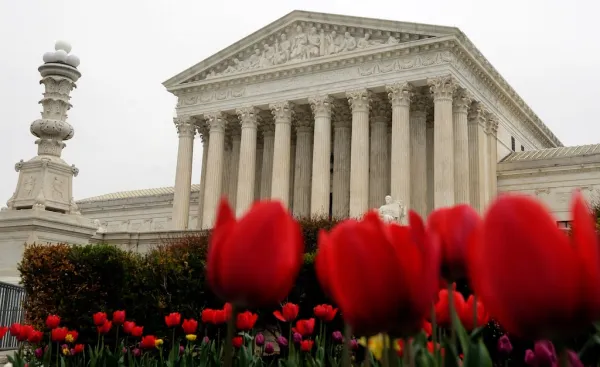
The Supreme Court ruled 6-3 on Tuesday that the federal government cannot cap how much a political party spends in direct coordination with its own candidates.
National Republican Senatorial Committee v. Federal Election Commission struck down a Federal Election Campaign Act provision that had limited coordinated party expenditures since 1974, overruling the court’s 2001 decision in FEC v. Colorado Republican Federal Campaign Committee. Justice Brett Kavanaugh wrote for the majority that the limits violate the First Amendment. I think the Court got this one right, and I say that as someone who also believes campaign money has gotten out of hand. Those two positions aren’t in conflict. They answer different questions.
Recommended Stories
For nearly two centuries, parties spent freely supporting their own candidates without anyone treating it as a constitutional crisis. The limits at issue trace back to a Watergate-era statute that treated a party helping its own nominee as the same as an outside group buying influence over a stranger. That was always a strange equivalence. A party isn’t an outside interest trying to capture a candidate. It’s the vehicle the candidate ran under. Telling the Republican National Committee it can’t coordinate support for its own Senate nominee is like telling a publisher how many column inches it can give its own editorial. The First Amendment doesn’t carve out an exception for parties working with their own candidates, and the court was right to stop pretending otherwise.
None of that answers the question actually bothering most people about money in politics, which isn’t how much a party can spend on its own nominee. It’s where the money comes from and whether the people footing the bill for a local election even live there anymore.
Those are different constitutional questions, and the line between them matters. The First Amendment protects domestic political speech regardless of who’s listening or how much money funds it. It has never protected a foreign national’s right to fund an American campaign. That prohibition predates NRSC, survives it, and rests on a different constitutional footing entirely: citizenship, not viewpoint. Buckley v. Valeo drew a sharp line between regulating how much speech costs and regulating who is constitutionally entitled to speak in a U.S. election at all. NRSC answered the first question. It left the second exactly where it was.
Which brings us to ActBlue. A House Administration, Judiciary, and oversight investigation released in April found donations flowing through the platform from Saudi Arabia, Iraq, Colombia, and other countries, and concluded the platform’s own board chairman acknowledged up to $38 million in 2024 contributions bearing the markers of foreign origin. Five current and former employees invoked their Fifth Amendment privilege a combined 146 times rather than answer questions about it, and the platform’s entire legal and compliance team departed within four months of the 2024 election. Texas Attorney General Ken Paxton has since sued, alleging the platform misled donors about safeguards its own counsel had flagged as inadequate. ActBlue disputes the characterization. A congressional investigation, a state attorney general, and 146 invocations of the Fifth from the company’s own staff suggest there’s more to find.
That’s the fight worth having, not a rerun of Colorado II. Rep. Bryan Steil’s Campaign Finance Transparency Act, requiring CVV and ZIP code verification for card donations, targets the actual mechanism by which the line gets crossed rather than capping how much the public can give to causes they believe in. Enforce who is eligible to participate. Don’t restrict how loudly the eligible can speak.
COURT SLAUGHTERS MYTH OF ‘INDEPENDENT’ AGENCIES: TRUMP CAN FINALLY FIRE BUREAUCRATS
The same frustration, with less legal clarity, applies to out-of-state money flooding local district attorney and school board races. George Soros has spent tens of millions backing prosecutor candidates in jurisdictions he doesn’t live in, and conservative megadonors do the same in reverse, without either breaking the law. That’s a debate about disclosure, not a First Amendment violation, and conflating it with foreign money only makes both harder to fix.
The court did its job Tuesday. It read the text, looked at two centuries of practice, and concluded that parties coordinating with their own candidates is core political speech. Congress still has its job: enforcing the one line the Constitution has always allowed it to draw. U.S. elections are for Americans. ActBlue’s compliance team didn’t resign en masse and take the Fifth 146 times because nothing was wrong. Find out what was, fix the verification gap, and leave the parties alone to do what parties have always done.
Jay Rogers is a financial professional with more than 30 years of experience in private equity, private credit, hedge funds, and wealth management. He has a BS from Northeastern University and has completed postgraduate studies at UCLA, UPENN, and Harvard. He writes about issues in finance, constitutional law, national security, human nature, and public policy.