

Is America a “creedal” nation, or one bound only by a unifying culture? This is one of several debates roiling conservatism these days. Conservatives may find solace in thinking, well, unlike our liberal brethren, at least we’re not facing a takeover by communists who hate America. But this debate is vital.
A new report by my friend and Heritage Foundation colleague Jay Richards settles the issue brilliantly. “We should reject the false dilemma that pits the American creed against American culture. Rightly framed, they are partners in the same story,” writes Richards.
Stay informed.Stay ahead.
Join Washington Examiner for unlimited access to the news, analysis, and commentary that matter most.
Already a member? Log in
Heritage has been writing on this subject pretty much since its creation in 1973. In my time there, David Azerrad and Arthur Milikh — with David now a professor at Hillsdale and Arthur the senior bureau official for the Bureau of European and Eurasian Affairs — wrote insightful papers and articles.
I myself have broached the subject here, here, and here. One of the themes I have highlighted is the use of immigrants to tear down both the creedal and cultural aspects of the United States at the same time by denigrating the assimilationist ethos that has always been part of the immigration process, particularly at peak periods such as the Ellis Island era.
The wisdom of Richards’ approach is that it frames the issue within today’s politics and needs. It provides not just a forensic incision of the question, but a much-needed road map for what to do.
“To capture and preserve the meaning of American citizenship and of our American heritage for the next 250 years, we should work to preserve the people, the place, and the principles that together form an indivisible whole,” wrote Richards, who has a doctorate in philosophy from Princeton Theological Seminary.
Richards starts the paper by juxtaposing the two superficially opposing views at their most raw. “Our nation is not founded on a religion. It’s not based on a common culture, even, or heritage. … We’re a creedal nation.” That was how one of our most libertarian Supreme Court Justices, Neil Gorsuch, put it in an interview with Nick Gillespie, editor of the nation’s most prominent libertarian journal, Reason.
That comment lit up X for days, with the usual mix of light and heat. Among the comments that provided the most enlightened views, Richards provides those from two of my favorite Italian Americans, Christopher Rufo and Antonin Scalia.
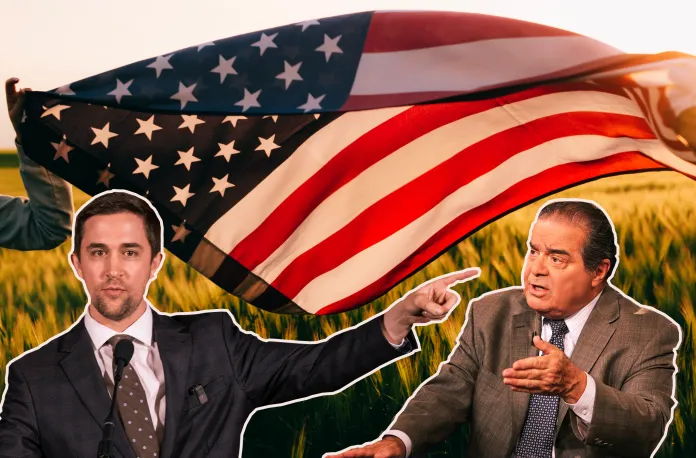
Principles, said Rufo sagely, do not float free from the underlying culture. Scalia “made the culturalist case with characteristic bluntness: America does have a distinct culture descended from British (and mostly Protestant) colonies. To pretend otherwise is dangerous.”
These are good arguments, but as Richards added, “Pitting creed against culture sets up a false dilemma.” Justice Gorsuch, he writes, “is right to argue that America was constituted by explicit moral commitments rather than mere geography, ethnic kinship, or dynastic accident.”
Rufo and Scalia, on the other hand, “are right to argue that the American creed, such as it is, did not drop from the sky; it is the fruit of a specific culture — the Christian West — and the specific inheritance of the British settlers who founded America. Some American colonists even saw their passage to the New World in terms of a covenant much like the biblical exodus of the Hebrews from Egypt into the promised land.”
If we strip the creed from that culture, it becomes like the seeds of Scripture that are thrown on hard, dry soil, and thus fail to take root, says Richards.
Take a man living in Bratislava who has never lived in or visited America, yet believes that all men are created equal and all the other aspects of the creed. Is he an American? Clearly not.
Both the creedal and the cultural arguments overreach, Richards explains. In the case of the culture-focused critics, Richards writes, “If we define America as a specific cultural inheritance rooted in English Protestant settlements, what is the status of the millions of loyal Catholic, Jewish, Orthodox Christian, and other Americans whose ancestors came later?”
‘THE RIGHT WAY FORWARD’: IMMIGRATION AND NATIONAL IDENTITY
It is with them that “the creedalist offers a clear answer: full membership on equal terms for all who subscribe to creedalist principles and adopt the relevant civic habits. Creedalism is not just consistent with strict requirements for immigration and citizenship; it requires them. Americans are under no obligation to admit those with political or religious views that are contrary to American principles.”
The synthesis of these two views is the only way to bridge the gap that now exists, and it should remind us again how lucky conservatives are to be avoiding a takeover by an alien ideology.