
The black American dilemma comes down to an either/or choice — either take on the awesome responsibilities of the citizen, or continually complain about institutional racism and the denied rights of the second-class citizen.
Either emulate statesmen and businessmen, artists and scientists, risk-takers, and big stakes test-takers — those who play the great game and thus command civil society — or envy them. Play the victim. Seethe with resentment under slogans such as “We are the 99%” or “Black Lives Matter” or “eat the rich.”
Recommended Stories
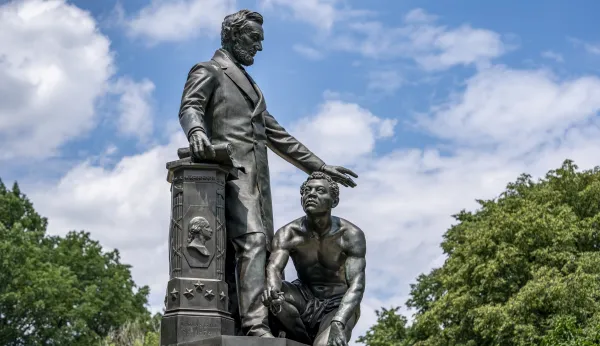
Both choices are self-fulfilling prophecies.
American sociologist Robert Merton popularized the idea of the self-fulfilling prophecy — a definition of a situation that becomes a part of the situation and thus affects its developments. “If men define situations as real, they are real in their consequences.” His paradigm example was of a solvent bank. False rumors of insolvency spread, so a run of panicked depositors destroyed it.
But the self-fulfilling prophecy can also be positive: “Fake it till you make it.” The little engine that thought he could pull the train over the mountain — “I think I can!” — and so he did.
Merton could also have used abolitionist Frederick Douglass as archetype. A man born into slavery who yet envisioned black freedom.
Ultimately, Congress fulfilled Douglass’s (and others’) three decades of abolitionism when they passed the Civil Rights Amendments. That is, the Thirteenth Amendment abolishing slavery, the Fourteenth Amendment declaring birthright citizenship, and the Fifteenth Amendment protecting the black man’s right to vote.
Nine in ten blacks had been enslaved until the Thirteenth Amendment. Nevertheless, and despite the Fugitive Slave Act (1850) and the Dred Scott decision, Douglass framed the Constitution as a “glorious liberty document.” His strict construction of the text broke the constitutional code.
In a speech delivered in Glasgow, Scotland, in 1860, Douglass explained his strict constructionist approach. First, he made an analogy. The slaveholders’ government is to the Constitution as a lost ship is to a compass. Just as a ship may veer off course despite an accurate chart, so is the government that tolerates the criminal enterprise of slavery, an unconstitutional government.
Douglass disagreed with his abolitionist rival William Lloyd Garrison. Garrison had denounced the Constitution as a slaveholding instrument, a “covenant with death and an agreement with hell.” The free states should separate from the slave states, he insisted.
Douglass argued that the people should vote the slave power out of office. Commit themselves to their colorblind Constitution. Any original intentions for slavery that were not explicit in the text were irrelevant. “The American Constitution is a written instrument full and complete in itself,” he said.
But the presumption of liberty mandates its construction in favor of freedom. As Douglass put it, “I presume [the Negro] free unless he is proved to be otherwise.”
The following syllogism sums up his strict constructionism:
“Its language is “we the people” not “we the white people” … If Negroes are people, they are included in the benefits for which the Constitution was ordained and established.”
The great American self-fulfilling prophet thus used the Constitution to fake freedom to make freedom for four million formerly enslaved people.
But black America today follows Merton’s failed-bank paradigm. Consider:
If 47 million black Americans were a sovereign nation, their roughly $2 trillion in annual spending power would put them on par with the G20 member nations. But too many blacks live in urban slums or rural squalor as functional illiterates. Black America tends to think of itself as poor, with consequences that condemn one in five to poverty.
Yes, black Americans were denied economic opportunity for 300 years. From the time that slavery was first codified in 1660s Virginia, until the landmark civil rights bills of the 1960s ended legal segregation. But that Jim Crow zero-sum society has gone with the wind.
For three generations now, black Americans have lived in a positive-sum society that teems with trillions of dollars. Black America itself abounds with multitrillion-dollar wealth. And yet its poverty mindset persists.
Hence the dilemma. And so I ask my fellow black American:
Which self-fulfilling prophecy will you choose?
The Frederick Douglass archetype.
Or the failed-bank paradigm.
Choose strict construction. Make “parity” your action-idea.
MAMDANI HATES EVERYBODY — WHICH IS WHY HIS MAYORALTY IS DOOMED
Hollywood screenwriter Michael Tierno defines “action-idea” as the mission statement of a story, or the idea of a story built on a single action. For Jaws, it’s “stopping a killer shark.” The Odyssey is about making it home from abroad.
The action-idea of black History — beginning with African settlement in America circa 1526 — emblazons the statue of civil rights martyr Octavius Catto in Philadelphia: “The Quest for Parity.”
Taru Taylor is a lawyer licensed in Washington, D.C.