

WHAT’S HAPPENING TODAY: Good afternoon and happy Wednesday, readers! We’re inching closer to August recess and we’re sure many of you are excited to get out of D.C. and take some much-needed vacations. 🚙☀️✈️🌴 But before you escape – we have a few busy days of news ahead!
- 🚢🛢️ As we briefly mentioned yesterday, the White House is considering extending the Jones Act waiver a third time – despite pushback from Republicans in Congress, including House Majority Leader Mike Johnson. Today’s newsletter takes a closer look at why the administration could break with the party.
- ⛰️☢️ You may be familiar with the name Yucca Mountain. But do you know why the Nevada site was picked as the sole location to store nuclear waste in the 80s, or why the project was scrapped decades later? Keep reading to find out.
Welcome to Daily on Energy, written by Washington Examiner energy and environment writers Callie Patteson (@CalliePatteson) and Maydeen Merino (@MaydeenMerino). Email cpatteson@washingtonexaminer dot com or mmerino@washingtonexaminer dot com for tips, suggestions, calendar items, and anything else. If a friend sent this to you and you’d like to sign up, click here. If signing up doesn’t work, shoot us an email, and we’ll add you to our list.
Recommended Stories


WHITE HOUSE EYES THIRD JONES ACT WAIVER EXTENSION:
The White House is eyeing a third extension to the Jones Act to help ease oil prices, despite opposition from the maritime industry and Republican lawmakers.
The waiver: President Donald Trump first issued a waiver to the Jones Act in March, allowing refineries to use foreign-flagged ships to transport fuel between U.S. ports. The purpose of the waiver is to lower gas prices by increasing the available fleet.
The administration later extended the waiver, moving its expiration date to Aug. 16. And it is now considering another extension.
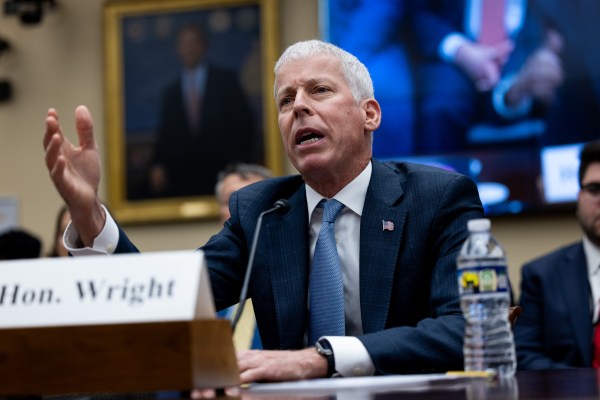
Energy Secretary Chris Wright said during a media briefing in Texas yesterday that an extension of the waiver is “quite likely to happen.” He said the waiver has helped move energy resources around the country.
As of July 28, the waiver has facilitated 195 voyages, resulting in the transportation of about 50 million barrels of fuel, according to a Cato Institute tracker.
U.S. shipping industry opposition: The maritime industry has warned that the continued extension of the waiver could undercut American maritime jobs.
Jennifer Carpenter, president and CEO of the American Waterways Operators, told Maydeen that, “it’s clear that the White House is searching for levers to bring down gas prices as the midterms approach, and we appreciate and understand that.”
However, Carpenter, who also serves on the American Maritime Partnership, argued that the Jones Act waiver does not move the needle enough on gas prices and instead has shifted routine domestic commerce to foreign operators like China and Russia.
“Transportation amounts to a very small amount of the price of fuel at the pump, and the incremental difference between U.S. flag vessels and foreign flag vessels, it’s minuscule,” she said.
Reuters reported that international vessels transporting fuel from the U.S. Gulf Coast to the West Coast would save about 6.6 cents per gallon, or 1% of California’s current gas prices, according to Argus. It noted that there is higher demand for foreign ships to Asia on the East Coast, meaning that it is cheaper to ship on a Jones Act vessel.
It was reported yesterday that the oil industry expected the waiver to be extended last month but the administration was continuing conversations with maritime industry representatives and lawmakers over making changes to the waiver.
Carpenter said that there are people in the administration who understand their concerns, but others maintain that the waiver has helped.
The domestic maritime industry is not alone with these concerns.
Republican lawmakers have also vocally opposed further extending the waiver. For instance, last month, House Speaker Mike Johnson, House Majority Leader Steve Scalise and 50 other House Republicans sent a letter to Trump urging him to let the waiver expire.
WHAT IS YUCCA MOUNTAIN?
Callie wrote a deep dive, published today, that explains why the Trump administration is looking for a permanent solution to store nuclear waste someplace other than Yucca Mountain, which has remained incomplete and abandoned 40 years after being designated as the sole facility for that purpose.
Where is Yucca Mountain? Yucca Mountain is located roughly 100 miles northwest of Las Vegas and just over 20 miles from the California border. Just over 1,400 people live in the Amargosa Valley, about 18 miles south of Yucca Mountain.
Why was it picked? The Nuclear Waste Policy Act of 1982 required the Department of Energy to select a deep underground repository to store spent nuclear fuel and high-level waste.
The combination of Yucca Mountain’s remote location, dry climate, deep water table, and stable volcanic rock made many scientists believe that the site had the best technical and scientific characteristics to serve as a nuclear waste repository.
What was the pushback? The state of Nevada has heavily opposed using Yucca Mountain for nuclear waste storage, claiming that the site’s aquifer drains into the Amargosa Valley, a highly productive agricultural region in the state.
Nevada Attorney General Aaron Ford has also said the facility would not be large enough to store all of the nation’s nuclear waste, as Yucca Mountain’s statutory design capacity was only 77,000 metric tons. Plus, officials have pointed to concerns about the transportation of spent nuclear fuel to the site, as an accident or attack along routes from existing plants could put millions of people at risk.
For more details on why the project was ultimately abandoned and where else the Trump administration is looking to store high-level atomic waste, check out Callie’s explainer here.
All the rest
OIL STAYS STEADY AS WE WAIT FOR DEAL OR NO DEAL: Oil prices were largely unchanged today, as U.S. officials have insisted negotiations with Iran to reopen the Strait of Hormuz have been productive.
“It looks like things are very good,” Trump said last night during an interview with Fox News. The president also teased that a deal could be made as early as today or tomorrow.
“We’ll find out. We’ll know in 48 hours,” he said.
If a deal is struck, some analysts have suggested, prices will not fall as dramatically as they did in June after the signing of the initial MOU between the U.S. and Iran. This is in a large part due to the fact that there has been some traffic through the strait over the last two months, as well as there being less oil trapped in the Persian Gulf than there was between March and May.
Just after 2:30 p.m. EDT, Brent crude was down by just 0.6% and was selling at $79.31 a barrel. West Texas Intermediate had also fallen 0.65% and was priced at $75.28 a barrel.
PERMITTING REFORM ON PAUSE: It’s official: the Senate will not be reaching a deal on meaningful permitting reform before the upper chamber breaks for August recess at the end of the week.
Democratic Sen. Sheldon Whitehouse of Rhode Island confirmed to Daily on Energy alum Josh Siegel that negotiators are now aiming to make a deal when Congress comes back in September.
Yesterday, Whitehouse met with other top dealmakers Sens. Shelley Moore Capito of West Virginia, Martin Heinrich of New Mexico, and Mike Lee of Utah, to discuss the new timeline and issues that still remain.
Capito also told Siegel that all four of the negotiators, who are the chairs and ranking members of the committees on Environment and Public Works and Energy and Natural Resources, are on the same page.
“It’s just timing,” she said.
ENERGY DEPARTMENT STRIPS SOLAR FROM BIDEN LOAN FOR PUERTO RICO: The Department of Energy is advancing a nearly half-billion-dollar loan agreement, set under former President Joe Biden, to prop up Puerto Rico’s electrical grid, but is dropping funds meant to build out solar power as detailed in the original deal.
The details: The Office of Energy Dominance Financing announced this morning that it closed a $489.4 million loan to Amanecer Puerto Rico, a subsidiary of Pattern Energy, with the hopes of lowering electricity costs for the Caribbean island and supporting its grid. The funds are expected to finance the construction of 220 megawatts of battery energy storage systems in Arecibo and Santa Isabel, providing enough backup electricity for more than 100,000 customers during power shortages.
The loan looks very similar to a conditional commitment for a loan guarantee to Amanecer Puerto Rico announced in January 2025. That loan guarantee, which was also set to be up to $489.4 million, was intended to finance three stand-alone battery energy storage projects totaling 180 megawatts of power. The funds were also expected to support a 70-megawatt solar project.
The announcement for the loan finalized by the Trump administration notably makes no mention of building out solar in Puerto Rico, but instead says the funds will also support a “pathway for the future development of reliable, dispatchable natural gas-fired generation.”
Read more from Callie here.
UN WARNS EL NINO COULD PLACE MILLIONS INTO HUNGER: The United Nations has warned that the current El Niño weather could place at least 49 million people into acute hunger by the end of next year.
The UN said that parts of Central America and southern Africa are expected to be hit the hardest. Extreme weather is also expected for eastern Africa.
“El Niño is a massive threat to the food security of millions who are already vulnerable,” Carl Skau, acting executive director at the UN’s World Food Programme, said. “The sooner we help families to prepare for these climate shocks, the greater our ability to save lives and protect livelihoods.”
ICYMI – FEMA MAY NOT HAVE ADEQUATE STAFF FOR DISASTER RESPONSE: Worker shortages at the Federal Emergency Management Agency could make it challenging for the agency to respond to upcoming natural disasters.
A Government Accountability Office report found that, in fiscal year 2025, over 4,300 staffers left the agency, which has resulted in a loss of institutional knowledge and experience.
“If FEMA continues to wait for potential mission changes, which require legislative action or other agency actions, it risks having critically low staffing levels in the event of large or concurrent disasters in the 2026 hurricane season, such as those seen during the 2024 hurricane season,” the report reads.
RUNDOWN
Inside Climate News Coming to Some of Pennsylvania’s Most Picturesque Places: Data Centers
Associated Press British Columbia is logging its last old growth. Protesters are sleeping in the road to stop it
Grist Wildfire season is changing. Spokane is showing how.
The Confluence The great Pacific bluefin tuna comeback