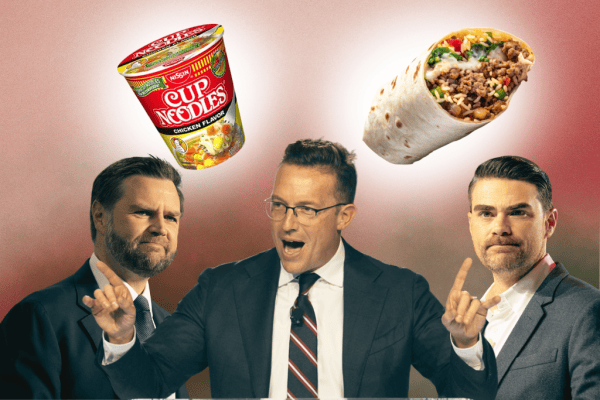
The latest political argument consuming social media ostensibly began with a college student’s gripe that a burrito shouldn’t cost $20.
Then entered Marc Thiessen, the former George W. Bush speechwriter and ally of President Donald Trump, who said: “Cry me a river.” Vice President JD Vance then took a swing at Thiessen, but instead of championing Trump’s economic policy, he opted for a fat joke at Thiessen’s expense.
Recommended Stories

In a interview with Laura Ingraham on Fox News’s The Ingraham Angle hours later, Vance blamed 40 years of economic policy, as well as progressives, for concerns about the cost of living.
Vance’s response, paired with other social media reactions on the Right, effectively amounted to “suck it up,” which nonetheless exposes a recurring challenge for the Trump administration and the wider Republican Party as they try to convince voters that have both the short-term and long-term solutions to combating financial pressures many Americans face in everyday life.
Some Republicans dismissed the discourse as another example of young people complaining. Rep. Dan Crenshaw (R-TX), who lost his primary earlier this year, called the $20-burrito debate “dumb,” and told 20-somethings to “stop whining, get a job, eat Ramen like the rest of us did in college, on a budget with 4 roommates.”
“The market doesn’t care what you think something ‘should’ cost,” Crenshaw said. “Only communists care (they set prices remember? Then everyone starves, remember?) Are you a communist? Or are you an American adult male capable of handling his own s***?”
Conservative commentator Ben Shapiro had a similar take, arguing that younger Americans shouldn’t be buying costly burritos anyway.
“If you’re paying $20 for a burrito and you’re not independently wealthy, you’re doing life wrong,” Shapiro said. “We have enough problems as a country without insane expectations that the government is going to provide us gourmet-quality burritos.”
Other MAGA figures have called out Shapiro and Crenshaw for their burrito takes, saying their comments reflect a failure to properly understand people’s affordability concerns.
Podcaster Benny Johnson chimed in to “end the debate,” pointing to the bigger issue facing young Americans: Basic necessities are just too expensive.
“Anyone telling you otherwise is lying or retarded. Facts don’t care about your feelings,” Johnson said, listing out the cost comparisons of groceries, gas, and housing from 2006 to 2026.
Comparing prices of beef, gas, and housing from June 2006 to June 2026, costs have certainly gone up, according to the Federal Reserve Bank of St. Louis, which tracks economic data. One pound of beef rose by roughly $4.50, gas prices have nearly doubled per gallon, and housing costs have also doubled.
The Trump administration has struggled with affordability messaging in office, a major change from his successful campaign strategy of holding President Joe Biden accountable for high inflation. His campaign regularly accused Biden and administration officials of being out of touch with voters who were seeing their grocery bills keep rising.
Since taking power, the message on affordability has gotten lost in translation. Trump frequently says the United States is the “hottest country in the world” under his leadership, making it difficult for his administration to acknowledge the high prices affecting families. The president, in particular, has been implored to focus on affordability concerns by members of his own team, particularly in the wake of elections last November, where Democrats won back the governorships of New Jersey and Virginia, and socialist Zohran Mamdani swept to power as mayor of New York.
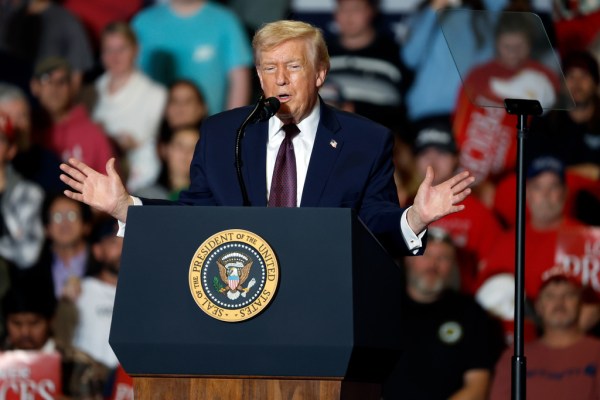
On Wednesday night, during an event in Las Vegas, Trump touted the state of the economy and then shrugged off the possibility that gas prices could go back up due to the Iran war.
“When oil goes down, and it’s going to go down very rapidly … We may have to send it up again. We may have to — you know what happens when we send it up,” Trump said. Although gas prices have started to come down after spiking in April and May, the monthly average is still above $4, a number that hadn’t been breached since 2022.
The comment was reminiscent of one he made in May, where Trump suggested that families should change their buying habits to cope with rising costs related to tariffs, rather than expressing an understanding of the frustration about those costs.
“Maybe the children will have two dolls instead of 30 dolls, you know?” he said during a Cabinet meeting in the Spring. “And maybe the two dolls would cost a couple of bucks more than they would normally.”
AFFORDABILITY PAIN IS NOT FADING AND IT’S COSTING THE PARTY IN POWER: BYRON YORK
Wade Miller, the executive director of Citizens for Renewing America, said the Trump administration is working to undo long-term policies enacted by Democrats, which have inflated the cost of living.
“I think that the Trump admin is making a lot of various decisions to put in place the fundamentals long term for job creation, the ability to be able to afford things, labor markets, re-industrialization,” Miller said. “Those are all long term bills. They don’t happen overnight.”
But Miller conceded that the way many Republicans have confronted affordability issues may seem insensitive to voters.
“We have to be perceptive of the situation that people are in and try to communicate through that,” he said. “I think that dismissing it isn’t helpful.”
While the administration has largely succeeded in bringing inflation rates, which reached 9.1% in July 2022 under Biden, down, voters don’t experience inflation — they experience price levels. If the cost of a burrito rises from $5 to $10, that’s still a 100% increase even if inflation is now down to 3%. This seems to be the mark that pro-Trump messengers keep missing.
The burrito debate underscores the political difficulty facing the Trump administration on the affordability front. While the president can point to economic growth, wage gains, or eased inflation, those figures do not necessarily change what voters see when they pay for lunch, fill their gas tanks, or prepare a down payment. Refusing to acknowledge those realities hurts electoral prospects, which the Democrats learned the hard way in 2024.