

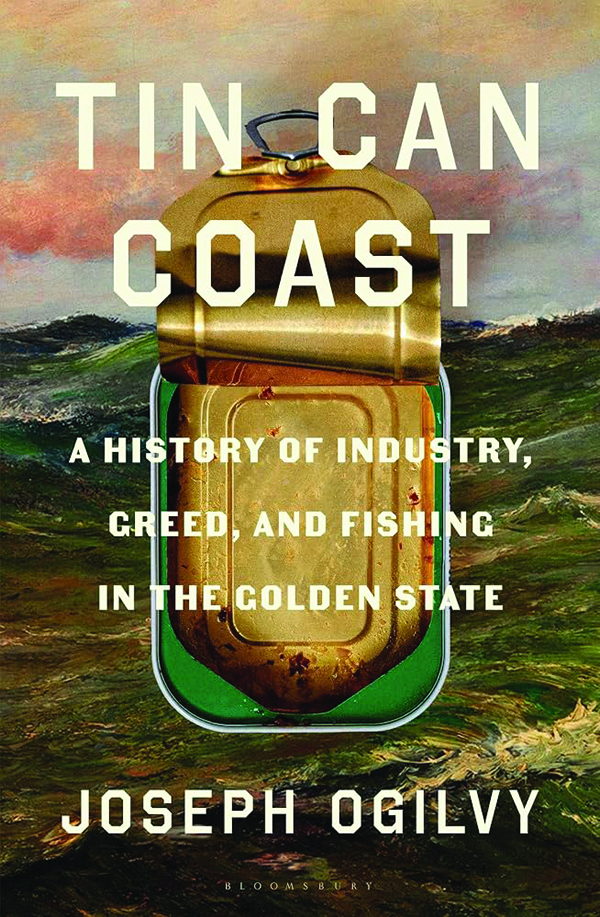
California was one of the last places in the world to join the “global economy,” but upon its discovery, the bounty of the “California Current” was plundered at record speed. In Tin Can Coast, author Joseph Ogilvy looks at the human and environmental history of the Golden State’s waters and the long succession of boom-and-bust cycles, which ultimately resulted in little but environmental devastation and a massive shoreline with almost no commercial fishing.
Stay informed.Stay ahead.
Join Washington Examiner for unlimited access to the news, analysis, and commentary that matter most.
Already a member? Log in
Ogilvy’s narrative is expansive, informative, and entertaining, while avoiding all of the pitfalls one might expect from a modern history of American capitalism. The reader is drawn into California’s unique character as a state where dreams are consistently taken too far and eventually turn into nightmares.
Tin Can Coast opens with a description of California’s native peoples, including the Chumash of the Channel Islands, and the state’s entry into the global economy at the price of the mass slaughter of sea otters, primarily by Aleutian Islanders whom Russians had employed to do this work. The decimation of otter populations, as well as Spanish missionaries encouraging the natives to farm instead of gather shellfish, led to an explosion in the population of the abalone, a celebrated California sea snail.
Here and throughout the book, Ogilvy emphasizes that when we look at the environment, our “baseline” is often drastically distorted by the devastating impacts of other human activities. This is true of America generally, with things such as the thickness of forests and the size of buffalo herds impacted by apocalyptic levels of disease and death among native populations. In 19th-century California, miners pulling salmon out of the rivers with pitchforks were spoken of, and having grown up in the Northwest, I was accustomed to seeing old pictures of enormous salmon. But it was seldom explained that this was an era of greatly reduced populations of both Native Americans and marine mammals, which had been hunted for fur and fat.
As one fishery boom followed the next, the California Current saw a cascade of environmental problems. Then there were the miners who filled creeks with waste, and the debris from road construction that went into the ocean. Ogilvy deals with these topics with considerable nuance. Outside of the sea otters and, later, the dolphins caught in tuna nets — animals that are nearly impossible not to sympathize with — Ogilvy declines to tell a maudlin tale designed to make his readers feel bad about humanity. Instead, he shows a real concern for the humans who had to make a living and the animals that wanted to stay alive. Nevertheless, this is a dark history: The fishing and canning industry moved from one thing to the next until sardines and tuna all but disappeared. California stopped being a commercial fishing state nearly 45 years ago.
Ogilvy also does an impressive job in explaining where racism — in this story, mostly Progressive Era anti-Asian racism — impacted history and policy, but he doesn’t treat it as some sort of “original sin” that has tarnished the entire state. He looks at the individual assets that immigrants brought to their industries instead of treating them like interchangeable economic units who did dangerous jobs for low wages. The Chinese had trade networks to sell the abalone meat and shells, while the Sicilians had traditional lampara nets that allowed them to catch sardines (though, given the enormous bounty in California at the time, they had to be modified to handle more weight). However, the Japanese immigrants, who had been to Japan’s world-leading fishery universities and had the most technologically advanced diving suits, were able to harvest previously unreachable deep-water abalone. It isn’t uncommon to hear that immigrants were successful because of traditional knowledge they brought with them, but it is rare to read an account that attributes their success to more advanced education and technology than anything in America at the time.
Another strong point is Ogilvy’s description of the history of environmental regulation, something for which modern California is famous (or infamous). Ogilvy acknowledges that regulators need to consider a wide variety of factors and are never making truly neutral scientific judgments. In this instance, that would have been impossible because, to this day, the mysterious and volatile process of sardine reproduction is poorly understood. What is clear, however, is that amid the efforts of some genuinely well-intentioned people, the great majority of environmental regulations were attempts by industry pressure groups to stifle competition, particularly that of Asians who were subjected to endless discriminatory legislation that was generally overturned in court. At the same time, harvest limits were clearly necessary, particularly once sardine reduction became a big industry, and the demand for sardines was no longer limited by how many people wanted to eat. Instead, sardines were a source of elemental constituent parts: a commodity that could be fed into the maw of the global economy, in this case, most notably as fertilizer and chicken feed. Many attempts were made to limit sardine “byproducts” to the waste that is produced by tinning sardines for human consumption, but every effort seemed to encourage greater harvests.
TREAT CHINA’S FISHING PIRATES LIKE THE PIRATES OF OLD
Going into this book, I was concerned that it might suffer from a variety of irritating modern academic orthodoxies, particularly related to environment, economics, and race. It is mercifully free of all of these things, which I attribute to the fact that the author is a chef who simply grew interested in where fine foods come from. There are very few negative things I can say about the book, although some may find the footnotes excessive and distracting. (I did not mind the endless stream of tangentially related facts and anecdotes.) My only substantive criticism is that the author failed to reference Adam Smith, who discussed Scotland’s forage fisheries, offshore processing, and the government regulation of both things, and this was a real missed opportunity to compare an ancient fishery to a California gold rush. On the other hand, I was pleasantly surprised to encounter a discussion of the great Dutch humanist Hugo Grotius in a concise explanation of the development of modern international maritime law.
On the whole, though, Tin Can Coast is a marvelous book that would be of interest to anyone who likes to read serious nonfiction. The story gets deep to the heart of the California character, and emphasizes that in every boom, the players involved overborrow and overextend their business in the belief that the good times will go on forever — a mirror of our current Bay Area AI bubble. However, unlike California’s crazy entrepreneurs of past and present, Ogilvy did not rush: He spent five years writing this book part-time. In the end, he produced a remarkable and thoughtful history of California’s coast.
Brad Pearce writes the Wayward Rabbler on Substack and is also a regular contributor to the American Conservative and the Libertarian Institute. He lives in eastern Washington with his wife and two children.
