Stock prices for the American vaccine manufacturer Moderna more than doubled on Wednesday after the company reported successful results from its messenger RNA melanoma cancer vaccine.
The mRNA shot, in combination with Merck’s immunotherapy drug Keytruda, met critical benchmarks in a global late-stage clinical trial of more than 1,100 patients with higher-risk or advanced melanoma whose detectable cancer had been surgically removed.
Recommended Stories
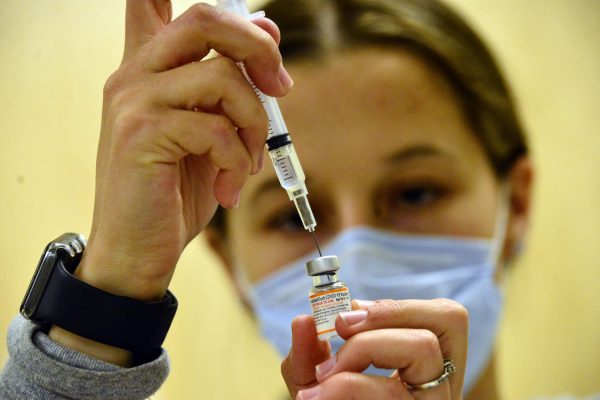
Merck’s stock climbed more than 10%. The soaring valuations are indicative of the significance of the breakthrough in cancer treatment and the possibilities for mRNA technologies.
Moderna CEO Stephane Bancel wrote in a blog post Wednesday that the trial results mark “an extraordinary milestone for Moderna, for mRNA science, and most importantly, for patients with cancer.”
“For many years, the idea that we could take the unique genetic fingerprint of a patient’s tumor and use mRNA to create a medicine designed specifically for that individual patient’s cancer sounded like science fiction.” Bancel wrote. “Today, we have demonstrated the clinical benefit of this approach.”
Cancer vaccines utilizing mRNA effectively train the patient’s immune system to identify and destroy tumor cells. Instead of a one-size-fits-all approach, the vaccines are uniquely created to target the genetic profile of the patient’s cancer cells.
The initial data from the clinical trial suggest that Moderna’s vaccine and Merck’s immunotherapy drug in combination could serve as a new treatment option for melanoma. Although melanoma makes up only about 1% of skin cancers, it causes the majority of skin cancer deaths.
Moderna was one of the pharmaceutical giants that rushed to create an mRNA vaccine during the COVID-19 pandemic, but its financial prospects fell with the winding down of the public health emergency.
Even with Moderna’s share price having doubled, the company’s stock is still trading at less than a third of its 2021 peak following the launch of its COVID-19 vaccine.
The new development comes as the Trump administration has revoked research funding for mRNA vaccines for upper respiratory infections and has downplayed their importance, adding to a record of policies more skeptical of the benefits of vaccines.
COVID-19 VACCINES DURING PREGNANCY: WHAT WE KNOW NOW
But Bancel argued the company’s investment in mRNA technology for cancer treatment will revolutionize cancer medicine.
“We have started to demonstrate the potential of an entirely new class of medicine—and an entirely new way of thinking about cancer care: using the information encoded within an individual patient’s cancer to design a specific therapy that helps train their immune system to fight it,” Bancel wrote.