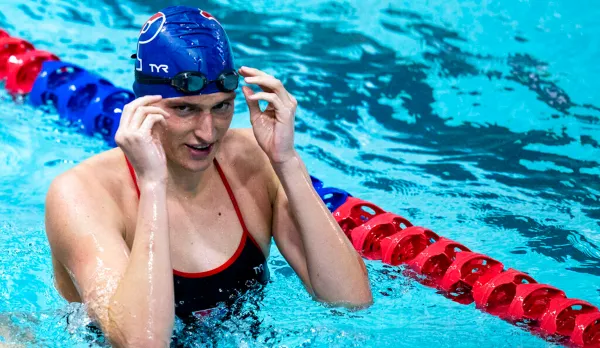
The debate over fairness in women’s sports has bounced back to center court, with Sophie Cunningham becoming its latest flashpoint. After telling ESPN she believes women’s sports should be reserved for biological women, the professional basketball player spent two weeks in the throes of a national firestorm as rallies of support erupted outside WNBA arenas in Seattle, Portland, and Minneapolis. From the sidelines, Minnesota Lynx coach Cheryl Reeve doubled down on her belief that transgender athletes should participate in categories based on gender identity, calling this a “human rights issue.”
The media is the biggest perpetuator of this division, ensuring that each side is advocating from entirely different vocabularies. And few institutions have done more to shape that vocabulary than the Associated Press. Through its widely referenced stylebook and guidance on “inclusive storytelling,” the AP Stylebook discourages use of “biological female” and defines gender as a “social construct” rooted in “self-identity.” It warns writers to “be aware of nuances and pitfalls in the use of ‘female’ and ‘woman/women,'” explaining that “female” describes sex, not gender, and can be perceived as “emphasizing biology and reproductive capacity over gender identity.” That logic runs not only through AP’s own reporting but through massive outlets that follow its lead, including the New York Times, NPR, and the Los Angeles Times.

Recommended Stories
AP’s guidance marks a shift with major consequences not only for the coverage of women’s sports, but the conversations surrounding it. Those conversations are not new. Earlier this year, intense debate reignited when the Trump administration sued California, Minnesota, and Maine over policies that allow transgender athletes to compete based on how they identify. The language journalists use to describe these events shapes public discourse and influences key debates in courtrooms and the halls of Congress.
The AP Stylebook is one of the most influential language guides in American journalism, used by the Chicago Tribune, Newsweek, USA Today, and countless other newsrooms. Its stated aim is to ensure uniformity, clarity, and accuracy in mass communication — a goal that should, in principle, align with journalism’s responsibility to reflect reality.
In its 2026 edition, AP devotes a chapter to “inclusive storytelling,” touting representation for marginalized groups as a defining pillar of its values. Many would agree that women, and female athletes in particular, have been historically marginalized in sports. The “frailty myth” took hold in the 19th and early 20th centuries, when doctors claimed intense physical activity would damage women’s reproductive organs and cause “hysteria.” Indeed, the Boston Marathon barred women from competing until 1972. Women have fought tirelessly for their right to participate in high-level athletics, and they risk losing that progress.
When the largest news organizations promote language that avoids clear sex-based terms, they minimize the fairness concerns many female athletes have raised. This is especially concerning when that coverage discourages legitimate discussion of biological differences between male and female athletes.
Male biology, notably the testosterone that increases muscle mass and bone density, undeniably advantages male athletes over female athletes. The fastest male mile in 2025 was 3 minutes 45 seconds, compared to 4 minutes 11 seconds on the female side. At the high school level, allowing biological males to compete in girls’ sports risks costing female athletes a spot on the leaderboard, which can earn them life-changing athletic scholarships. This directly threatens decades of progress for women in athletics and, by extension, in access to education.
By blurring these lines for the public, AP is complicit in the rising inequality facing girls’ and women’s sports. George Orwell warned in “Politics and the English Language” that imprecise language can distort understanding, writing that “the great enemy of clear language is insincerity.”
Ideologically driven ambiguity is especially apparent in AP’s section on covering transgender athletes, where they instruct writers not to “misgender or imply doubt” about male athletes competing in women’s sports. The AP Stylebook, which serves as the industry standard, holds real power to shape how major outlets present reality to mass audiences. As Cunningham told ESPN, “I am here to extend love, but I also think with that love is truth, being honest.”
Honesty, credibility, and public trust are built on precise language, not ideologized terms created to minimize legitimate equity concerns and conceal truth. It is impossible to offer nuanced coverage of women’s sports while avoiding the very words necessary to describe who is competing.
FROM ‘WHITE PRIVILEGE’ TO ‘TRANS INCLUSION’: THE WNBA IS RELEVANT FOR ALL THE WRONG REASONS
A style guide that encourages ambiguity over accurate, relevant terms ultimately lowers the standards of journalism we consume. Newsrooms and corporations across the country lean on the AP Stylebook to make editorial decisions and set their own standards. When those standards are rooted not in neutrality but in identity politics, the foundational tenets of journalism are put at severe threat.
If journalism is meant to serve the public interest, its language has to serve the truth first.
Margaux Jubin is a journalism student at The George Washington University who writes extensively on Middle East policy and U.S. politics, contributing to outlets including The Jerusalem Post, The Times of Israel, Jewish News Syndicate, The Algemeiner, The Berkeley Beacon, and more.