

Donald Trump is on his way to the Republican nomination. He finished a strong second in Iowa and won landslide victories in the next three states, New Hampshire, South Carolina and Nevada. There is no sign that his untroubled progress to the nominating convention in Cleveland will be upset by any of those splitting the field behind him.
For real conservatives, the reality of Trump’s ascendency is painful. But it has to be acknowledged. The primary season is already wasting, and although the brash billionaire still does not get majority support, it is clear that if things remain as they are, he won’t have to.
Recommended Stories


It is no longer possible to put any faith in predictions of his inevitable implosion. That supposed inevitability was probably always more apparent than real, and it seems to have forestalled the concerted and decisive action against him by the party’s biggest players that might have proved effective.
He is popular not in spite of his brash willingness to flout every convention (including that of being consistent or even coherent) but because of it. So it isn’t going to wound him or bring him down.
It therefore falls to the other candidates and, even more, to the 60-70 percent of Republicans not backing Trump to unite behind someone else. This can only happen, as we have urged before in this space, if the no-hope candidates immediately abandon their selfish pursuit of the impossible goal of nomination, and drop out.
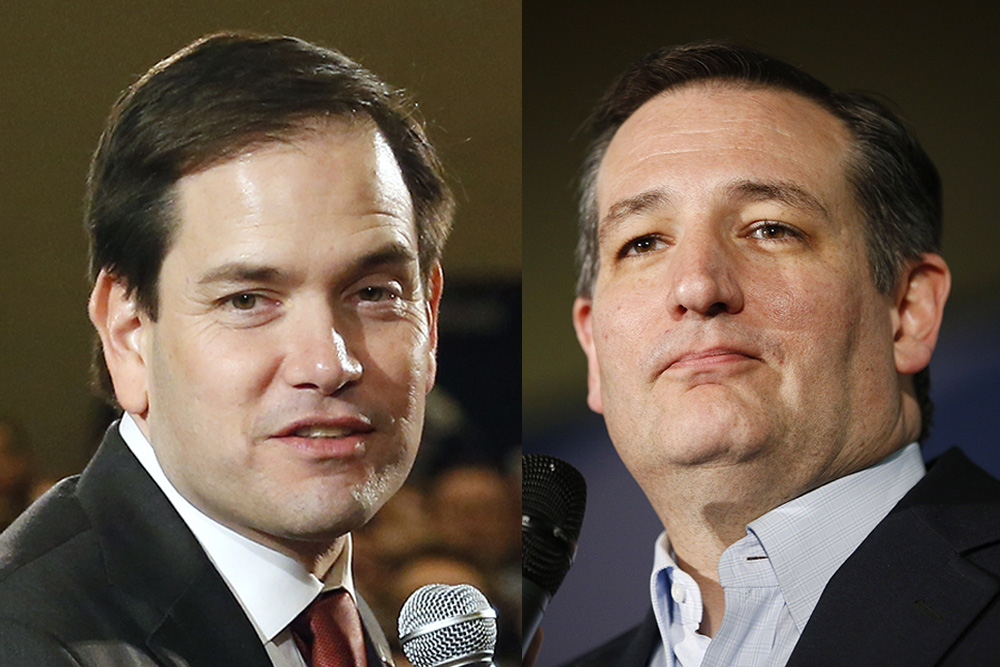
That means Ben Carson and John Kasich. Neither has any path to the nomination, and if they wish to be known as principled conservatives rather than as self-centered blowhards, they need to get out of the way and back one of the only other conservatives with a chance of success, Sen. Marco Rubio or Sen. Ted Cruz.
The brutal math of the neck-and-neck race between Cruz and Rubio means neither has any reason to feel he should drop out. Each can make the case that he is the most viable non-Trump candidate. They are equal in the number of delegates won, and perhaps equal in their chances in states that will be decided between now and mid-March.
Rubio, additionally, is seeing late deciders choosing him rather than Cruz, as his strong favorability numbers and the entrance polls from Nevada indicate. He can also argue that Cruz has been weak where he should be strong, with evangelical voters especially.
On the other hand, Cruz can argue he is the only one who has actually beaten Trump in any of the contests so far. And it works in Cruz’s favor that if Rubio were to drop out, fewer of his supporters than Cruz’s would consider voting for Trump, so Cruz might scoop up the majority of them.
The fact that neither man feels compelled to drop out is no tragedy, at least not yet. The next round of primaries, on March 1, includes no winner-take-all states. If Cruz or Rubio campaign effectively, there is a chance that Trump can be prevented from running away with all the delegates. Cruz should, at least, defeat Trump in the biggest contest that day, in his home state of Texas. Two weeks after that, on March 15, the winner-take-all prizes of Ohio and Florida loom. At that point, the stakes become much higher and the dangers much greater.
Cruz and Rubio both owe it to conservatives and the country to assess their chances hard-headedly after these competitions. If cool judgment finds that one or the other no longer has a strong chance, he should drop out and leave the field clear for a two-man race.
Perhaps no one runs for president without possessing such an excess of confidence as to make such cool self-deprecating judgement possible. So stepping aside might be something that these hyper-ambitious senators would find too tough. But that may be their only option other than delivering the GOP to Trump.
