How Iowa’s marquee candidates aim to combat state’s surging cancer crisis

Published August 26, 2026 7:00am ET | Updated August 26, 2026 8:16am ET


Cancer has emerged as an unavoidable issue on the campaign trail in Iowa, where candidates vying for two of the state’s most powerful offices are offering competing prescriptions for confronting the disease sweeping the state.

Iowa has the second-highest rate of new cancer diagnoses in the country and is one of just three states seeing a rise in cancer diagnoses despite the disease seeing a downward trend nationally, according to the Iowa Cancer Registry.

Researchers estimate 21,700 Iowans will be diagnosed with cancer in 2026, and 6,400 will die from the disease. Roughly 2 in 5 Iowans are expected to receive a cancer diagnosis in their lifetime.

The troubling trajectory has elevated cancer from a public health concern to a political issue as voters prepare to choose a new governor and U.S. senator in November. The two open-seat contests are among the most closely watched races in the country, giving candidates an opportunity to distinguish themselves on what can be done in Des Moines and Washington to reverse the trends.

There is no single explanation for Iowa’s cancer burden. Breast, prostate, lung, and skin cancers have helped drive the state’s elevated incidence, while researchers have pointed to a range of possible risk factors. Questions about agricultural chemicals and contaminants in Iowa’s water have also fueled political debate, though researchers have cautioned against attributing the statewide cancer rate to any one environmental cause.

Democrat Rob Sand and Republican Zach Lahn are competing to succeed Gov. Kim Reynolds (R-IA), while Democrat Josh Turek and Republican Rep. Ashley Hinson are battling for the Senate seat being vacated by retiring Sen. Joni Ernst (R-IA). The gubernatorial race is rated as “leans Democrat” by the Cook Political Report, and the Senate race is rated as a “toss-up.”

The four candidates agree the issue needs to be addressed and that it’s hurting communities in the Hawkeye State, but their ideas for solutions vary.

Lahn and Sand find common ground on water quality

In the gubernatorial race, Lahn and Sand have made Iowa’s cancer crisis a cornerstone of their campaigns, with both candidates putting cleaner water and changes to agricultural practices near the center of their proposed solutions.

Lahn has made that state’s rising rate the defining issue of his campaign, with his communications director, Dan Capodilupo, telling the Washington Examiner it is “one of the main reasons Zach got into the race.”

“High nitrate load in water is one of the top causes of colon cancer — one of the fastest-killing cancers that there is,” Capodilupo said. “Zach committed to funding the IWILL program to improve Iowa’s water quality and address this crisis head-on.”

Iowa’s Water and Land Legacy, or IWILL, is a statewide initiative meant to secure funding for Iowa’s natural resources.

Lahn also plans to offer incentives for farmers to adopt clean water initiatives, as some speculate the cancer crisis is tied to the agriculture industry.

“Zach will work alongside farmers to provide incentives for proven conservation practices that reduce runoff, improve water quality and protect our natural resources without punishing producers,” Capodilupo said.

Lahn’s broader platform calls for independent state safety testing of products used in Iowa and directing more University of Iowa research toward determining the cause of the state’s cancer problem. He has also taken aim at large agricultural companies, proposing antitrust action against dominant agricultural companies while emphasizing his policies would not punish individual farmers.

Sand has similarly made water quality a major component of his platform on the cancer problem, but has paired those proposals with a broader focus on prevention, screening, and access. He has called the cancer crisis an issue that transcends politics and has traveled the state speaking with families affected, according to his press secretary, Maddie Moher.

“Rob has heard firsthand from Iowans in every corner about the toll cancer has taken on their families and communities,” Moher told the Washington Examiner. “Their stories are a reminder that cancer doesn’t care who you vote for, what your politics are, or where you live.”

His “A Healthier Iowa for All” plan calls for increased water-quality monitoring, expanded conservation incentives for farmers, additional wetlands to filter pollutants, and greater transparency surrounding manure management. Sand has also proposed increased radon testing and the creation of a Cabinet-level cancer task force to coordinate the state’s response.

Sand also pushes for improvements on the healthcare side by supporting expanded access to early cancer screenings and follow-up testing, increasing tobacco prevention efforts, and reversing Iowa’s privatization of Medicaid.

Despite their overlap, Lahn and Sand are still seeking to draw contrasts. Sand’s campaign accused Lahn of failing to offer a plan for the crisis.

BOTH GUBERNATORIAL CANDIDATES LOOK TO MAKE IOWA HEALTHY AGAIN

“Zach Lahn has refused to release a plan to address this issue, and has promised to ban some of the most promising new cancer treatments,” Moher said.

That leaves Iowa voters with two candidates who differ substantially on healthcare policy but agree that improving Iowa’s water should be part of the effort to bring its cancer rate down.

Hinson and Turek diverge on how Washington should tackle cancer

The candidates battling to represent Iowa in the U.S. Senate have similarly put the state’s cancer crisis at the forefront of their campaigns, but Hinson and Turek differ on where Washington should focus its response.

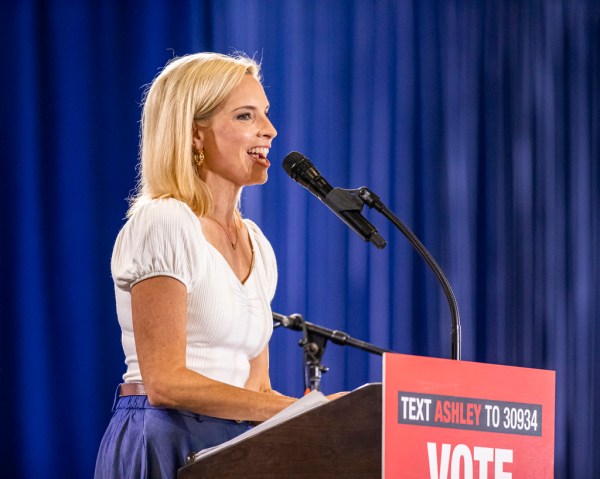
Hinson has centered her approach on expanding cancer research and improving access to screening and early detection, particularly for Iowans living in rural communities. She has made her pitch by pointing to her resume in the House, both introducing and sponsoring legislation.

“Iowa’s growing cancer rate is unacceptable, and we have to work together to fix it,” Hinson told the Washington Examiner. “That means more funding for cancer research, early detection and prevention efforts, especially in rural areas, and innovative treatments that can save lives.”

A spokesperson for Hinson’s campaign cited her previous work to address the high diagnosis rate in Iowa, particularly through the CATCH IT Act. The legislation aims to improve rural healthcare providers’ access to equipment, including mammography machines, mobile cancer screening units, CT scanners, and diagnostic ultrasound equipment.

She also introduced legislation in August that would direct a portion of federal revenue collected from tariffs on imported tobacco products toward cancer research, with a focus on pediatric and rare cancers.

Turek, meanwhile, has tied Iowa’s cancer problem to a broader argument that patients are being denied affordable and necessary medical care, making changes to health insurance a central part of his proposed response.

“I also think that every single Iowan that I talk to believes that it’s fundamentally wrong that insurance companies are dictating care and that we’re maximizing profits to these large insurance companies where they’re making billions of dollars in profit, literally just pulling care away, off the backs of the most vulnerable,” Turek told Ability magazine.

Turek has also mentioned how the issue is personal to him. His grandmother died from pancreatic cancer, and his father battled cancer after being exposed to Agent Orange while serving in Vietnam. Additionally, his sister was diagnosed with breast cancer, and her insurer initially refused to cover a PET scan to see if the disease had spread, an experience he has often cited.

Like Hinson, Turek refers to his resume as he discusses his plans to tackle the cancer problem. He points to bills he sponsored in the state Senate that seek to move funding toward research and ban medical devices that use carcinogens.

Similar to the gubernatorial candidates, Turek has looked further upstream, connecting Iowa’s cancer problem with its long-running water quality concerns. His platform calls for additional water quality sensors and a crackdown on chemical companies that pollute water supplies.

HOUSE DEMOCRATIC CAMPAIGN ARM ADDS FIVE NEW CANDIDATES TO ITS ‘RED TO BLUE’ PROGRAM

Hinson and Turek’s competing approaches give voters a distinct choice over Washington’s role in confronting the crisis. Hinson has emphasized getting more resources for Iowa communities, while Turek argues those efforts must be coupled with broader changes to the healthcare system.

Whoever Iowa voters send to Des Moines and Washington will inherit a complex cancer crisis that is greater than one solution. But with diagnoses continuing to rise, candidates across party lines increasingly agree that reversing the trend requires state and federal action.