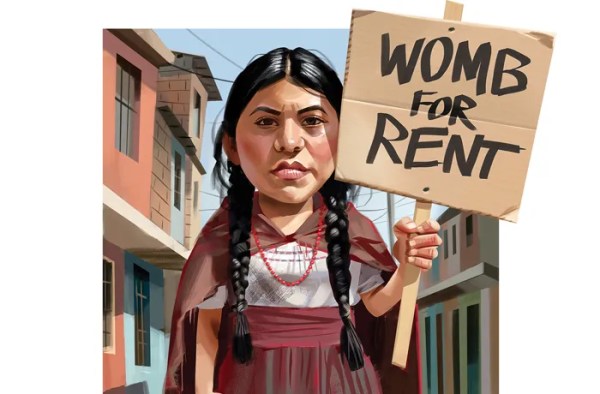
Who sees the mother?

Published August 27, 2026 6:00am ET


The week you bring your precious child home from the hospital, your phone fills with congratulations and, if you’re truly fortunate, your porch fills up with food from friends. Everybody wants to know how the baby is sleeping and whether she has her dad’s nose. Fewer people ask the other question: how is her mother doing?

Scripture tells us numerous stories about God’s provision for women who pray for His blessing. Hannah, who struggles with infertility, is blessed with a son, Samuel. Sarah was 90 when her son Isaac was born, after believing for decades she would never conceive. And of course, God provides for Mary of Nazareth through the miracle of her conception and birth of His son, Jesus Christ. Throughout Scripture, the Lord consistently reminds us that his provision, grace, and faithfulness are evident in the many different phases of motherhood.
In Ephesians 5:1, the Apostle Paul calls on believers in Christ to “Follow God’s example therefore, as dearly loved children, and walk in the way of love, just as Christ loved us.” Caring for mothers across all stages of life is just one way we as Christians can follow God’s example. Practically, I believe this includes ensuring underutilized resources reach America’s mothers.

Across our nation, we know that the resources for many struggling mothers are already here: a pharmacy down the road can run a blood pressure test; a telehealth line can conduct a quick, convenient, and private check-in. Community health centers can be equipped to handle the most common problems that arise, and our churches can also play a vital role. One of my top priorities in the Senate is raising awareness of these resources and finding avenues for them to become more accessible. 

The United States — the most blessed and prosperous nation in human history — has the highest rate of maternal mortality of any developed country, even though we spend more on healthcare than any nation on Earth. According to the Centers for Disease Control and Prevention, more than 8 in 10 of these deaths are preventable. And deaths are only the beginning: every year, tens of thousands of American women nearly die — they hemorrhage, suffer strokes and heart failure, or leave the hospital with injuries that follow them for years.

Most of these struggles come in the weeks and months after a mom goes home — after the congratulations stop, after everyone around her assumes mother and child are doing fine. These complications can include bleeding, heart problems, high blood pressure, infection, and depression; problems we know how to treat if someone catches them in time.

Catching them isn’t complicated or expensive; it just takes a postpartum checkup, where somebody takes a woman’s blood pressure, screens for depression, or asks how she is really doing. Yet roughly 40% of American mothers never make it to that appointment. Plenty could not get there if they tried, since in well over half of our country’s rural counties, there is no hospital delivering babies and no obstetric provider at all. In parts of Alabama, a checkup can mean an hour in the car each way. With your newborn in the back seat, this simply isn’t an option for many families.

That’s why I introduced the More Opportunities for Moms to Succeed, or MOMS, Act in the Senate to ensure moms have the resources they need, including prenatal, postpartum, and early childhood development care, telehealth when the nearest specialist is a county away, and support for community and faith-based organizations. And it’s why I joined a bipartisan group of colleagues on the Rural Obstetrics Readiness Act, which trains and equips rural hospitals to handle obstetric emergencies.

I am also proud to lead the NIH IMPROVE Act, which would authorize the only dedicated federal research aimed at solutions for the maternal mortality crisis. Today, when a new mother leaves the hospital, our healthcare system can lose sight of her. This causes many problems for families that could have effectively and inexpensively prevented a complication had a woman seen a healthcare provider earlier. 

AMERICA MIGHT BE WITNESSING PEAK MOTHERHOOD

Of course, our government cannot be the whole solution, but we can help spark the change. Earlier this year, the Trump administration did just that by launching Moms.Gov, an initiative included in my MOMS Act that provides a one-stop shop for mothers to access underutilized resources. I’m also grateful for partners such as Healthy Moms, Healthy Babies America, who understand that protecting moms and babies isn’t a red or blue issue — it’s an American issue. In the Senate, I remain laser-focused on passing the MOMS Act, the Rural Obstetrics Readiness Act, and the NIH IMPROVE Act this year.

To be truly pro-life is to protect the baby and the mother throughout a woman’s pregnancy journey, in the delivery room, and in the years that follow. If there is a new mother in your community, ask about her — be the one who sees her. Then tell our government that we expect the same. Our country should be the safest place in the world to have a baby — one of my top priorities is making that a reality.

Katie Britt is a senator representing the state of Alabama.