

WHAT’S HAPPENING TODAY: Good afternoon and happy Wednesday, readers! The entertainment industry and moviegoers are mourning another major loss today. Tim Curry, the actor known for The Rocky Horror Picture Show, Muppet Treasure Island, and much more, passed away earlier today. 💔
- ☢️🚢 Callie was on the ground at the International Atomic Energy Agency’s ATLAS initiative launch, where Energy Secretary Chris Wright touted nuclear energy as the next fuel for the commercial shipping industry. Keep reading to find out what he had to say on how soon reactors on ships could be deployed.
- 🏭📝 Meanwhile, we take a closer look at the Environmental Protection Agency’s effort to repeal federal requirements for public input on air permits.
Welcome to Daily on Energy, written by Washington Examiner energy and environment writers Callie Patteson (@CalliePatteson) and Maydeen Merino (@MaydeenMerino). Email cpatteson@washingtonexaminer dot com or mmerino@washingtonexaminer dot com for tips, suggestions, calendar items, and anything else. If a friend sent this to you and you’d like to sign up, click here. If signing up doesn’t work, shoot us an email, and we’ll add you to our list.
Recommended Stories

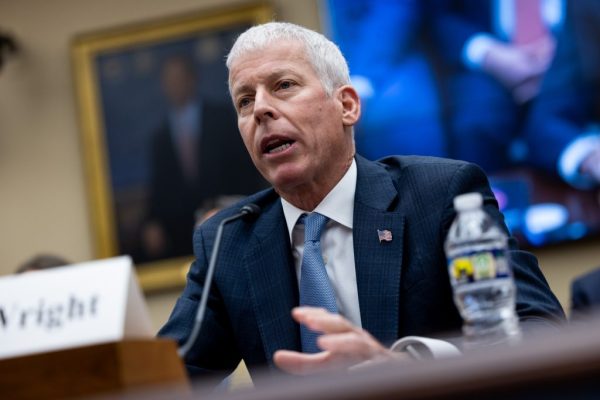
COULD NUCLEAR ENERGY FUEL COMMERCIAL SHIPPING?
Not only will nuclear energy be able to power artificial intelligence, Energy Secretary Chris Wright said, but it will also fuel commercial shipping.
“We’re seeing shipping move to natural gas, and just like our energy evolution, what’s the next step? What’s the next step in that road? Nuclear,” Wright said this morning. “Imagine shipping where refueling is … every few years. It’s not every voyage.”
The secretary said nuclear power can accelerate voyages and allow ships to carry more goods by reducing the need for refueling stops and ending reliance on oil or gas.
“We can lower the cost of trade and transport between nations,” he said. “I should stop talking because I get too excited. But I think it’s a great vision.”
His comments came during the International Atomic Energy Agency’s Atomic Technologies Licensed for Applications at Sea initiative, launched in Washington, D.C., on Wednesday, which is exploring the use of small modular reactors to power commercial ships and even provide offshore energy to coastal communities.
The timeline: It remains to be seen how soon the United States or other nations will be able to deploy nuclear reactors on commercial ships, or even at adjacent ports. If you remember, last week, NANO Nuclear CEO told Callie that he believed maritime nuclear power could be deployed as early as the early 2030s.
Wright, however, shied away from proposing a deadline.
“[I]t’s going to require international regulators, governments working together…the key process in gathering started this week. Right here, right now,” Wright told Callie during a press conference this afternoon. “When that leads to ships and transformation of global shipping, too early to say deadlines for that.”
IAEA director general Rafael Grossi also pointed out that the idea of using nuclear energy to fuel commercial ships isn’t something that will happen in 200 years.
“This is coming,” Grossi said.
Incentives for the industry: There is widespread agreement that installing nuclear reactors on commercial vessels is going to take a lot of money. Nuclear energy on land already is considered to be the highest-cost energy generation.
The Trump administration has aimed to relieve that financial burden by extending federal subsidies for nuclear power plants, and offering loans from the Department of Energy to build advanced and traditional reactors.
When asked if the administration would consider doing the same for a maritime nuclear energy industry, the answer is “not yet.”
“No plans for that right now about having tax or federal policies to incentivize nuclear shipping,” Wright told reporters. “This is not a plan for big subsidies or picking winners and losers. This is just putting the commercial framework in place so that innovation and competition will drive progress.”
EPA SEEKS TO SHIFT POWER TO THE STATES OVER INDUSTRIAL FACILITIES AIR POLLUTION
The Environmental Protection Agency could soon impose a rule that could limit communities’ ability to have a say in proposed industrial projects like data centers.
What’s being reported: The New York Times reported that the EPA within the next year plans to finalize a proposed rule that would eliminate a federal requirement that facilities classified as “minor” polluters must provide public notice and seek input through states and local agencies for air permits.
The Clean Air Act requires “minor” air polluters to disclose how much pollution their proposed project will release. The EPA proposed a rule in July that would repeal the federal requirement and give states and local agencies authority to decide whether or not the public can participate in reviewing minor polluters’ permits. The comment period for the proposed rule ended on Aug. 21.
What’s considered a “minor” polluter? A minor polluter is any stationary facility that emits pollutants less than 100 tons per year. Any industrial source like a chemical manufacturer could be considered a minor source if it installs emission control to remain below the threshold. Data center developers have been building out on-site gas-fired plants for power generation.
As we have previously noted, communities across the country have been grappling with the rapid expansion of data centers with people raising concerns over local resources.
The EPA told Maydeen in a statement that the proposed rule is not solely focused on data centers, calling the New York Times reporting “fake news.”
“Don’t let yourself get fooled by the fake news media,” an EPA spokesperson said in a statement. “In our proposal we are saying that states get to pick how they want their permitting process to go for minor sources. The proposal does not directly address data centers. In fact, there are thousands of minor sources including laundry mats and car repair shops.”
The spokesperson added that the proposal does not require states to make revisions to their programs or alter emission standards. The EPA argued that the proposal realigns the program with the Clean Air Act and is meant to speed up the permitting process.
Reaction: Former EPA air chief Joseph Goffman told Maydeen that the permitting process is instrumental to ensuring that the industrial sources are operating to meet emission standards.
“It takes away one of the safeguards needed to ensure that new sources or sources undergoing major changes actually meet those [emission] standards in real life,” Goffman said. “It takes away public guarantee.”
Goffman noted that public input on an air permit is not intended to block the permit, but rather to ensure that its requirements will effectively reduce emissions.
All the rest
WRIGHT TALKS SAUDI ARABIA NUCLEAR DEAL: During this afternoon’s press conference, Wright also confirmed to reporters that President Donald Trump had sent the civil nuclear agreement signed with Saudi Arabia to Congress.
The agreement will supply American companies with access to Saudi Arabia’s nuclear energy program, with the goal of expanding U.S. industry exports and creating more American jobs. It does not allow for enrichment of nuclear materials.
When the deal was first announced, Trump praised it but said it hinged on Saudi Arabia joining the Abraham Accords. As of this week, the country had not made any indication that it was signing the accords or normalizing diplomatic relations with Israel.
Wright brushed off this fact this afternoon, telling reporters that the signing of the accords is being worked on in tandem with the nuclear deal.
“President Trump and the entire administration share the desire to get all countries in the Middle East to join the Abraham Accords, move past the Arab conflict and towards the Arab commerce,” Wright said. “So yes, President Trump has explicitly linked Saudi Arabia joining the Abraham Accords to the deployment of nuclear power into Saudi Arabia. Both of those tracks will be worked in parallel.”
TRUMP ADMINISTRATION LOOKS TO RUBBER-STAMP DRILLING IN THE ARCTIC: The Interior Department is reportedly planning to issue a categorical exclusion for some oil and gas drilling activities in Northern Alaska from National Environmental Policy Act reviews, making it easier to drill new wells in the remote region.
The details: A new report from Public Domain reveals that the categorical exclusion is expected to apply to nearly all stages of oil and gas development in the National Petroleum Reserve of Alaska, including seismic surveys and exploratory drilling.
Typically, a categorical exclusion is issued under NEPA when an activity has “no significant impact” on the environment. As activities such as seismic surveys rely on equipment and vehicles that can weigh over 15 tons, environmentalists insist that they must be subject to federal scrutiny.
According to Public Domain, the categorical exclusion is being developed without any public input. As written, it would also make it easier for oil and gas companies to build pipelines, mines, access roads and other infrastructure.
Quick reminder: The categorical exclusion would come just months after the administration held what it called a “historic” lease sale for oil and gas drilling in the NPR-A. The sale, held in March, garnered 430 bids on nearly 200 tracts spanning more than 1 million acres.
CANDIDATES SIGN AI PACT AHEAD OF MIDTERMS: More than 15 candidates signed onto a pact pledging to impose and support restrictions on AI data centers.
Wired reported that the pact includes five promises on data centers and AI: banning data center tax breaks, performing AI safety reviews, protecting workers from displacement, holding AI companies accountable, and opposing AI bailouts.
None of the candidates are Republicans. One is Dan Osborn, who is challenging incumbent Republican Sen. Pete Ricketts in Nebraska as an independent. Another is the Texas Democratic gubernatorial candidate, Gina Hinojosa, who is running against Texas Gov. Greg Abbott.
Abbott has recently taken a more aggressive stance on data centers by imposing a moratorium on the AI facilities and supporting certain regulations.
WHAT TO KNOW ABOUT THE DEADLY FLASH FLOOD IN NEPAL: Catastrophic flash flooding hit China and Nepal today, leaving over 150 people dead and dozens more reported missing.
The damage: CNN reported that Nepali officials are saying at least 157 people are dead as a result of the flooding, and upward of 300 people are still missing. At least 54 of those missing are American, according to the New York Post.
Photos show homes and apartments located along riversides partially submerged in muddy water. In one devastating CCTV video shared on social media, a wall of mud and water could be seen destroying buildings along the Nepal-China border, flooding streets filled with people fleeing.
The cause: Scientists are now saying that the deadly flooding appears to have been triggered by the partial collapse of a glacier located near the Nepal-China border. It was not immediately clear what caused the glacier to collapse, but Nepali officials have reportedly said an earthquake was detected in the region around the time of the flooding, according to Reuters.
Dan Shugar, an earth scientist and associate professor at the University of Calgary, told the outlet that satellite imagery also showed that a large amount of snow on the glacier had melted in the 24 hours before the collapse.
“Some of the glaciers in the valley were covered in snow yesterday and today they are mostly bare ice. So in other words (and I haven’t seen any weather station data yet), it was probably warm,” Shugar said.
RUNDOWN
Canary Media Is Maine finally about to make wind power happen?
Bloomberg Trump Administration’s Geothermal Push Gets Big Test in Utah Desert
The Associated Press Heat makes emergency rooms busier. Study shows which illness and injuries rise during hot spells