Post-apocalyptic worlds remain perennially compelling movie settings because they offer an escapist fantasy of life after social order. Strip away the institutions, laws, and contemporary conveniences that contour our daily lives, and see what remains. Ridley Scottâs latest film, The Dog Stars, based on Peter Hellerâs 2012 novel, revisits that harsh world. It does so against the incongruously gorgeous vistas of the Colorado Rockies and sprawling verdant fields.
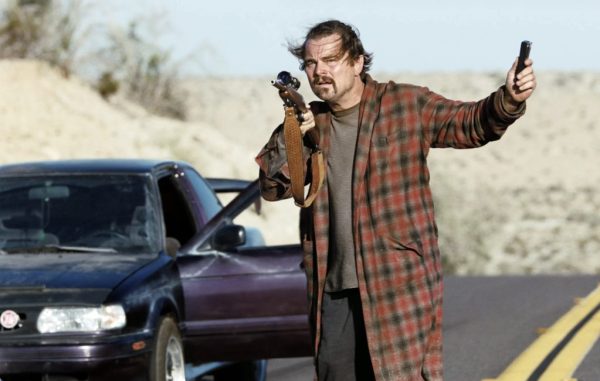
Scottâs civilization has not been ravaged by flesh-eating zombies or dystopian technology. Its survivors preside over the comparatively unglamorous ruins left by a deadly flu pandemic. It is here that we meet Hig (Jacob Elordi), a former mechanic and pilot, and Bangley (Josh Brolin), a heavily armed former Marine with whom he shares an abandoned airfield.
Recommended Stories
Elordi â otherwise busy setting tailoring trends in Manhattan and keeping half the writers at GQ employed â convincingly assumes the grizzled, industrious countenance of a man who can repair machinery and keep an aging Cessna in the sky. It is an impressive transformation, given that I am not entirely convinced Elordi knows how to unclog a toilet. Brolin complements him with the stoic, fatherly presence of a more weathered soul. âYou love this stuff,â Hig tells him after Bangley wantonly kills two teens who wander onto their property carrying little in the way of weaponry. Bangley never quite denies it. His methods, he insists, are what continue to keep them alive.
Lone survivors remain scattered across the continent, scavenging for scraps and fending off marauders. Hig takes his plane on scouting runs, gathering medicine and supplies, and occasionally dropping in on a nearby Mennonite colony where his mechanical skills are useful. Despite losing scores of families and friends, the Mennonites continue to farm, worship, raise children, and uphold their traditions. Though the world has ended, their social fabric remains remarkably intact.
That distinction supplies The Dog Stars with its governing idea. Bangley believes connection is a liability. He advises Hig to stay away from the Mennonites â whom he repeatedly calls Mormons, one of the filmâs running jokes â because every new relationship creates another vulnerability. Hig cannot accept that survival alone constitutes a life.
Scott has returned to this question throughout his career. Alien (1979), Black Hawk Down (2001), and The Martian (2015), all place human beings in circumstances where ordinary social protections vanish and character is reduced to its essentials. Here, Higâs struggle concerns what he is staying alive for, once staying alive has become an end unto itself.
The film consequently plays more as a drama than an action picture, although Scott has hardly forgotten how to stage violence. A nighttime assault on the airfield, which Bangley repels with rifles, knives, traps, and a small arsenal of improvised defenses, is among the filmâs most thrilling sequences.
The social premise deepens when Hig follows a mysterious radio transmission beyond the security of home. After his plane is forced down in unfamiliar territory, he encounters another guarded enclave occupied by Pops (Guy Pearce) and his daughter Cima (a charming Margaret Qualley, who shares an easy, understated chemistry with Elordi), a young widow and former medical student. As Hig repairs his plane and slowly earns their trust, Cima offers him something almost as scarce as his cherished real coffee: human connection. Their growing attachment restores a sense of purpose that mere survival could never provide.
Eventually, the trio reaches Grand Junction, the source of the transmission, where Scott offers a grotesque counterfeit of civilization. The settlement possesses the trappings of order â uniforms, hospitality, ritual, even a cheerfully retro aesthetic redolent of Fallout â but beneath them lies barbarism. Its polished surfaces conceal a society more savage than the supposedly primitive world outside.
The contrast with the Mennonites is pointed. The Christian farmers possess little technology, weaponry, or institutional grandeur, yet retain the habits that make communal life possible: trust, work, faith, family, and mutual obligation. Grand Junction has reconstructed civilizationâs appearance while discarding its moral substance. In spirit, it resembles the sort of fear-based society more commonly associated with the Soviet Union or California.
DAVID HARSANYI: EL SAYEDâS INSANE CIRCUMCISION ANALOGY
That tension ultimately resolves the argument between Hig and Bangley. Self-reliance, vigilance, and strength can keep people alive after the world ends. But they cannot by themselves rebuild a world worth living in. The Dog Stars understands that civilization depends upon people willing to trust one another, bind themselves to communities, and believe there remains something worth building toward. At the end of the world, survival may be instinct.
Hope is the thing that makes survival human.
Harry Khachatrian (@Harry1T6) is a film critic for the Washington Examiner. He is a software engineer, holds a masterâs degree from the University of Toronto, and writes about wine at BetweenBottles.com.