
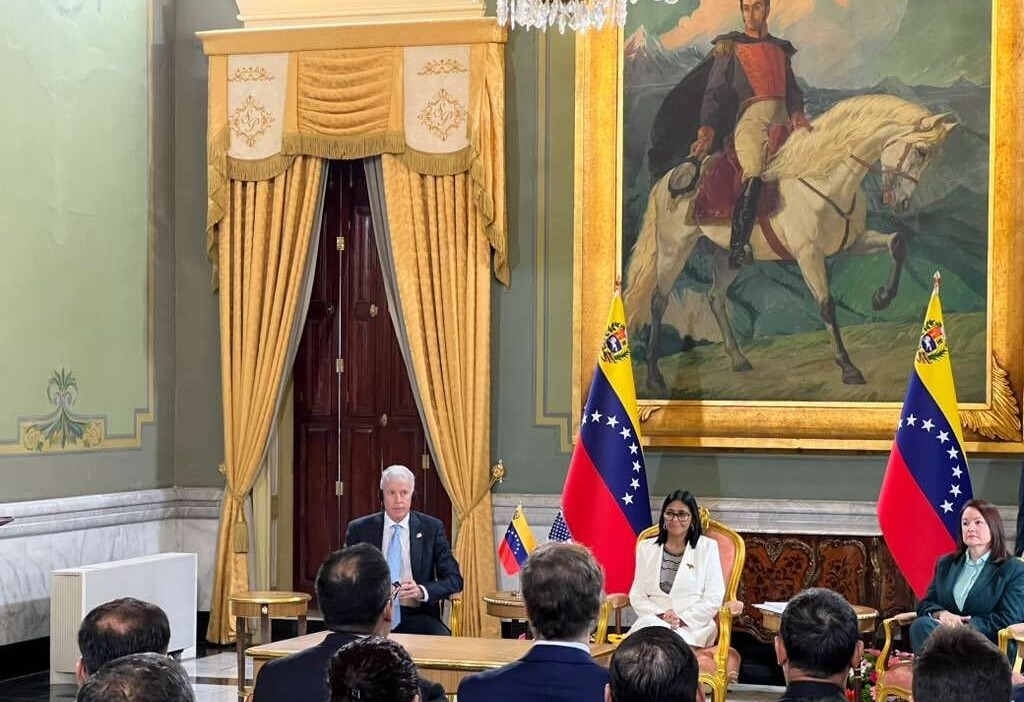
CARACAS, Venezuela — Five energy companies signed deals with Venezuela to rapidly increase oil and gas drilling, with some new wells expected to start as soon as this week, adding to the Trump administration’s efforts to increase production in the South American country.
Representatives with Chevron, Eni, GE Vernova, Primavera, and Aspect Energy all signed agreements with the Venezuelan government at the Miraflores Palace in Caracas on Wednesday afternoon.
Real journalism.Trusted by millions.
Unlimited access to in-depth reporting, expert analysis, and the stories that shape our country.
Already a member? Log in
U.S. Energy Secretary Chris Wright celebrated the agreements at the signing event, saying the administration was able to facilitate the deals at “Trump speed.”
“President Trump didn’t want a nudge or a slow drift in a positive direction. He wanted to see as fast as possible transformation in Venezuela,” Wright said.
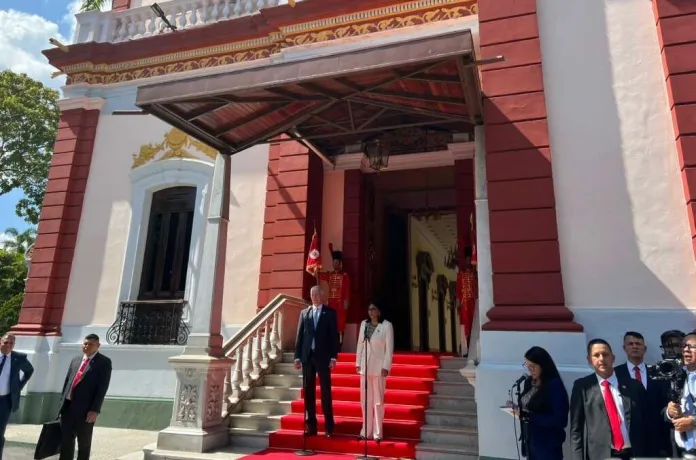
The deals are wide-ranging, some focusing on stabilizing the Venezuelan electricity grid and others on drilling new wells.
Eni CEO Claudio Descalzi said after the signing that the Italian oil and gas major could start on new wells as soon as Thursday. The company aims to achieve 1 million barrels of production per day.
Chevron’s deal, announced early Wednesday, assigns the company additional land in the country’s oil-rich Orinoco Belt, where the company has been operating since 2001. As part of the agreement, Chevron plans to invest more than $7 billion over the next five years. It aims to more than double oil production to roughly 600,000 barrels per day.
The Trump administration ousted former Venezuelan dictator Nicolas Maduro on Jan. 3, bringing him to the U.S. to face narco-terrorism charges. At the time, Trump said that part of his motivation for changing the Venezuelan government was to reclaim and develop the country’s vast oil resources.
“We’re going to be taking out a tremendous amount of wealth out of the ground, and that wealth is going to the people of Venezuela, and people from outside of Venezuela that used to be in Venezuela, and it goes also to the United States of America in the form of reimbursement for the damages caused us by that country,” Trump said during a press conference just after Maduro’s capture.
The administration made it clear that they intended for the private sector to lead the revitalization of Venezuela’s oil industry, made possible by various policy changes from the U.S. and Venezuelan governments.
This includes the passage of a new hydrocarbons law in Venezuela, which ended state-owned oil company PdVSA’s monopoly on Venezuelan oil and reopened the country to private and foreign investment. Under the former rules set by socialist leader Hugo Chavez, PdVSA held a 60% minimum share of all joint ventures. This pushed out nearly all remaining U.S. companies, such as Exxon Mobil and ConocoPhillips.
The deals announced Wednesday are separate from the deal made by the Trump administration late last week.
As part of that agreement, the government is taking a 35% equity stake in private oil and gas exploration and production company North American Blue Energy Partners.
The White House said earlier this week that “Venezuelan interim authorities” granted NABEP, a private oil and gas exploration and production company, 100-year concessions for 17 oil fields that have proven reserves of roughly 65 billion barrels of crude.
The company, which is led by Venezuelan businessman Alejandro Betancourt, has granted the Pentagon’s Office of Strategic Capital a 35% equity stake in its corporate parent. The White House said this came “at no cost to the American taxpayer.”
The desire to bolster the Venezuelan oil industry and increase U.S. imports of the heavy crude oil has been accentuated by surging gasoline and oil prices caused by the months-long war in Iran.
The Republican Party faces an uphill battle to keep both the Senate and the House during the November midterm elections, and high gas prices complicate those efforts.
MOST OIL PASSES THROUGH STRAIT OF HORMUZ SINCE WAR BEGAN, CHRIS WRIGHT SAYS
Trump has attempted to persuade voters that higher gasoline prices in the short term are worth it to keep Iran from obtaining a nuclear weapon. But as the administration has repeatedly claimed Iran has been totally defeated and the U.S. is in control of the Strait of Hormuz, gas prices have only continued to rise.
As of Wednesday, the national average price of gasoline was roughly $4.12 per gallon, according to AAA, up from $3.18 one year ago.