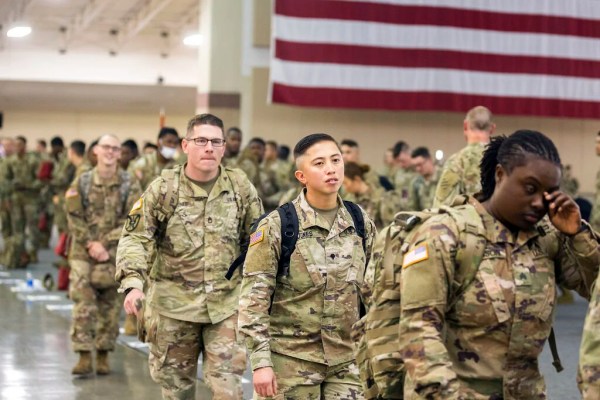
Six years ago, I joined the National Guard. If not for the military, my career choices in tech and a master’s degree would naturally have led me to occupy very homogeneous social circles. I do occupy some such circles, but I also ditched my laptop and home office to spend July in Fort Stewart, Georgia, in the rain and heat, training for combat with other soldiers from across America who work in every trade imaginable: Big Four consultants, mechanics, cops, firefighters, waiters, stay-at-home moms (for 50 weeks a year), software developers, and truck drivers.
The Reserves and National Guard provide a way for young, ambitious people to give something to their country without putting their careers, their dating, and their desire to build a family on hold. The military needs soldiers who have the brains to be corporate attorneys, bankers, journalists, and machine learning engineers in its ranks. What’s more: America’s white-collar workforce desperately needs the kind of people who are willing to drop what they are doing to be activated for hurricane relief, to sacrifice occasional weekends training in deserts and swamps, and, sometimes, to go to war.
Recommended Stories
I consistently hear those older than me stressing the need for more self-sacrificial, bought-in Americans. Within the cottage industry of podcasters and columnists diagnosing what troubles young men in America, there is a common refrain: Bring back national service. There’s some consensus that the problems of loneliness, mental health struggles, and economic instability are large issues among Gen Z, and, thus, such a large solution — conscripting these adults into the military for two or so years — is frequently proffered. It’s the kind of solution I hear in the papers of record, but also at my barber shop.
The end state of the solution itself is often somewhat vague. On Ross Douthat’s podcast Interesting Times, Scott Galloway recommends mandatory national service because “it will be hugely beneficial for patriotism, for America, and for young men and women.” These calls for national service revolve around the question of what other people should be conscripted to do to improve America and society. These calls lack the personal demand that John F. Kennedy made during his inaugural address: “ask what you can do for your country.”
As a member of Gen Z, I am suspicious of those older than me who did not serve, yet suggest a mandate that everyone else in my age cohort do so. I have reservations about those who have served, who claim that every young person would be better off undergoing the same experiences they had.
Military service is sacrificial. It is no small thing to ask an 18-year-old to enlist for four years, or to commission into active duty and lose crucial post-college career moves. To the very ambitious members of Gen Z, military service seems the largest self-imposition. When leaving college, missing out on four years spent working in Bay Area tech might spell an unrecoverable setback. To forgo a job offer in New York or Boston with a consulting firm after graduation may be financial malpractice. There are very few politicians and leaders looking this cohort of ambitious young people in the face and saying, “What can you, personally, do for your country?”
I’m part of this Gen Z sub-cohort. When pundits bemoan a perceived surge of undateable, financially adrift men addicted to online gambling, I don’t feel singled out: I work for a startup in San Francisco, I have a postgraduate degree, and I come from a two-parent household. Young Americans like me owe the country something, but the successful can also personally gain from being part-time soldiers.
IS SLEEP APNEA WORTH MORE THAN AN AMPUTATION? VETERANS DESERVE BETTER THAN THE VFW’S STANCE
There is a particular benefit to liberals in their twenties, like myself, in joining the military: spending time with a true cross-section of America. Yes, the military is composed of more Republicans than Democrats, but both are aided by working alongside and caring for each other as friends. Gathering around near-immovable tasks that take no account of your voting patterns is something that each of us, and the country, needs.
Calls to adopt national service as a cure to societal ills will likely continue. Whether it is adopted as a policy, and whether or not it works, there is a route right now for ambitious young Americans to answer a 65-year-old call to “ask what you can do for your country” without losing out on the career and life for which so many of us are striving.
Nathaniel Hanrahan is a Captain in the Army National Guard. The views expressed here are his own and do not reflect those of the Department of War, the Army, or the National Guard.