In Focus delivers deeper coverage of the political, cultural, and ideological issues shaping America. Published daily by senior writers and experts, these in-depth pieces go beyond the headlines to give readers the full picture. You can find our full list of In Focus pieces here.
Russia’s invasion of Ukraine was framed as a swift, precise operation that would bulldoze the government in Kyiv over the course of days. More than four years later, the Russian military is bogged down in a meat grinder with no clear path to an immediate victory.
Recommended Stories
Yet despite this ongoing and costly failure, European leaders remain intensely paranoid about the threat Moscow poses to their own continent. EU officials and NATO leaders characterize Russia as the West’s greatest threat, and this fear has inspired nations like Germany and France to begin revitalizing their militaries after decades of declining power.
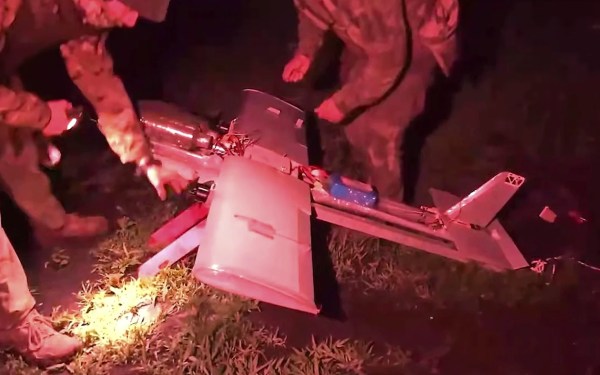
Recent incidents have shown that this fear is not entirely unreasonable. A drone fitted with explosive devices was discovered last month at the Leipzig/Halle Airport in Germany, forcing closures and suspended flights while the unmanned aerial vehicle was diffused. The German government this week pinned the incident on Russia, with Interior Minister Alexander Dobrindt calling it a “new quality of danger” compared to previous hybrid attacks from Moscow.
“Drone sightings, drone threats including in a hybrid context, are something we know from the past,” he added. “That a drone armed with explosives is at an airport is a new threat scenario.”

The Leipzig/Halle Airport incident is an inflection point for the continent. While “disinformation efforts, drone incursions, cyberwarfare, and other acts of sabotage” have become a well-documented threat from Moscow, the presence of explosives in a major European airport crossed a line — and leaders are now scrambling to prepare.
“It is clear that it has all the hallmarks of state-sponsored terrorism,” EU foreign policy chief Kaja Kallas said at a Tuesday press conference. “The question is: What do we do about this?”
Jan Techau, a senior fellow with the Transatlantic Defense and Security program at the Center for European Policy Analysis, told the Washington Examiner that the continent is in an attitude of “defend, defend, defend” against hybrid threats while preparing as quickly as possible for a potential hot conflict.
Open warfare between Russia and the West might seem fantastical as Moscow struggles to make progress against a country as small as Ukraine, but there are key geographic weak spots that strategists are eyeing with genuine concern.
“The worst-case scenario is open warfare on NATO’s eastern flank — a Russian attack on a NATO country on the eastern flank in the Baltics, or elsewhere […] it’s the scenario that NATO is preparing for and that NATO was built for,” Techau said. “And it’s scary not just because of the war itself. It’s scary because the Europeans are militarily reinforcing but they’re not there yet. And it’s scary because it could test the transatlantic bond. The Europeans are not quite sure whether the Americans would be a reliable partner.”
One region that gives defense experts pause is the Suwalki Gap, a small stretch of land between Lithuania and Poland that is bordered by Belarus and Russia. In Europe’s worst nightmare, Russian forces could blitz the 40-mile corridor and effectively cut off the Baltic nations from the rest of the NATO alliance.
“A crisis in the Baltics would immediately test European resolve, particularly if Russia combines massive force at the front with sabotage, hacking, and information operations in Europe’s rear,” a report from the Harvard Kennedy School’s Belfer Center for Science and International Affairs asserted back in February.

Such a scenario would likely force vertical escalation of threats, up to and including discussions of nuclear weapons. Demanding immense military resources for the sake of reclaiming small NATO members like Lithuania, Estonia, and Latvia would be a powerful stress test of the alliance’s cohesion and efficacy.
“The method to grab a little piece of land and then build the fences very, very quickly so that NATO would have to use an excessive amount of military force to gain it back — and then turn that into a nuclear issue by saying, ‘This is now our territory. If you attack back, we could threaten you with nuclear arms.’ This is kind of the scenario that military planners in Europe and in the U.S. have been thinking about for a long time,” Techau told the Washington Examiner.
In these scenarios, Russia’s goal would not be to win a conventional war of expansion against its Western opponents, but to turn a small slice of NATO territory into a dividing point that ultimately busts up the alliance.
“If Putin does decide to attack NATO, his goal will be to divide and discredit the alliance rather than actually defeating it,” a Thursday report from the Atlantic Council said. “Crucially, Putin may also believe that today’s volatile geopolitical environment represents a unique window of opportunity for Russia to split the West and achieve victory over Ukraine.”
WITKOFF AND KUSHNER TO HEAD TO KREMLIN FOR MEETING WITH PUTIN BEFORE KYIV VISIT
Europeans are particularly afraid that they will not be able to trust that the United States will have their back as Russian threats escalate. Just days before the German government blamed Russia for the airport drone incident, President Donald Trump told the press that he was confident Moscow would never attack a NATO country.
“I’ve had good talks with Putin,” Trump said during an Oval Office event last month. “He’s not going to be attacking a NATO territory.”
Additionally, the U.S. military is currently tangled up in operations against Iran. That conflict, which multiple members of NATO actively opposed, further frayed relations between the White House and other NATO leaders.
Trump has repeatedly threatened to leave the alliance entirely, which does not bode well for how the U.S. would respond if asked to join a conflict against Russia for reclaiming a slice of Baltic territory.
Russian hybrid warfare remains the most likely long-term threat to European nations, but security experts remain concerned that if this gray-zone campaign of subversion goes further, hot conflict will no longer seem so far-fetched.