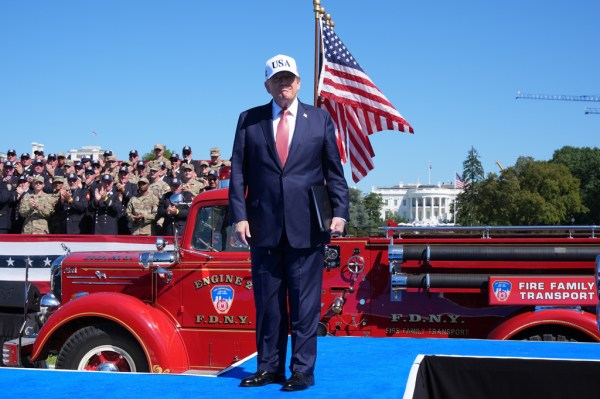
The old political proverb that “all politics is local” is becoming irrelevant to the modern campaign trail as candidates are no longer branding themselves to residents of their state but presenting a profile to the national stage.
Candidates running for Congress, governor, and even lower offices in the 2026 midterm elections increasingly find themselves campaigning on issues that extend far beyond state lines.
Recommended Stories
A controversy in Michigan can become ammunition in Georgia. A proposed data center outside a small town in Ohio can become part of a national debate. And an endorsement or association with President Donald Trump, the Democratic Socialists of America, or a world leader can define a candidate long before voters learn much else about them.
The trend is part of the broader nationalization of American politics, which has steadily eroded the independence candidates once enjoyed from their political parties. That shift is particularly visible in the 2026 midterm elections, where candidates must balance national political identities that can generate attention, donations, and primary support with local concerns that could determine the victor in November.
“In the earlier era, it was the case that while people were aware of what was going on in politics nationally, they also prioritized and prized sort of their own close-to-home issues more than anything else,” said Ethan Porter, an associate professor of media and public affairs and of political science at George Washington University.
Those concerns have not disappeared, Porter said, but they are increasingly “eclipsed” by voters’ broader political commitments.
The letter next to the name
For candidates running in this year’s elections, one of the biggest consequences is the difficulty of escaping the reputation of their party affiliation.
“Two or three decades ago it was much more straightforward to identify with a party but also declare yourself independent of that party,” Porter said.
That has become more difficult as national media, social media, and increasingly polarized parties have created political brands that stretch across state lines.
“The first thing people notice is whether there’s a D or an R next to a candidate’s name,” Porter said, “and that will deeply impact how that candidate is perceived.”
The dynamic is particularly pronounced in the Trump-era Republican Party, where candidates regularly compete for the president’s endorsement and loyalty to Trump has become a dividing line in Republican primaries. In other words, Trump has become the party, Porter said.
For example, in Texas’s GOP primary runoff election between Sen. John Cornyn (R-TX) and Attorney General Ken Paxton, Trump’s endorsement ultimately became the tipping point between the two candidates. The president deemed Cornyn not close enough to his MAGA movement, backing Paxton and ousting the incumbent.
But Democrats face their own version of the phenomenon.
The rise of socialist candidates has created another national political identity candidates can embrace, but also one their opponents can use against them. Those candidates can simultaneously campaign as Democrats and as critics of the Democratic establishment.
TRUMP VS. OBAMA ENDORSEMENTS: HOW PARTY LEADERS PICK THEIR CANDIDATES
Porter said part of the attraction may have less to do with voters understanding every ideological distinction than with the appeal of politicians willing to challenge their own party.
“They are both of the party but not of the party,” Porter said of socialist candidates. “They’re outsiders to the party, and people like that.”
National politics brings national money
There is also a practical reason for congressional candidates to talk about issues thousands of miles beyond their districts: People living there can send them money.
Online fundraising and social media have dramatically expanded the potential for a campaign.
A candidate who takes a provocative position on a national policy can generate news coverage, social media engagement, and donations from across the country, even if most of those people will never see the candidate’s name on a ballot.
For example, Michigan Democratic Senate nominee Abdul el Sayed has taken a firm stance opposing Israel. While Michiganders may be more concerned about paying their utility and grocery bills, the take garnered national attention and caught the eye of people across the country who were willing to donate to el Sayed’s campaign.
Twenty years ago, Porter said, candidates had little ability to make that kind of appeal outside their states.
“That’s just obviously no longer the case,” he said. “Candidates are constantly appealing to co-partisans out of state.”
Porter also noted that the decline of local media has reinforced the incentive to campaign nationally.
“It can be hard to actually sort of get in the limelight based on local issues,” he said.
A candidate weighing in on a major national controversy, by comparison, can immediately enter an existing political conversation.
“The worst thing you can be as a candidate, especially for a competitive race, is ignored by voters and the media,” Porter said.
Winning the primary, surviving the general
Nationalization presents perhaps its biggest challenge during the transition from a primary to a general election.
Primary voters tend to be more partisan and ideologically committed, rewarding candidates who take firm positions on the issues propping up their party. The broader electorate that turns out in November can look considerably different.
“Candidates in both parties are going to be incentivized during primaries to appeal to the most die-hard partisans,” Porter said, cautioning that “general elections are not won by student die-hard partisans” but by voters closer to the political center.
That can leave candidates trying to unwind parts of political identities they spent months constructing.
Michigan has offered a particularly clear example this cycle as el Sayed attempts to appeal to independents and centrist Republicans after taking deeply partisan stances. El Sayed emerged from a primary election in which disputes over Israel, pro-Israel campaign spending, and association with controversial streamer Hasan Piker became major lines of attack.
TRUMP ENDORSEMENT TRACKER: HERE’S WHO THE PRESIDENT HAS PICKED IN GOP MIDTERM ELECTION PRIMARIES
Those issues could mobilize ideologically synonymous voters nationally, but he now has to compete for a broader electorate concerned with Michigan’s economy, industry, and cost of living.
Republicans face the same dilemma.
Trump’s endorsement can carry enormous weight in a Republican primary, but tying a campaign too closely to the president creates risks in states or districts where his standing is weaker among the general electorate.
Nationalizing a campaign, Porter said, can therefore be “great” for raising money and winning a primary.
“But in doing so, you might have taken provocative, divisive stances on issues that are going to be much less appealing to the actual general electorate you will be facing in the general election,” he said.
When local issues become national issues
Nationalization does not only flow from Washington down.
The 2026 midterm elections are also demonstrating how issues that begin as disputes between local governments and residents can spread across the country and become part of national political identities.
Data centers are one example.
The rapid expansion of AI infrastructure has brought disputes over electricity costs, water consumption, development, and land use into races around the country. A voter may not have a data center proposed in their backyard but can still encounter advertisements, videos, and political arguments originating in communities far away.
“We’re in an era where political advertising is not localized at all,” Porter said. “You might not have a data center in your backyard, but you might see a persuasive ad.”
Whether the issue ultimately develops a durable partisan identity is less clear.
Porter said data center opposition could instead become an expression of anti-incumbent sentiment, with voters blaming whichever party is in power when they become dissatisfied with development or economic conditions.
HOW FAKE POLLING COULD UPEND THE MIDTERM ELECTIONS
It illustrates how nationalization transformed not only the way candidates campaign but the issues they campaign on. A fight that begins over a project in one community can provide campaign language for candidates across the country in a time when national political divisions increasingly shape how voters understand what is happening in their own backyards.
For candidates navigating the midterm elections, that leaves increasingly little separation between what counts as a local issue and what counts as a national one.