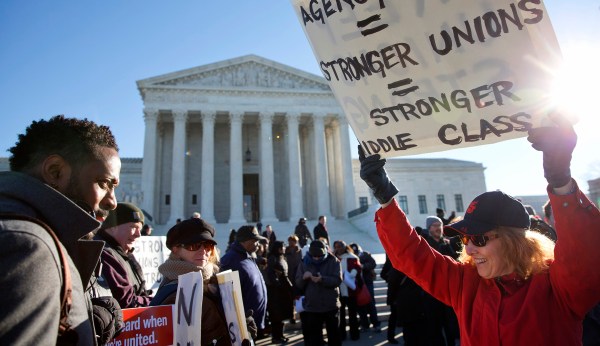
Every Labor Day brings another round of headlines lionizing organized labor’s role in American life. This year, the more revealing story is what some union bosses are doing to keep workers from learning they don’t have to join at all.
In Oregon, a bill became law, effectively criminalizing mailers that inform public employees of their First Amendment right — affirmed by the U.S. Supreme Court’s 2018 ruling in Janus v. AFSCME — to leave their union and stop paying dues without losing their job.
Recommended Stories

The Oregon statute is written broadly enough to chill almost any outside communication to a government worker about that right. The organization I work for sued, and the case is now before the 9th Circuit, which will determine what shouldn’t be a controversial point: The government cannot ban truthful speech about a First Amendment right just because a union finds that speech inconvenient to its bottom line.
In June, the New York lawmakers passed a nearly identical bill, A.10835-A, that would hand that state’s attorney general broad new power to investigate and fine groups over communications she concludes “falsely impersonate” a union. It hasn’t been signed into law yet — it’s sitting on Gov. Kathy Hochul’s (D-NY) desk — but the message is the same one Oregon sent: When workers start leaving in numbers that matter, some union allies would rather suppress the truth than change anything about the union’s practices.
Oregon and New York aren’t the only places workers are being cut off from a real choice, either. Some unions are dispensing with the legislature altogether and just locking the door. In Orange County, Calif., a pair of publicly compensated in-home caregivers say union representatives shut off the lights and blocked the exits during a new-hire orientation, refusing to let anyone leave — even for a bathroom break — until every attendee had signed paperwork authorizing the union to deduct dues from their paycheck.
My organization filed a class-action suit against that union on the caregivers’ behalf. A different court will ultimately sort out those legal claims, but you don’t lock the doors to force people to hear your pitch unless you’re pretty sure the audience won’t listen voluntarily.
It’s not an isolated case, either. This summer, my organization filed more than three dozen separate unfair labor practice charges against three California unions on behalf of home caregivers who say their wages were taken without real consent — forged signatures on cards workers never saw, opt-out requests ignored for years, and a security guard turning away a worker who’d never even signed up when she came in person to formally decline membership.
One caregiver’s “signature” on her membership card wasn’t even close to her actual name. In all, 36 workers came forward with some version of the same story: They tried to leave, and the union simply didn’t let them.
None of that is what a movement actually winning the argument needs to do. You don’t have to intercept the mail. You don’t have to keep the lights off. You don’t have to forge signatures.
Those are the acts of a movement that has run the numbers and doesn’t like what an informed, unpressured worker tends to decide.
The numbers explain why the stakes feel so high to union leadership. Since Janus, more than 295,000 public employees have left their unions with help from the Freedom Foundation alone, and public-sector unions nationally have forfeited an estimated $848 million in dues they used to collect by default.
Nobody had to talk them into leaving. Workers were simply told, after decades of automatic paycheck deductions, that they had a choice after all — and most who leave give the same reason — they never signed up for the union’s politics, and they’d rather keep the money.
If that’s what happens when workers get the facts, the honest response from union leadership would be to compete for members on the merits. Instead, in state after state, the response has been to make the facts harder to come by, leaving opt-out rights off the workplace rights posters required by law, or, in Oregon’s case, trying to make it illegal to mention the right at all.
BIG TECH’S AI FUTURE RELIES ON AN UNLIKELY HERO: THE BLUE-COLLAR WORKER
That’s worth sitting with this Labor Day, a holiday established to honor the American worker. Let’s honor the hundreds of thousands of workers who, the moment they realized they had a real choice, made it.
The job now is making sure the rest of them get that same chance — not a darkened room, not a law written to keep them in the dark.
Aaron Withe is CEO of Freedom Foundation.