

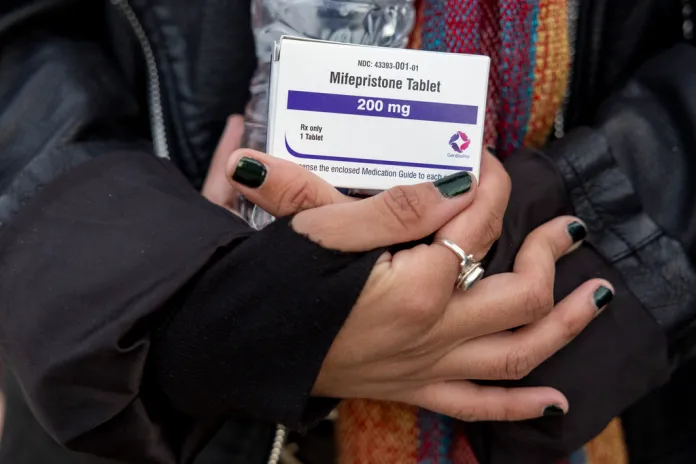
President Donald Trump’s Justice Department sought Wednesday to oppose Louisiana’s push to restrict abortion drugs by mail while refusing to defend the safety analysis behind the Biden-era rules, frustrating the appeals judges who pressed government lawyers to explain their position.
The arguments before the 5th U.S. Circuit Court of Appeals in New Orleans highlighted the administration’s delicate approach to a lawsuit that President Donald Trump’s base is cheering. The challenge is backed by Alliance Defending Freedom, which represents Louisiana and wants the Food and Drug Administration to restore in-person requirements for the dispensing of mifepristone.
Stay informed.Stay ahead.
Join Washington Examiner for unlimited access to the news, analysis, and commentary that matter most.
Already a member? Log in
“We are not taking a position on the merits,” DOJ lawyer Daniel Winik told the panel.
That stance reflected the one of Attorney General Todd Blanche’s earlier assurances that the administration would not defend the Biden administration’s prior approval of the mail-order abortion drug policies. But federal lawyers were also asking judges to reject relief sought by the state and prominent anti-abortion advocates while the FDA reassesses the drug’s safety.
“We are not defending what Biden did and will not,” Blanche said during his July confirmation hearing.
Winik shared that same view Wednesday morning, stating that the review was proceeding but that not much else could be said otherwise.
“The only thing I can say, Your Honor, is what we’ve said in the briefs, which is that FDA is conducting an ongoing review,” Winik said. “It is committed to do this. It’s doing it in an ongoing fashion.”
Wednesday’s exchanges underscored the conservative Trump administration’s delicate balancing act: refusing to defend the Biden-era safety findings, while asking judges to let the FDA finish its review before ordering the restrictions that anti-abortion advocates want. Meanwhile, Louisiana is just one of 23 Republican-led states hoping that ADF’s case prevails.
Louisiana argues the mail-order rules undermine its near-total abortion ban and force taxpayers to cover emergency care for complications. Restoring in-person dispensing could restrict online access nationwide, including in states where abortion is legal.
Winik argued the connection between the FDA’s rules and Louisiana’s alleged injuries was too indirect to give the state standing, the legal requirement that a plaintiff show concrete harm traceable to the challenged action. He also argued the Supreme Court’s intervention in May prevented the appeals court from granting the requested relief.
The high court in May paused a 5th Circuit order that restored the in-person dispensing requirement for mifepristone that the Biden administration had removed. Advocates have pushed for the rule to be repealed, in large part because states that allow such drugs have caused an influx of residents in states that restrict their access to obtain them, thereby flouting state laws limiting abortions.
Meanwhile, Judge Stephen Higginson, an appointee of former President Barack Obama, grew frustrated when Winik declined to explain whether Louisiana needed to petition the FDA before filing suit, an issue concerning the agency’s own procedures.
“I find it very, very unsatisfactory that the agency won’t give an opinion as to its own regulations,” Higginson said.
The questions extended to the scientific record. Higginson asked about Louisiana’s argument that the FDA created gaps in its safety data by reducing reporting requirements. Judge Priscilla Richman, an appointee of former President George W. Bush, asked what risks the agency accepted when approving other drugs.
Winik declined to take a position on the challenged safety analysis, emphasizing that the FDA’s review should address those issues.
The approach has also frustrated advocates seeking immediate action. Gabriella McIntyre, legal counsel at ADF, told the Washington Examiner before the hearing that the administration could resolve the dispute without waiting for another study.
“When it comes to what the DOJ could do now, of course they could settle this case tomorrow,” McIntyre said. She argued the issue of standing should be no problem for the state.
The judges also pressed Louisiana on whether federal rules caused the harms it described, rather than independent decisions by patients, prescribers, and states protecting abortion providers. Lawyers for drugmakers Danco Laboratories and GenBioPro defended the evidence supporting mail dispensing.
The Washington Examiner previously reported that a Senate Republican investigation led by Sen. Bill Cassidy (R-LA) found Danco, GenBioPro, and Evita Solutions could not adequately explain how they ensured prescribers complied with FDA safeguards. Danco reported average annual revenue of $16 million, while GenBioPro said roughly 95% of its revenue came from abortion drugs. Both disputed suggestions of noncompliance, with Danco accusing the senators of cherry-picking details.
Christina Francis, a board-certified OB-GYN with the Association of Pro-Life Obstetricians and Gynecologists, urged the FDA on Wednesday to “do its job and restore common-sense safeguards that protect women,” she told the Washington Examiner.
“The FDA abandoned women and girls when it removed longstanding safeguards for mifepristone and paved the way for mail-order abortions, leaving patients vulnerable to serious health risks and abuse,” Francis added.
BIDEN-ERA ABORTION BY MAIL RULES FACES KEY TEST AT APPEALS COURT HEARING
It is not clear when the court will issue a decision.
The next moves in the case will likely follow next month, when the FDA must update the district court on its mifepristone review and completion timeline by Oct. 7. The final completion of the review is likely to arrive sometime after the current midterm elections cycle, advocates told the Washington Examiner.
