
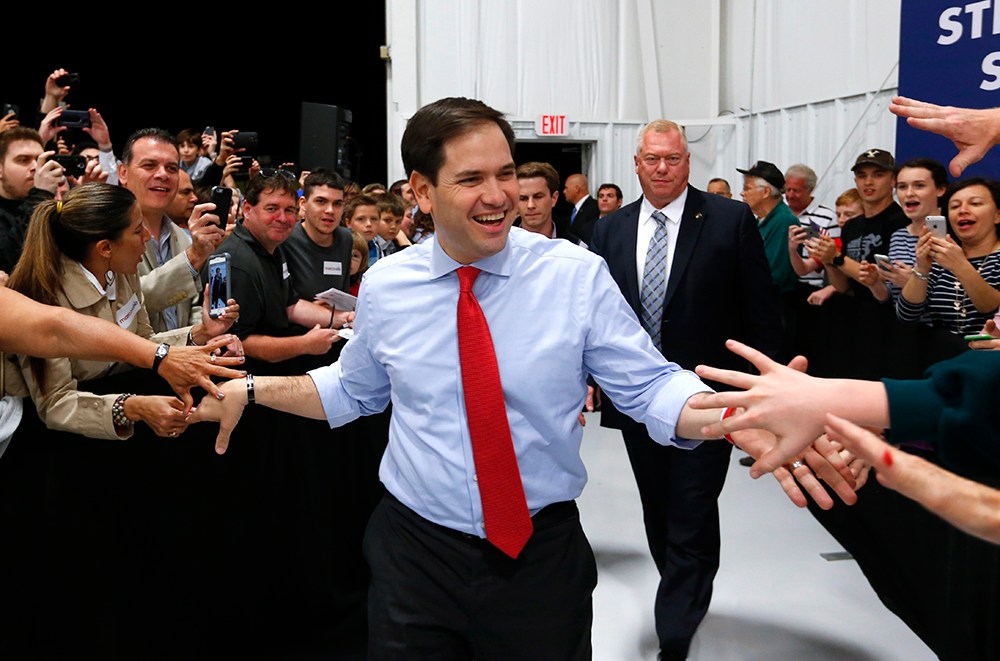
Marco Rubio’s grip on dozens of nominating delegates, despite suspending his presidential campaign, could help box out Donald Trump in Cleveland and force a contested convention.
Real journalism.Trusted by millions.
Unlimited access to in-depth reporting, expert analysis, and the stories that shape our country.
Already a member? Log in
The Florida senator exited the Republican campaign in mid-March. But officially, Rubio remains a candidate, and that entitles him to as many 91, and possibly more, of the approximately 167 delegates he won in various caucuses and primaries. Rubio’s hold on these delegates, and how deep into a contested convention fight it would stick (if at all) is determined by the varied rules of the state Republican parties where they were won.
“Our nominee will be the candidate who gets the 1,237 [delegate] votes, not just who comes closest. It may happen on the first ballot — or not. It is just too early to tell,” said a senior member of the Republican National Committee and GOP rules committee veteran. “Every state has different rules.”
National Review’s Eliana Johnson first reported on the complexities of Rubio’s delegates and their potential significance should July’s Republican convention is contested. Trump, the New York celebrity businessman and front-runner, leads the race for delegates over Sen. Ted Cruz of Texas. But the billionaire populist could fall short of the 1,237 he needs to secure the nomination before the primary season concludes in June.
Rubio suspended his campaign on March 15, after losing his home state primary, and its 99 winner-take-all delegate prize, to Trump. A Rubio campaign official did not respond to request for comment on the senator’s plans going forward.
Some GOP insiders believed that the senator suspending his campaign made his delegates immediately unbound and free to support the candidate of their choice at the convention. Theoretically, that would offer Trump a wider pool of uncommitted delegates to woo and possibly make it harder for Cruz and others inside the party to block the reality television star from the nomination on the crucial first ballot on the convention floor. But in fact, that’s not the case.
For example, in at least seven states — Arkansas, Iowa, Kansas, Massachusetts, North Carolina, Tennessee and Virginia — 62 Rubio delegates are bound to vote for him on the first ballot, even though he has suspended his campaign. That also is the case for the 29 Rubio delegates from Minnesota and Oklahoma, unless the senator’s name is not formally placed in nomination on the convention floor. If that’s the case, those delegates become unbound on the first ballot.
After the first ballot, most delegates are free to support whomever they wish, regardless of which candidate won the primary or caucus in the state they represent. There are all sorts of exceptions to this rule, depending on the state. Oklahoma binds delegates on every ballot; Tennessee binds on the first two ballots. What about the 10 delegates Rubio won in the Washington, D.C., GOP caucus? There are no rules addressing this scenario, party officials said.
Some RNC rules experts argue that there is no such thing as a “bound” delegate at all, regardless of directives from the state party. “Are the delegates bound in the first place?” The answer is no, they never have been,” said Curly Haugland, the RNC committeeman from North Dakota who also will serve as a delegate to the 2016 convention.
Haugland is a member of the RNC rules committee. He said that RNC rules 37 and 38 preclude the binding of delegates.
Ultimately, the convention rules committee will have the final say over the rules governing the nominating process in Cleveland. The panel, to be comprised of two delegates from each delegation representing the states and U.S. territories, will have the opportunity to approve a rules package that clears up any ambiguities or contradictions.
The rules committee, which meets in Cleveland the week before the July convention, will determine candidate eligibility to be placed in nomination on the convention floor. For instance, in 2012, the convention rules committee passed Rule 40(b), which said that a candidate had to have won a majority of delegates in at least eight states to be placed into nomination.
The panel might also choose to weigh in on the binding of delegates. Some rules experts say that the RNC has the power to supercede any directives given to delegates by their state parties. It has been 40 years since the Republican Party held a contested convention, making the rules process difficult to predict. But one rules change that is not expected to be entertained is one that would grant the nomination to the candidate who has won a plurality of delegates, but has fallen short of 1,237.
“There is a way to change the rules so that the plurality winner is nominee, but then the party would be creating weakest nominee in history,” said a GOP insider who has been involved in previous convention committee debates.