
Early September in France is la rentrée, the “return” to school and work from the long summer vacation. The political season resumes too. This September, la rentrée began the final run-up to the April-May 2027 presidential elections. France has a long tradition of strikes and street protests. No one was surprised that public-sector unions marked the return to work by going on strike, or that a quarter of a million high schoolers began the school year by blockading their schools, or that fishers, construction workers, farmers and even police officers marched to protest high fuel prices.
Recommended Stories

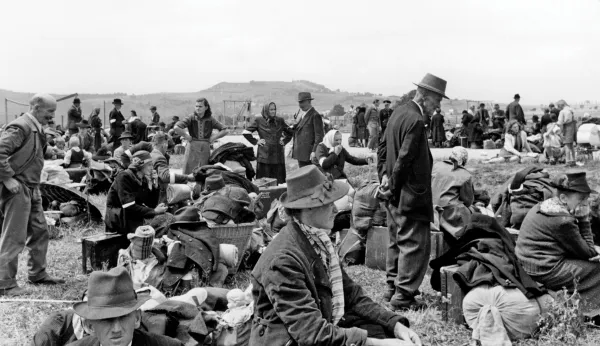
Within a month, however, a cascade of disorder developed on a scale not seen in years. The rioting and destruction on the weekend of Oct. 17-18 by an alliance of immigrant-descended “New French” and the radical Left has not just shaken the foundations of the Fifth Republic. It calls into question the future viability of France as a state and the French as a nation.
School for scandal
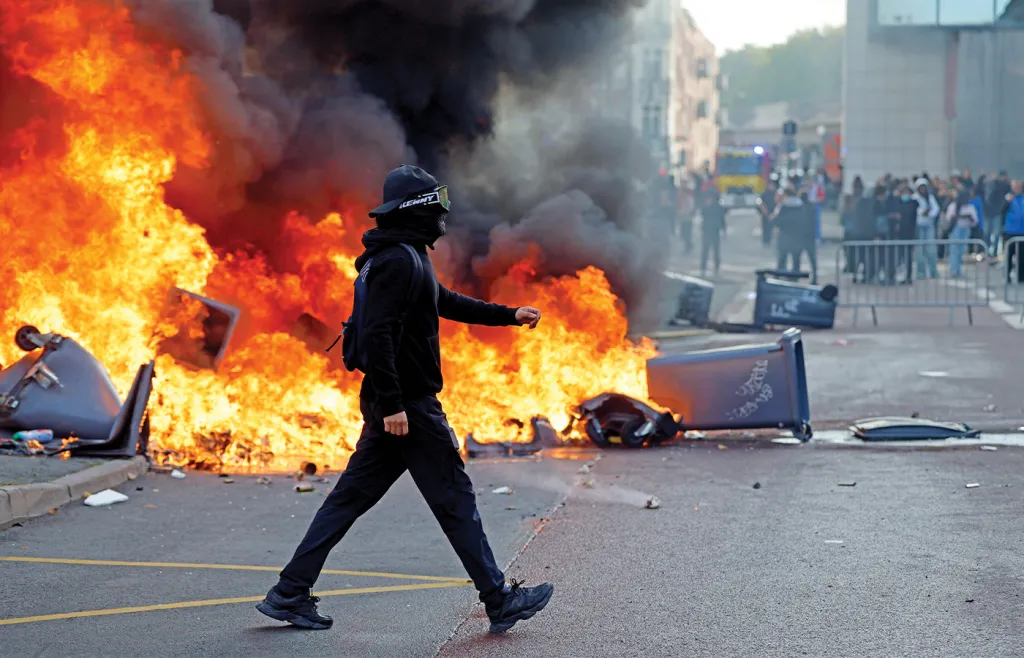
The school protests began on Sept. 18 in Saint-Denis, a northern suburb of Paris whose inhabitants are mostly of immigrant and migrant background. From there, they spread across the country. Police made over 6,000 arrests at the school protests in the last two weeks of September. More than a thousand schools were damaged, and more than 900 people were injured. At Annecy, the quiet lakeside town where Paul Cézanne painted, a pupil beat up a female teacher. In Marseille, a mob attacked firefighters and a hooded youth lit an aerosol and sprayed it in the face of a woman who remonstrated with the rioters. In Nantes, the Nelson Mandela high school was destroyed, the flames fed by its eco-friendly wooden construction and long central atrium.
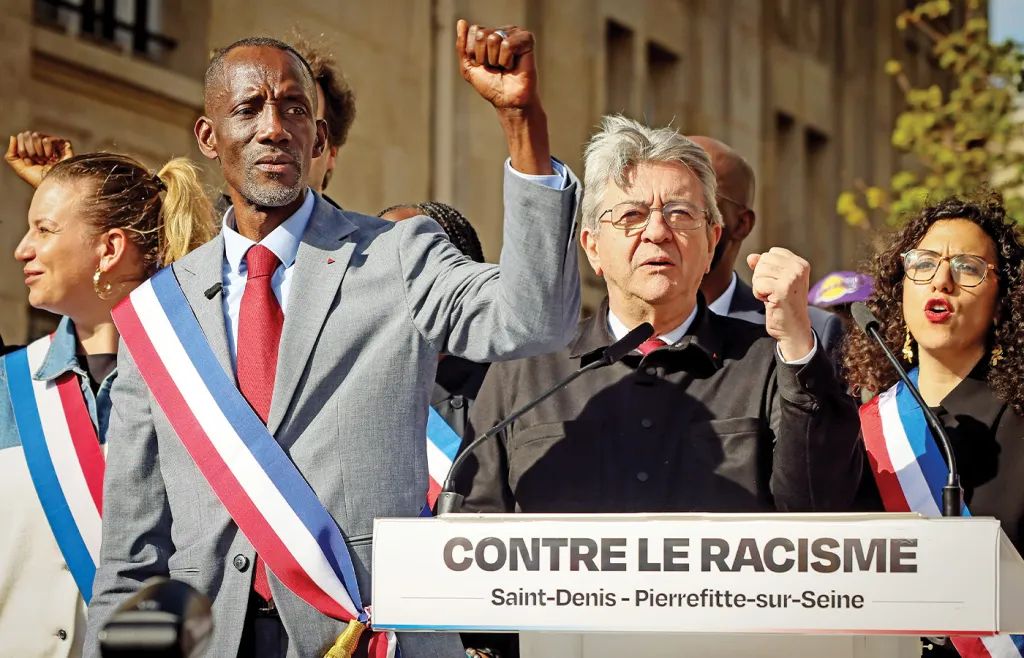
Jean-Luc Mélenchon, the far-left leader of the France Unbowed party, is second in the polls for the presidential elections. Mélenchon and his La France Insoumise deputies encouraged the high schoolers as a way to pressure President Emmanuel Macron and his lame-duck prime minister, Sébastien Lecornu, and to rally support against the nationalist Marine Le Pen, who leads Mélenchon in the 2027 polls.
“Violence can be legitimate at a certain point,” said Bally Bagayoko, the LFI mayor of Saint-Denis, when he visited striking students. Bagayoko, the son of Malian immigrants, half-heartedly attempted to extinguish a burning trash can at the school gates, then danced with the students who had set fire to it. Other LFI deputies blocked the police as they attempted to control the disorder and joined students in raising the Palestinian flag, not the French tricolor.
“We’re going to attack all the police stations in the country,” Ritchy Thibault, a former LFI parliamentary assistant, told students in Saint-Denis. Thibault said they should also burn down the Élysée Palace, the presidential residence. Police arrested Thibault and asked the Paris prosecutor’s office to investigate Bagayoko for incitement. Meanwhile, on Oct. 1, multiple intelligence agencies briefed a government crisis meeting that the disturbances, which began with complaints of underfunded schools and overcrowded facilities, were “an operation organized by LFI and its proxies on the far left.”
“What you’re doing is incredible,” Mélenchon told students when he visited a school strike on Oct. 6. Though the students claimed to be protesting budget cuts and rundown schools, the protests now aligned with the familiar racial, religious and political battle lines of a divided France.
The French suicide
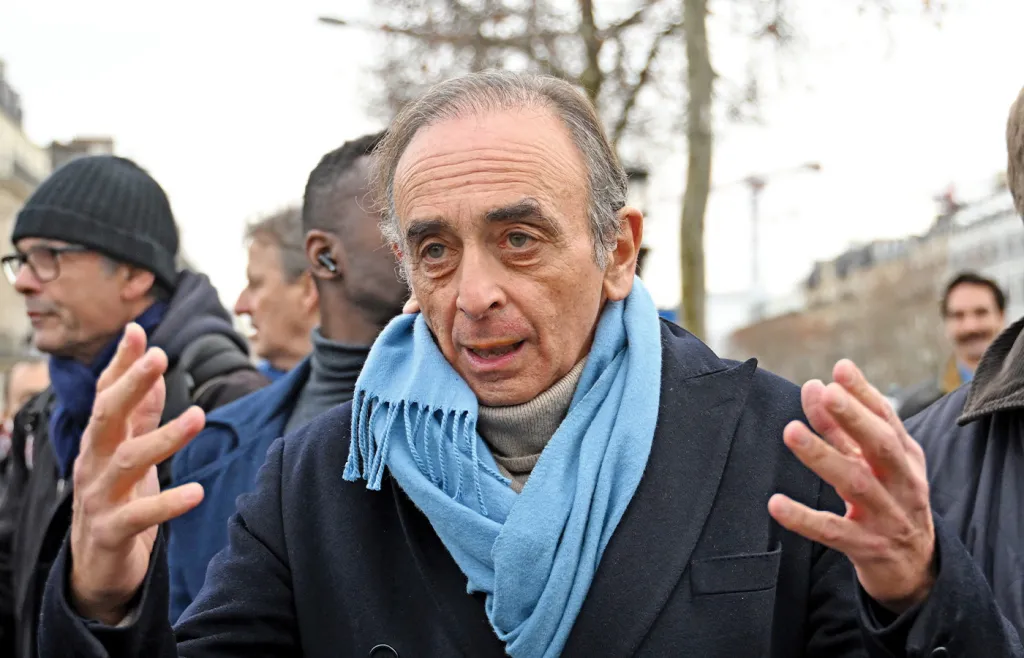
“We have to make a distinction,” Éric Zemmour told me with typical French clarity. “There are protests, and for years there has been looting and violence on the sidelines that are nothing to do with the protests.” The same happens, he said, when Paris Saint-Germain or the French national soccer team wins or loses a big game. The current eruption is political, Zemmour believes, but it also represents a different and deeper challenge: the manipulation of a growing mass of alienated and hostile immigrants.
“Within the framework of these looters and rioters, you must distinguish two categories,” Zemmour said. “You have the racaille, the suburban scum of African and North African origin, who, for the most part, loot and steal. And you have the leftists, antifas, and ‘black bloc’ who don’t loot and don’t steal but burn banks and burned down the Limoges city hall.”
A journalist born in 1958 to Jewish immigrants from Algeria, Zemmour ran for France’s presidency in 2022. He is running again in 2027 as the leader of the Reconquest party — its name evokes the Reconquista of Muslim Spain. His platform updates traditional big-state Gaullism with a “France first” emphasis on sovereignty, Euroskepticism, and the “remigration” of illegal and criminal immigrants. The 2014 bestseller that preceded his entry into politics, The French Suicide, is now translated by Nathan Pinkoski and published by Encounter Books.
The alliance between the racaille and the leftists began, Zemmour writes, in the 1960s. Leftists such as Jean-Paul Sartre and Frantz Fanon decided that the Third World and its immigrant children, which, in France, meant Arabs and Muslims from France’s collapsed empire, were a new “wretched of the earth.” Meanwhile, official French policy pushed immigrants to integrate into the Republic — a contrast with the laissez-faire attitude of the British, who hoped that market forces and manners would do the job.
“The French believe that one can become French through assimilation,” Zemmour said. “I myself am an example of this. My family lived for centuries in Algeria. When France came to Algeria and gave us French nationality, we assimilated into France. It means having the same way of life as the French, the same culture, adopting the same history — that is to say, forgetting one’s own history in order to acquire the history of the French. It’s the famous nos ancêtres les Gaulois,” the schoolroom phrase, “Our ancestors the Gauls.”
By the late 1970s, Zemmour said, it was apparent that Arab and Muslim immigrants were not assimilating as immigrants from Europe had before them: “Unlike them, the youth were less and less assimilated as time went by and increasingly alienated from France, hating France more and more.” A parallel society developed, socially isolated in the banlieues, peripheral housing projects; culturally inimical to secular laïcité; and increasingly influenced by transnational Islamism and American gangster style.
With LFI’s encouragement, the school blockades mutated into general protests that mutated into rioting. On Oct. 17, as many as half a million trade unionists marched in France’s cities. Usually, these marches are orderly affairs that degenerate into scuffles toward nightfall. This time, however, the violence started almost immediately. Over that weekend, masked and hooded rioters ransacked more than 3,000 businesses, including electronics stores, luxury clothing stores and banks. Nearly a thousand police officers were injured. A protester died from a heart attack in Paris, and another lost a hand trying to pick up a police stun grenade. The 19th-century town hall of Limoges, in central France, was destroyed by fire.
The CRS, France’s notorious riot police, were notably slow in coming forward. “They know what to do,” Zemmour said, “but for 40 years, they’ve been given orders to let it happen, since the famous incident under Jacques Chirac in 1986, the death of the young man Malik Oussekine,” a student of Algerian origin who was beaten to death by police as he passed a demonstration. “So instructions are given to the CRS not to strike, not to risk a death, to let things get smashed up, and then show up afterwards.”
As gangs of rioters forced their way into apartment blocks, terrified residents barricaded themselves into their homes. “The next step will be raids on apartments to rob honest people,” Jordan Bardella, of the National Rally party, said on Oct. 20. Bardella, who is likely to become prime minister if Marine Le Pen wins the presidency in 2027, blamed an alliance of “the ultraleft, whose actions amount to terrorism” and “suburban predators” whose pillage expresses their “sense of revenge against France.”
Police made over 2,500 arrests across the country, almost all of them men. Of the 855 arrested in Paris, 557 were held in custody. Only 1 in 5 was a minor. The majority were adults. The justice minister, Gérald Darmanin, said the arrested included both immigrants and French nationals. The interior minister, Laurent Nuñez, admitted that police had, at times, lost control of major cities. Yields on France’s 10-year Treasury bonds reached their highest level in 24 years. The riots threatened to force France into fiscal crisis. And France is one of the two pillars that support the economy of the European Union.
France falling
Mélenchon, the 75-year-old ex-communist who leads LFI, is also a descendant of a North African empire. Born to Spanish parents in Tangier, Morocco, he immigrated to France in 1962, the year that Charles de Gaulle extracted France from the Algerian war.
Mélenchon calls the immigrants the “New French.” He positions LFI, which he founded in 2016, as the patron that will avenge their humiliations and unlock the treasures of France’s subsidy state. Like American Democrats in 2020, he calls the Fifth Republic a vehicle of “white privilege” and calls for a “citizens’ revolution.” The future, he says, is créolisation, a reverse colonization in which France’s historic culture and population are permanently hybridized and reduced by immigrants and immigrant cultures.
Zemmour dismissed Mélenchon’s créolisation and “New France” as a “smokescreen for Islamization.” For proof, he described the “reverse assimilation” of native French youth who adopt the slang and style of the assertive children of mass immigration. “They say ‘wesh,'” akin to “yo,” “they swear on the Quran. I mean, it’s pathetic. And it is tragic, because the assimilation we failed at, they are succeeding at.” Islam, he noted, is “very adept at assimilating populations.”
Mélenchon, Zemmour told me, represents two recurring stories, one local, one civilizational. One is the “Frenchman who sides with the invader against other French people” — Zemmour cited Bishop Cauchon, “whom you know well,” who betrayed Joan of Arc to the English. The other is the irruption into modernity of the clash between the West and what the historian René Grousset called “that revolt of the East that is called Islam.” After European colonization, Zemmour said, there was decolonization. “And now there is the invasion and colonization of the European West by Islam.”
Meanwhile, France’s GDP has barely grown this year. Its debt-to-GDP ratio is 119%, far higher than the EU average, 82%. For more than two years, the Fifth Republic has been caught in a crisis unparalleled since its creation by de Gaulle in 1958. In the June 2024 elections for the National Assembly, the French lower house, Macron’s Renaissance party came second to a left-wing bloc, the New Popular Front. Rather than cede control of the chamber, Macron cobbled together four minority governments in little more than a year.
The first of this quartet took over after the longest-lasting caretaker government since 1962. After three months, it became the shortest-lived government in the Fifth Republic’s history, and the first to fall to a no-confidence vote since 1962. The second government lasted nine months, then collapsed when the National Rally and the New Popular Front colluded to block the cutbacks in its budget for 2026. The third, led by Lecornu, lasted a single day in September 2025. Lecornu returned a month later. He is currently failing to push his budget for 2027 through the National Assembly.
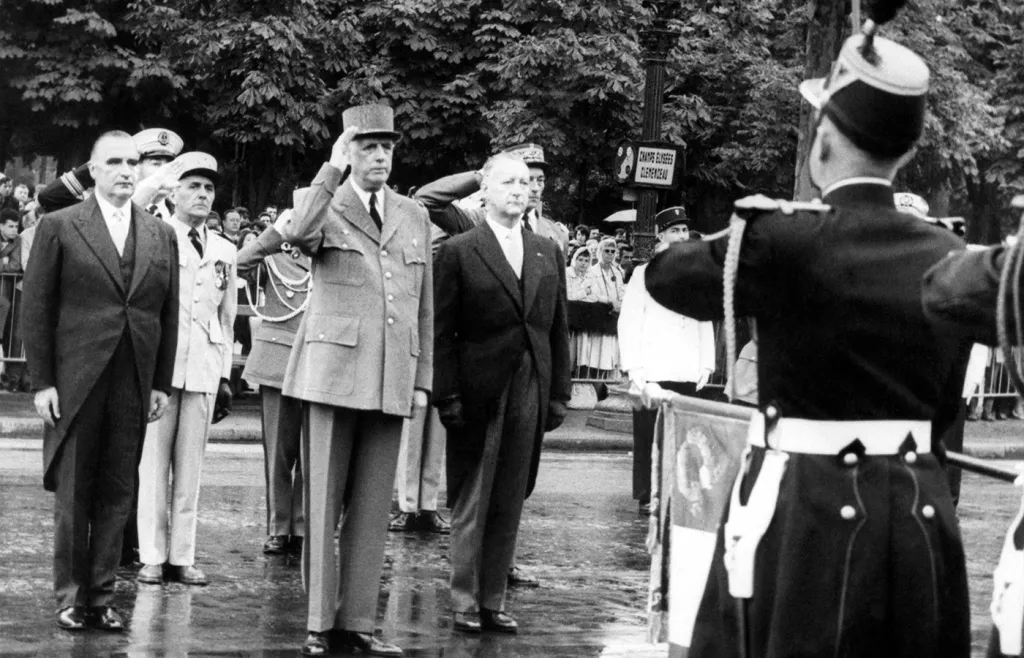
De Gaulle designed the Fifth Republic’s constitution to reduce the influence of communist and neofascist parties and avoid what he derided as the “party system.” The Fourth Republic of 1946 had given the National Assembly a role akin to the English House of Commons, but France’s fissiparous parties could not coalesce into two blocs. The Algerian revolt that began in 1954 was both a colonial crisis and, because Algeria was an overseas département of France, a constitutional one.
The National Assembly became unworkable. De Gaulle, the hero of the Free French who had preferred exile in London to surrender to the Germans in 1940, had gone into a form of inner exile during the Fourth Republic, retreating to his home in Colombey les Deux Églises. In 1958, le Géneral returned by public demand. He designed a new constitution that made the presidency more powerful. The presidential elections of 1962, the year that Mélenchon immigrated to France, were France’s first two-stage elections, designed by de Gaulle to exclude extremist candidates from the runoff and push voters and runoff candidates toward a centrist consensus.
De Gaulle’s constitution no longer works. The National Assembly has reverted to an incoherence of irreconcilable parties. The firewall of the two-stage presidential elections has collapsed. In current polls, the centrist candidates will struggle to reach double figures in the April 2027 first round, and the May 2027 runoff will be between the heirs to France’s extremist and anti-parliamentary traditions, Mélenchon and Le Pen. Macron is no de Gaulle. He is a small and peevish technocrat in the last months of a 10-year presidency that has failed to fix France’s economic and social problems.
France’s budget crisis is “extremely serious,” Zemmour said, but “the crisis that worries me the most is obviously the crisis of the Muslim invasion and of Western civilization.” Budgets can be balanced with “massive spending cuts.” A future in which “the French people no longer exist” and are “reduced to a minority on our own soil” cannot be undone by political means. This future, Zemmour believes, is coming closer, and “all western European countries are in danger.”
“For decades, the English and the French argued, as usual, over which of our models was better,” Zemmour said. “And we must admit that both of our models failed miserably, and that Muslim populations, regardless of the model, cannot be turned into Englishmen or Frenchmen.”
Zemmour acknowledges numerous individual cases of Muslim assimilation to the French model, but, like de Gaulle, he sees Islam as unassimilable. “It is not a religion like Christianity. It is a legal corpus that requires a separate organization, that completely governs people’s lives, that does not recognize the separation between the temporal and the spiritual, that does not recognize secularism, and that does not recognize fraternity with non-Muslims either. In truth, it forbids them from being brothers to the French or the English.”
TIMOTHY MILLER, AN INNOCENT WOMAN
He does not believe that Le Pen, who leads the polls for 2027, can reverse the trend: “She refuses to talk about zero immigration. I talk about negative immigration. She refuses to talk about the remigration of criminals and the unemployed, as I do.”
The fear in France and abroad is that the Fifth Republic is dying. Zemmour would rather restore it than replace it with a Sixth Republic. “The Fifth Republic is precisely what is needed to get France back on track,” he said. De Gaulle’s constitution was “a magnificent synthesis of all our regimes and all our history,” especially the Bourbon monarchy and Napoleon’s empire. That constitution, Zemmour said, has been “corrupted for decades” by the activist judges of the Constitutional Council. But Zemmour believes that the Fifth Republic and its constitution can be saved: “I think French civil servants will obey a legitimate authority if it is firm and authoritative.”
Dominic Green (@drdominicgreen) is a Washington Examiner columnist and a fellow of the Royal Historical Society.